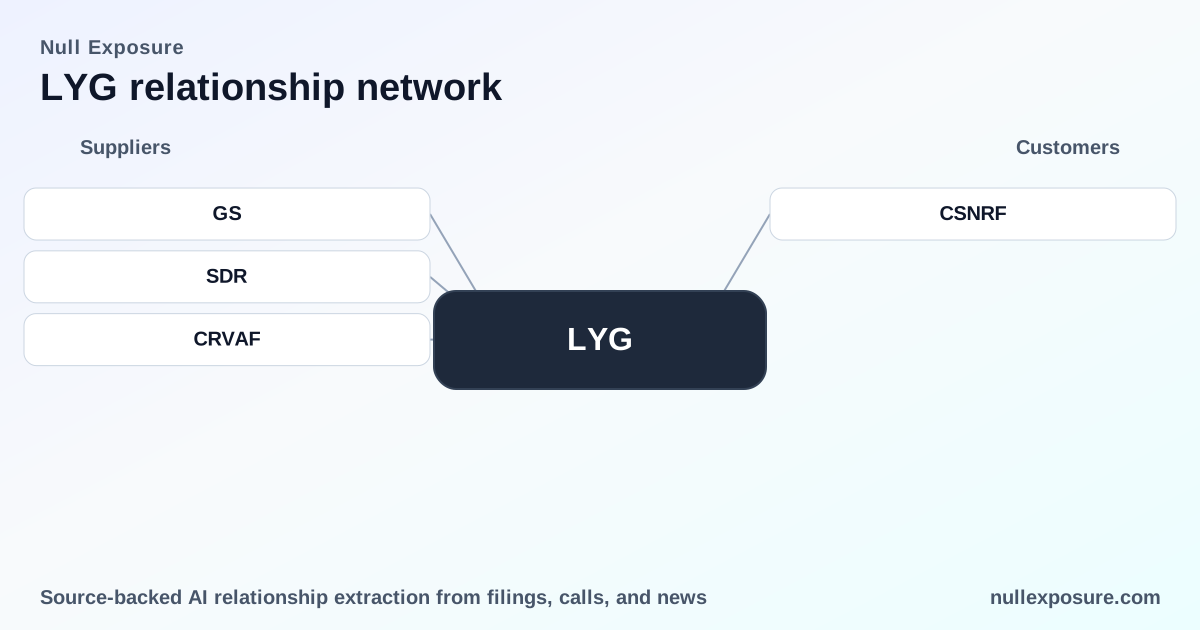
Lloyds Banking Group (LYG) — supplier relationship memo for investors
Lloyds Banking Group operates a broad UK-focused retail and commercial bank franchise that monetizes primarily through net interest income on mortgages and retail lending, fee income from payments and wealth services, and returns on capital via buybacks and dividends. Recent public filings and management commentary show Lloyds executing its capital-return programme through market brokers while simultaneously bolting on wealth and fintech capabilities to lift fee-generating revenue. For investors and operators evaluating counterparty exposure, the pattern is clear: capital management is outsourced to global brokers; strategic extension of the wealth and fintech stack is being achieved through acquisitions. For more supplier and counterparty intelligence, visit https://nullexposure.com/.
What the headlines tell you about Lloyds' operating posture
Lloyds is managing two related but distinct supplier relationships in parallel: (1) execution partners for capital-return activity, and (2) strategic vendors/acquisitions to accelerate wealth and fintech revenue. Execution partners reduce friction and speed for buybacks; acquisitions build recurring fee pools and customer relationships. This dual approach affects contracting posture, concentration, and criticality:
- Contracting posture: Lloyds uses large, incumbent brokers for share-repurchase execution, reflecting a transactional, market-facing contracting posture for capital returns rather than a bespoke in-house market-making capability.
- Concentration: The public record shows repeated use of a single global institution for execution; that concentration simplifies operations but creates a counterparty dependency for timing and execution quality.
- Criticality and maturity: Broker relationships are operationally critical during buyback windows but are mature, short-duration engagements governed by regulatory disclosure and brokerage contracts. By contrast, acquired wealth and fintech assets are strategic, long-lived, and more critical to medium-term revenue mix and platform integration.
These company-level signals come from recent filings and management remarks; no external constraints excerpts were provided that alter these assessments. That absence of constraint disclosures is itself a signal: no supplier-specific regulatory or contractual constraints have been flagged in the available relationship material, so evaluate counterparties on standard operational and concentration metrics rather than on disclosed constraint-driven restrictions.
Line-item review of every supplier relationship cited
Below are the relationships surfaced in the public record and what they mean for investors.
Goldman Sachs International — execution broker for share buybacks
Lloyds has repeatedly purchased its ordinary shares from Goldman Sachs International as part of its active buyback programme, with regulatory filings in February 2026 documenting multiple daily purchases. One report records a purchase of 8 million ordinary shares at a volume‑weighted average price of 104.4873 pence executed through Goldman Sachs (see coverage of the filing at https://ts2.tech/en/lloyds-share-price-edges-lower-as-buyback-rolls-on-and-uk-rates-loom/ and routine Reuters dispatches aggregated on TradingView such as the February notices at https://www.tradingview.com/news/reuters.com,2026-02-02:newsml_RSB4046Ra:0-reg-lloyds-banking-group-transaction-in-own-shares/).
Schroders Personal Wealth — wealth capability referenced in earnings call
Lloyds’ management discussed the Schroders Personal Wealth acquisition as a strategic extension of its wealth proposition, noting the business brings approximately £18 billion of assets under management/administration and contributes around £180 million of earnings, acquired with no reported capital outlay in the call transcript for Q4 2025 (InsiderMonkey captured the remarks at https://www.insidermonkey.com/blog/lloyds-banking-group-plc-nyselyg-q4-2025-earnings-call-transcript-1686658/). This is being positioned as a fee-revenue and customer-proximity play rather than a short-term trading relationship.
Curve — fintech purchase noted on the earnings call
Management stated succinctly that “we just bought Curve,” indicating Lloyds has acquired or invested in the Curve fintech business as part of its strategy to enhance digital payments and card aggregation services (remarks recorded in the same Q4 2025 earnings transcript at https://www.insidermonkey.com/blog/lloyds-banking-group-plc-nyselyg-q4-2025-earnings-call-transcript-1686658/). This transaction signals a push into embedded fintech capabilities that will be integrated into Lloyds’ retail customer journeys.
What investors should read into these supplier ties
The two classes of relationships have different risk/return trade-offs:
- Brokerage for buybacks (Goldman Sachs): This is an efficient, low-friction execution model that supports Lloyds’ capital return strategy and improves EPS and ROE metrics over time. The downside is concentration risk — heavy reliance on a single global broker for on-exchange liquidity and execution could amplify execution timing risk during volatile markets. The repeated filings through early 2026 indicate a sustained programme of repurchases, underpinning shareholder-return orientation.
- Wealth and fintech acquisitions (Schroders Personal Wealth, Curve): These deals are strategic and revenue-accretive, shifting Lloyds’ mix toward fees and recurring earnings. Integration risk is the chief operational concern: realizing the cited £180m of earnings and monetizing £18bn AUM requires successful client retention, cross-sell, and systems integration. These are long-duration supplier relationships where operational alignment and cultural fit determine value capture.
For a detailed view of how these relationships track against Lloyds’ capital and revenue profile, see the company’s FY2025 metrics (revenue TTM ~£18.6bn, return on equity ~10.2%) and note that buybacks plus strategic acquisitions are two levers management is actively using to boost shareholder returns and diversify fee income. Explore further supplier intelligence and counterparty mapping at https://nullexposure.com/ — we maintain consolidated supplier signals and disclosure monitoring for institutional investors.
Practical takeaway and monitoring checklist
Investors and operators should prioritize three monitoring items going forward:
- Execution concentration: track whether Lloyds broadens its panel beyond Goldman Sachs for buybacks or increases use of internal execution to de-risk counterparty concentration.
- Integration milestones: require quarterly KPIs for SPW and Curve integration — client retention, AUM inflows, net new assets, and margin capture.
- Disclosure cadence: monitor regulatory buyback notices and management commentary for cadence and scale of repurchases, which materially affect capital allocation and dividend policy.
Bottom line: Lloyds is executing a deliberate capital-management strategy via external execution partners while purchasing capability through targeted wealth and fintech deals. These relationships are operationally complementary: brokers deliver short-term capital efficiency; acquisitions deliver medium-term fee growth. That combination supports a clearer path to improved EPS and ROE, but it raises concentration and integration risks that investors should monitor through regular filings and call transcripts.
If you want structured signals and ongoing alerts for Lloyds’ counterparty activity, visit https://nullexposure.com/ for live monitoring and supplier intelligence. For bespoke research or integration of supplier signals into investment workflows, start at https://nullexposure.com/ — our platform centralizes supplier disclosures and market notices to help investors act faster.