Lyra Therapeutics (LYRA) — supplier relationships that shape a capital-constrained clinical-stage company
Thesis: Lyra Therapeutics develops localized drug-and-delivery solutions for ENT conditions, monetizing ultimately through product commercialization and strategic partnerships; today its financial profile is that of a clinical-stage biotech with minimal product revenue, heavy operating losses, and a dependence on outsourced suppliers and property leases to sustain R&D and potential commercial readiness. Investors evaluating supplier counterparty risk should focus on manufacturing concentration, long-term facilities commitments, and the advisory/real-estate vendors that influence near-term liquidity and restructuring outcomes. Learn more about supplier insights and monitoring at https://nullexposure.com/.
How Lyra operates and where suppliers matter most
Lyra is a clinical-stage company with limited recurring revenues (Revenue TTM: $600,000) and substantial operating losses (EBITDA approximately -$31.9M, Diluted EPS -22.9). The company relies on a mix of third‑party service providers: contract research organizations (historically for clinical work), contract manufacturers for components and finished implants, and real‑estate and facilities contractors to host labs and offices. Monetization only occurs when clinical candidates are commercialized or partnered, so supplier continuity and regulatory-compliant manufacturing are direct value drivers for investors.
Supplier posture and company-level constraints you must account for
Lyra’s supplier footprint and contract posture introduce both operational leverage and material supply risk:
- Long-term real estate commitments are in place: the company reports a lease for roughly 29,000 square feet with base rent of $2.2M per year and 3% annual rent escalators through a noncancelable term ending June 30, 2033; total rent expense was $6.4M in 2024. This establishes fixed overhead that pressures liquidity in a low-revenue profile.
- Manufacturing and raw material concentration is critical: key components including API and polymers are sourced from single suppliers for certain inputs, creating single‑point failure risk that affects the ability to supply product and meet regulatory requirements.
- Outsourced manufacturing and services dominate: the company intends to continue relying on CMOs and CROs for manufacturing, analytical testing, sterilization, packaging, labeling, and clinical services — a structure that is efficient but increases vendor management and quality-control importance.
- Geographic scope includes EMEA trials: Lyra conducts trials primarily in Europe for LYR‑210 and is positioned to continue non‑U.S. trials, adding cross-border regulatory and supplier complexity.
- Spend and scale signals: rent and facilities spend sit in a mid-range band ($1M–$10M), consistent with a small lab operator rather than a large commercial manufacturer.
These constraints are company-level signals about maturity and criticality: Lyra is operationally immature as a manufacturer (outsourced CMOs), contractually committed on facilities, and materially exposed to single-sourced APIs, which together elevate supplier concentration risk for investors.
Supplier relationships on record — concise, actionable summaries
Below I cover every supplier-related relationship disclosed in the reporting set.
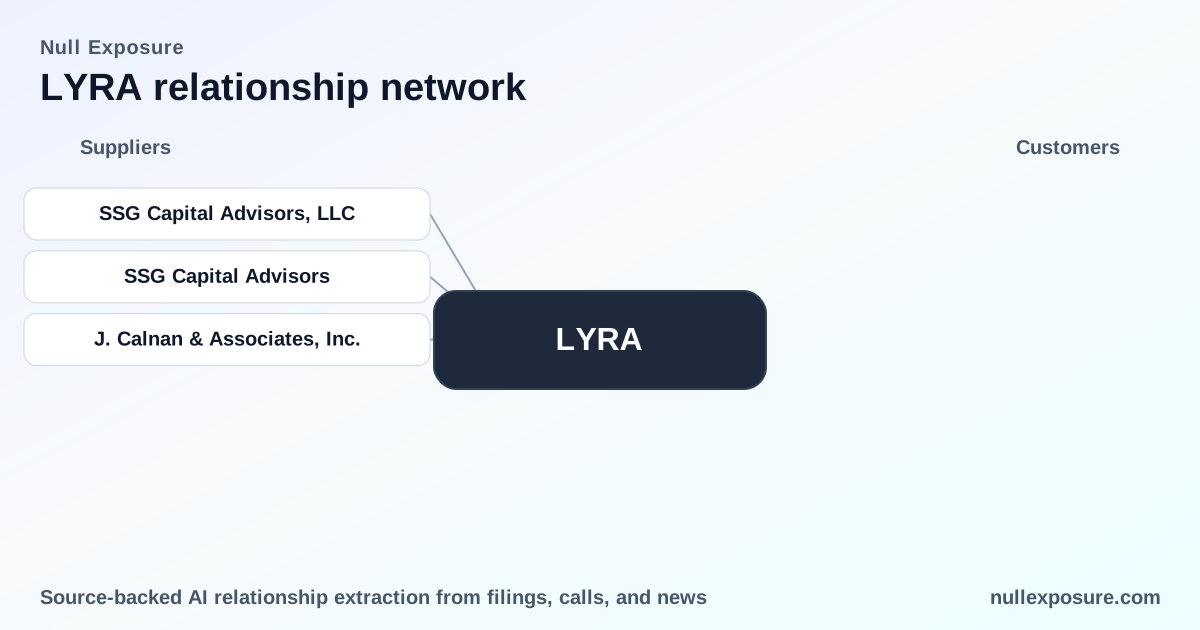
SSG Capital Advisors, LLC
Lyra engaged SSG Capital Advisors to assist with a corporate effort referenced in a January 12, 2026 corporate update; press coverage framed the engagement in the context of corporate restructuring and strategic options. According to the company’s Jan 12, 2026 press release on GlobeNewswire, SSG is serving as a financial advisor during Lyra’s strategic review. (GlobeNewswire, Jan 12, 2026)
J. Calnan & Associates, Inc.
J. Calnan & Associates acted as the construction/project executive on a life‑science repositioning at 880 Winter Street that lists Lyra Therapeutics among tenants receiving upgraded lab and amenity space; the project delivered high‑tech lab infrastructure used by Lyra. Boston Real Estate Times noted the project including Lyra as a tenant in a 2023 profile of the contractor’s personnel promotion, indicating J. Calnan’s role as a facilities/real‑estate contractor executing lab build‑outs where Lyra operates. (BostonRealEstateTimes, FY2023)
What these relationships signal about business risk and operational readiness
The two named relationships point to three investor-relevant themes:
- Strategic advisory engagement reflects a company in transition. The SSG Capital relationship signals active financial restructuring or exploration of strategic alternatives, which is consistent with the company’s low revenue, negative operating cash flow, and recent disclosures about suspending certain development activities (coverage in financial press tied to the SSG engagement). For investors, this raises binary outcomes — a transaction could meaningfully de-risk the balance sheet or alternately dilute current equity holders.
- Real‑estate and lab infrastructure are fixed and material. The J. Calnan involvement confirms the company’s reliance on third‑party contractors to create and maintain lab-ready space; combined with large lease commitments, this creates a fixed-cost base that constrains runway.
- Manufacturing dependency is structural, not anecdotal. Company statements identify single-source suppliers for critical API and polymer inputs and an ongoing reliance on CMOs and service providers for manufacturing and analytics; these are operational pinch points for timelines and regulatory approval.
Operational implications for investors and operators
For investors: prioritize counterparty diligence on the following axes:
- Supplier concentration and qualified second sources for API and polymers, because single‑source dependencies are listed as critical.
- Covenant and cash runway impacts from long‑term real estate obligations and advisory fees associated with strategic processes.
- CMO quality and regulatory history, since outsourced manufacturers will determine the ability to restart or scale production.
For operators: enforce vendor qualification programs, negotiate supply redundancy for APIs/polymers, and model fixed lease obligations into run‑rate cash needs. If pursuing transactions through advisors like SSG, treat any proposed financing or M&A as an opportunity to restructure real‑estate footprint and de‑risk single‑source inputs.
If you want an ongoing monitoring framework and supplier scoring tailored to Lyra’s exposures, start here: https://nullexposure.com/.
Bottom line — what to watch next
Lyra’s value inflection now depends less on new clinical data than on execution around suppliers and capital structure. The appointment of SSG Capital signals a transaction horizon; the company’s fixed real‑estate costs and single‑source manufacturing inputs represent immediate execution risks that translate to investor outcomes. Investors and acquirers should require transparency on supplier contingency plans, CMO contracts, and the use of proceeds from any strategic transaction.
To review Lyra’s supplier map and get alerts when material counterparty information changes, visit https://nullexposure.com/.