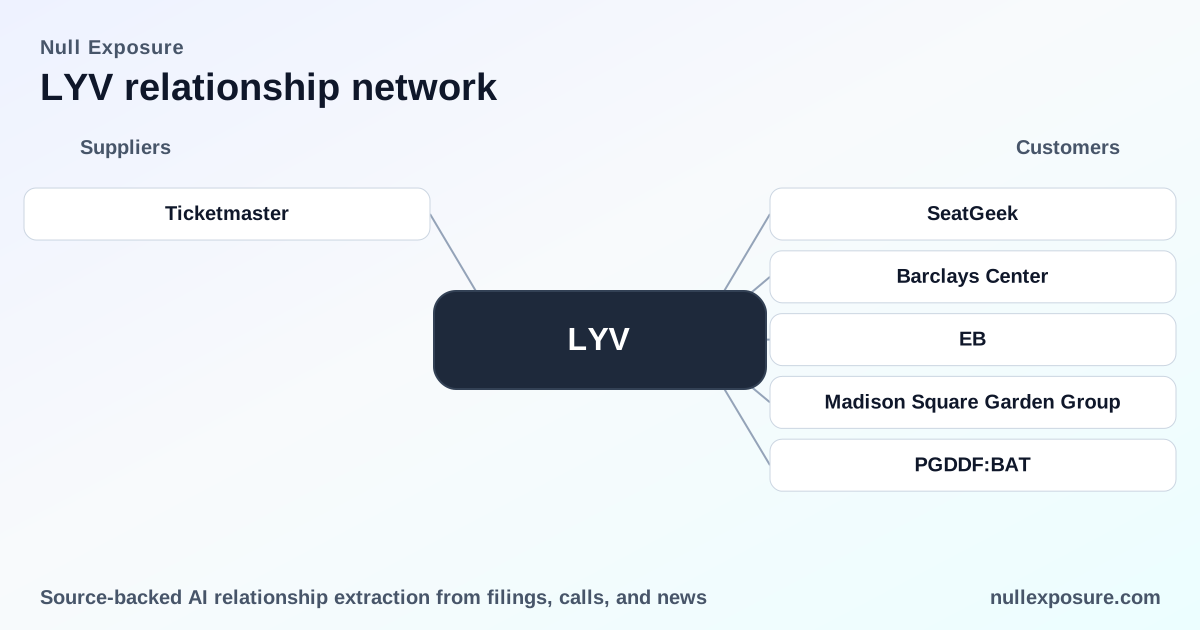
Live Nation (LYV) — Supplier relationships, commercial posture, and what operators need to price in
Live Nation monetizes live entertainment through three tightly linked channels: ticketing and fees (Ticketmaster), event promotion and artist management, and venue ownership with ancillary revenue streams such as concessions and premium experiences. The company generates cash by capturing ticketing commissions and service fees, promoting shows on a revenue-share or guarantee basis with artists, and realizing venue-driven revenue and sponsorships; operating leverage comes from scale in ticket distribution and venue fixed-cost absorption. For investors and operators evaluating LYV as a counterparty, the commercial picture is defined by high revenue throughput, usage-linked vendor economics, and growing regulatory scrutiny. Learn more at https://nullexposure.com/.
Why supplier relationships matter for Live Nation’s P&L and risk profile
Live Nation is an integrated supplier and buyer in the live-entertainment value chain: it sells tickets, runs shows, and operates venues, and therefore its supplier contracts directly affect margins, working capital, and capital allocation. The company reported roughly $25.2 billion of trailing twelve‑month revenue and EBITDA of about $1.96 billion, which highlights both the scale and the sensitivity of margins to fee structures and venue utilization.
Several operating-model characteristics drive how LYV contracts with suppliers and third parties:
- Contracting posture — usage-linked economics: Company disclosures describe promoter compensation formulas that include guarantees and percentages of ticket sales or event profits, reflecting a heavy use of variable, revenue‑linked contracts with artists and promoters rather than fixed-cost outsourcing.
- Service-provider relationships and revenue sharing: Venue operations outsource elements such as concessions and receive a share of net revenue, indicating LYV often acts as a platform owner collecting pass-through or shared revenue rather than absorbing all operating cost lines.
- Scale and capital intensity: LYV guides large capital programs — the company signaled $900M–$1.0B of capex for the year ending Dec 31, 2025, with ~85% allocated to revenue-generating projects — signifying material spend commitments that suppliers and contractors should price and schedule against.
- Concentration and criticality: Ticketing and promotion are core to the business model; suppliers that touch ticket distribution, venue delivery, or artist services influence results directly and therefore face tighter performance and compliance requirements.
These are company-level signals derived from public disclosures and provide a framework for supplier negotiation and risk assessment without assigning a given constraint to any single named counterparty.
The regulatory headline — Ticketmaster under legal attack
The highest-impact supplier relationship on the table is the one that already sits at the center of public scrutiny: Ticketmaster. A March 2026 news piece outlined a major legal challenge in which the Department of Justice, 39 states and the District of Columbia allege Live Nation has maintained an illegal monopoly in live entertainment since the 2010 merger with Ticketmaster, and that customers are paying elevated service and processing fees as a result. This legal overhang is the leading regulatory risk that suppliers and venue partners must factor into contract durations and indemnity structures (source: Morning Brew, March 2, 2026 — https://www.morningbrew.com/stories/2026/03/02/is-it-live-nation-s-turn-to-face-the-music).
Relationship coverage — every supplier link in the available results
Ticketmaster — Live Nation’s integrated ticketing arm is the subject of an antitrust action led by the DOJ and a coalition of states alleging a monopolistic posture and customer harm stemming from service and processing fees; the complaint ties back to the 2010 merger that combined promoter and ticketing functions at scale (Morning Brew, March 2, 2026 — https://www.morningbrew.com/stories/2026/03/02/is-it-live-nation-s-turn-to-face-the-music).
Commercial implications for suppliers, operators, and investors
Operationally, Live Nation’s model produces distinct negotiation dynamics:
- Suppliers that price on a usage or throughput basis will capture upside in busy cycles but must underwrite volume variance. LYV’s promoter contracts that include revenue percentages incentivize suppliers and artists to build stronger box-office outcomes, but they also expose suppliers to seasonality and event cancellations.
- Service providers to venues operate on shared-revenue terms and face high-performance expectations. Concessionaire arrangements that remit a share of net revenue to LYV mean margin pressure for vendors who must optimize per-cap customer spend and coverage economics.
- Large capital programs create supplier opportunity and concentration risk. The company’s 2025 capex plan of up to $1 billion, with most directed to revenue-generating projects, creates multi-year demand for venue expansion, technology upgrades, and premium-experience suppliers; counterparties should price for scale and delivery timelines.
- Regulatory uncertainty increases counterparty risk and contract friction. The DOJ/state actions against the ticketing business introduce legal and operational downside — contracts that assume perpetual control of ticket distribution or fee structures could be reformed by remedies or divestiture, so suppliers should build termination, transition, and indemnity protections into deals.
Key takeaway: suppliers with flexible, usage-based pricing and the capability to scale fast will benefit commercially, while fixed-cost vendors should insist on contract protections against volume swings and regulatory remedies.
If you’re evaluating Live Nation as a supplier or counterparty, capture these dynamics into your risk model — and review available relationship intelligence at https://nullexposure.com/ for contract-level signals and disclosure synthesis.
Practical negotiation checklist for operators
- Insist on clear volume and force majeure clauses tied to event cancellations and artist no-shows.
- Price for variable throughput and include minimum guarantees where possible to protect fixed-cost coverage.
- Build regulatory-transition provisions that preserve margin if ticketing structures change as part of a remedy.
- Align delivery milestones to capital projects and require contractor performance bonds on large venue upgrades.
Bottom line — what the market should price in
Live Nation is a market‑leading integrator of ticketing, promotion, and venue operations with material revenue scale and a capital plan that will sustain supplier demand. The Ticketmaster antitrust action is the single largest external variable that changes contractual longevity and fee economics; it affects not only ticketing partners but any supplier whose revenue depends on Live Nation’s distribution model. Investors and operators must price in usage-based contracting dynamics, significant capex-driven supplier engagement, and elevated legal risk when underwriting relationships with LYV.
For a deeper view of LYV supplier signals and to compare contract-level characteristics across counterparties, visit https://nullexposure.com/.