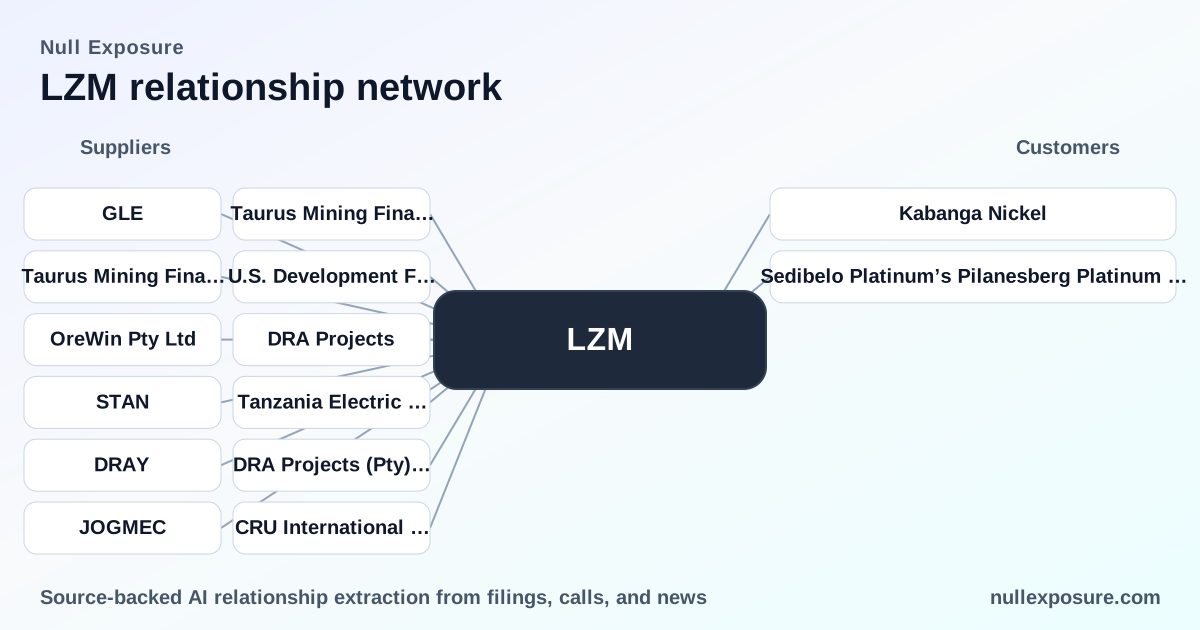
Lifezone Metals (LZM) — Supplier map and what counterparties reveal about project execution
Lifezone Metals is developing the Kabanga Nickel Project and monetizes through advancing a low-cost nickel supply chain: moving from exploration to declared reserves, completing feasibility and engineering, then securing project finance and executing construction to produce saleable nickel products. Revenue will derive from mine output and downstream processing; near-term valuation is driven by project finance milestones and de-risking with development finance institutions and commercial banks. For a concise view of how supplier relationships affect execution and credit risk, visit https://nullexposure.com/.
How LZM’s operating model channels counterparty risk into value creation
Lifezone operates as a project developer in the battery-metals supply chain: it converts a long-duration mineral asset into an investable mine by advancing technical studies, appointing EPCM/engineering providers, and assembling a multi-source financing package. This model concentrates execution risk around a small set of strategic counterparties (project lenders, lead banks, EPCM contractors and critical local services) and therefore investor returns depend on the timing and certainty of project finance and construction-phase delivery.
From the public releases: LZM completed a Feasibility Study in July 2025, declared reserves, and has entered bridge financing to sustain pre-FID activities. The dataset contains no supplier-level contractual constraints, which is a company-level signal: no explicit supplier contract excerpts were provided in the available disclosures, so investors must rely on announced counterparties and public filings to assess legal and cash-flow commitments.
Material counterparties and what each relationship means for execution
Taurus Mining Finance Fund No. 2, L.P. (Taurus Mining Finance)
Lifezone’s Kabanga Nickel subsidiary closed a $60 million bridge loan facility with Taurus to fund execution-readiness activities ahead of Final Investment Decision; the facility provides working capital to advance early-stage development. This bridge funding reduces near-term liquidity risk and buys time while longer-term project financing is negotiated (BizWire press release, Aug 11, 2025; also reported by CityBiz and market wire outlets).
Taurus Mining Finance (general references)
Taurus is referenced again as the provider of the same bridge facility and as a structured finance partner for mining projects; its repeated mention underscores Taurus’s role as the principal short-term financier enabling the company to progress toward FID (CruxInvestor reporting, Sept 2025 / FY2026 commentary).
Societe Generale (GLE)
Societe Generale is leading long-term project-finance structuring for Kabanga, mandated in September 2024 to coordinate a multi-source debt package and to prepare the financing syndicate. This places a major European bank at the center of debt origination, implying formal lender diligence and standard project-finance documentation processes (CruxInvestor and company press statements, FY2025–FY2026).
Standard Chartered (STAN)
Standard Chartered is named as a competitive participant for strategic investment partnerships and potential debt provision, indicating Lifezone is pursuing a marketplace of global banks for a multi-lender solution rather than a single-source loan (company press release and market reporting, Aug 11, 2025).
U.S. Development Finance Corporation (DFC)
Lifezone disclosed receiving an anchor expression of interest from the U.S. DFC, which signals potential political-risk insurance or concessionary project loans to support strategic supply of nickel to U.S. markets. DFC interest materially raises the political-risk mitigation profile for project lenders and anchors export-focused offtake strategies (CruxInvestor reporting, FY2026).
JOGMEC
Japanese export credit and development interest is present: Lifezone’s disclosures list meaningful interest from JOGMEC among potential lenders and ECAs, expanding the pool of DFI/ECA support and positioning the project to attract concessional credit from Asia as well as the West (CruxInvestor, FY2026).
DRA Projects / DRA Projects (Pty) Ltd. / DRA (DRAY)
DRA prepared the July 2025 Feasibility Study and acts as the EPCM contractor with approximately 70% of engineering complete; the schedule embeds a 15% contingency in a $942 million forecasted capital cost, reflecting advanced engineering and a standard EPCM risk buffer. DRA’s involvement is central to cost and schedule credibility given its experience with similar underground operations (Feasibility Study filings and CruxInvestor, July 2025 / FY2026).
CRU International Ltd. (CRU Group)
Independent market analysis by CRU placed Kabanga within the first quartile of the global nickel cost curve, supporting the project’s competitive operating-cost profile and long-term revenue potential, a key commercial validation used in lender and offtaker negotiations (Feasibility Study summary, FY2025).
OreWin Pty Ltd
OreWin provided qualified-person (QP) technical input for the geology and mineral resource sections of the Feasibility Study, with Sharron Sylvester named as Technical Director — this supplies the independent technical reporting required under securities regulation and lender due diligence (Feasibility Study technical report, July 2025).
Tanzania Electric Supply Company Limited (TANESCO)
TANESCO currently supplies grid electricity to the site and is sufficient for construction and initial mine development, reducing the need for immediate, expensive on-site generation capacity during early construction phases; long-term power arrangements will still be material to operating cost and reliability (Feasibility Study press release, FY2025).
What the counterparty map implies for investors and operators
- Financing posture is multi-phased: a $60M bridge from Taurus addresses immediate liquidity needs while Societe Generale leads a multi-source project debt process, and DFIs (DFC, JOGMEC) and commercial banks (Standard Chartered) are in the pipeline — this combination reduces but does not eliminate funding execution risk.
- Concentration around a few lead counterparties increases execution leverage: where SocGen and DRA carry technical and financial leadership roles, their performance and timelines will materially affect project FID and construction start.
- Critical local services are in place: TANESCO’s grid availability mitigates near-term power risk during construction, while OreWin and DRA supply technical credibility required by lenders.
- Commercial validation exists: CRU’s cost-curve analysis and declared mineral reserves in the July 2025 Feasibility Study strengthen lender and offtaker confidence and support higher-quality financing terms.
- Company-level signal: the disclosures include no supplier-specific contractual constraints in the available dataset, so on-the-ground covenants, security packages and offtake clauses remain items investors should request directly.
For a deeper model of counterparty exposure and milestone tracking, review our supplier-risk framework at https://nullexposure.com/.
Bottom line and recommended next steps
Lifezone has assembled the critical partners for a project-finance-led development pathway: bridge liquidity, a lead arranger (Societe Generale), commercial bank interest (Standard Chartered), DFI anchoring (DFC, JOGMEC), and established EPCM/technical providers (DRA, OreWin). The primary near-term risks for investors are successful syndication of the remaining project debt, timing to FID, and final capex reconciliation against the $942 million estimate.
Actionable next steps for investors and operators:
- Request copies of lead financing term-sheets, security packages and DFC/ECA conditional commitment letters to validate funding certainty.
- Stress-test cashflow and capex sensitivities around the 15% contingency and power-cost scenarios with TANESCO.
- Initiate direct technical and commercial diligence with DRA, OreWin and CRU outputs to confirm schedule and cost assumptions.
For ongoing monitoring, milestone tracking and supplier exposure analysis, visit https://nullexposure.com/ for tailored reports and alerts.