LZ Technology Holdings (LZMH): supplier relationships, capital posture, and what investors need to know
LZ Technology Holdings Limited is an information-technology and advertising company headquartered in Huzhou, China that monetizes through technology services and digital advertising contracts and platforms. The company has generated nearly $788 million in trailing twelve‑month revenue while operating at a loss (negative operating margin and diluted EPS), and it recently completed a U.S. initial public offering that established its current capital market relationships. Key commercial characteristics for counterparties and investors are concentrated ownership, a thin public float, and a nascent U.S. capital market profile driven by its IPO underwriting and legal advisors. For an ongoing view of supplier and capital relationships visit https://nullexposure.com/.
What the corporate picture looks like in plain terms
LZMH reports substantial top-line scale — Revenue TTM $787.9M — but continues to show negative profitability metrics (operating margin -10.1%, profit margin -4.98%, EBITDA negative). Market capitalization sits at $193.1M with an extremely high insider ownership stake (~96% insiders) and a very small float (about 4.93 million shares). Those balance-sheet and ownership features drive how the company contracts, funds operations, and prioritizes supplier relationships: expect centralized decision-making, limited public liquidity for equity-based supplier incentives, and a reliance on external capital markets when scaling or refinancing.
How the IPO relationships shape supplier risk and contracting posture
The company’s recent public-market entry defines several near-term supply-side dynamics. The presence of U.S. underwriters and U.S. securities counsel signals a deliberate push to access international capital and to professionalize governance and disclosure for global counterparties. That increases contract credibility for large customers and suppliers while simultaneously exposing the company to U.S. securities compliance costs and oversight. For operators evaluating commercial exposure, the IPO relationships are a credible sign of institutional onboarding that changes counterparty risk profiles.
- Concentrated ownership and tiny float mean strategic decisions are driven by insiders and large controlling holders rather than the market; supplier negotiations are likely bilateral and executive‑driven.
- Recent IPO underwriting and U.S. counsel indicate a higher bar for disclosure and contract enforceability in cross-border relationships.
- Negative margins and high EV/EBITDA create commercial pressure to extract margin from supplier terms or to prioritize cost-sensible procurement.
If you want ongoing monitoring of how these relationships evolve and how they affect supplier risk, check https://nullexposure.com/.
Every disclosed relationship from the public record
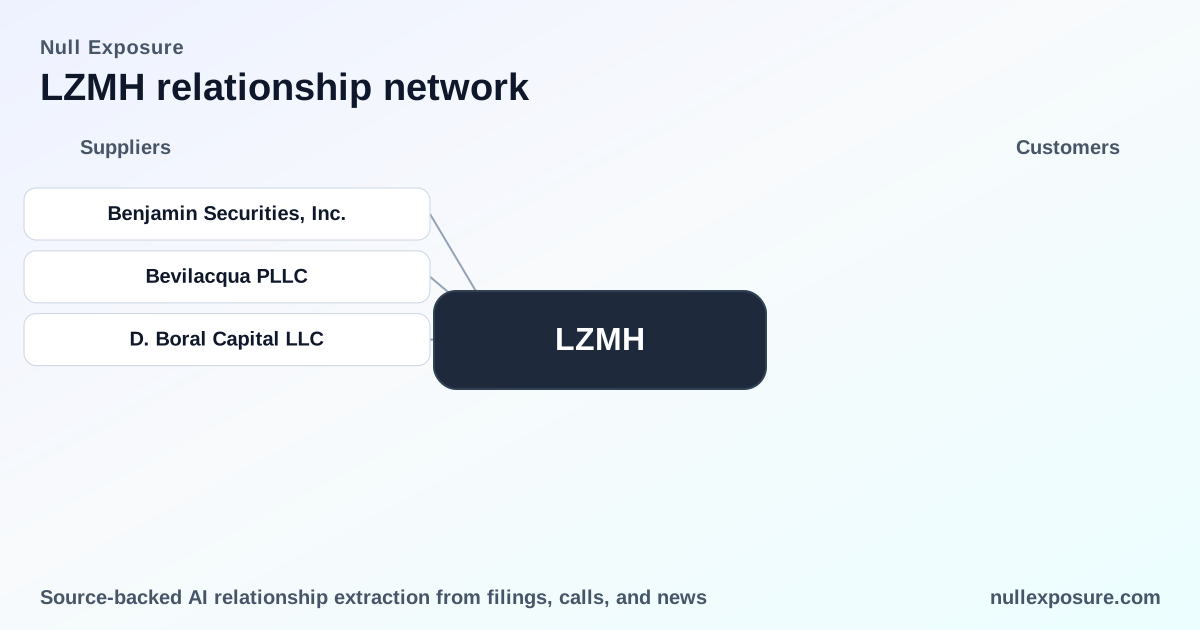
The following three counterparties are disclosed in the company’s IPO press release and form the primary external provider set identified in public filings and announcements for FY2025.
-
Benjamin Securities, Inc.: Benjamin Securities acted as an underwriter on LZMH’s initial public offering, providing capital-raising and distribution services that enabled the company’s U.S. listing in FY2025. According to the IPO press release on GlobeNewswire (Feb. 28, 2025), Benjamin Securities, Inc. served as one of the underwriting firms for the offering. Source: GlobeNewswire press release, Feb. 28, 2025.
-
D. Boral Capital LLC: D. Boral Capital joined Benjamin Securities as an underwriter for the offering and therefore shares responsibility for placement, book‑building, and offering execution tied to the company’s equity issuance. That role connects D. Boral directly to the company’s public‑market liquidity and distribution strategy. Source: GlobeNewswire press release, Feb. 28, 2025.
-
Bevilacqua PLLC: Bevilacqua PLLC provided U.S. securities counsel to LZMH for the offering, delivering legal work that enabled the company to meet U.S. regulatory and disclosure requirements tied to the IPO. The press release identifies Bevilacqua PLLC as U.S. securities counsel to the company in FY2025. Source: GlobeNewswire press release, Feb. 28, 2025.
What the relationships imply for suppliers and counterparties
These disclosed relationships create a specific operating environment:
- Contracting posture: The IPO underwriting and U.S. counsel engagement indicate that LZMH has committed to U.S. public-company disclosure and governance norms, which raises counterparty confidence for larger, institutional suppliers while also imposing compliance costs the company will pass through or offset in contract negotiations.
- Concentration: With insiders holding over 96% of shares and institutions barely present, commercial decisions are likely concentrated among a small executive/insider group; suppliers should model negotiation outcomes on the preferences of a controlling ownership rather than a dispersed investor base.
- Criticality: The underwriter and legal counsel relationships are critical in the short term for capital access and regulatory standing, but they are not supplier relationships that deliver recurring operational inputs such as cloud, data, or key R&D services—so operational dependency remains driven by the company’s internal teams and its customer contracts.
- Maturity: These are early-stage public-market relationships; the presence of underwriters and U.S. counsel signals an institutionalization step rather than a fully mature, diversified capital and advisory network.
Data gaps and company-level signals
The records used to identify relationships show no explicit constraint entries for LZMH. That absence is a company-level signal: it either reflects a genuine lack of reported contractual constraints affecting supplier operations or it indicates limited coverage in the public relationship registry — treat this as a neutral-but-actionable data point that requires confirmation via due diligence calls or direct inquiry. Where data is missing, plan commercial terms with built-in protections (payment terms, service-level verification, and exit triggers).
Investment and operational takeaways for suppliers and buyers
- Risk profile: High insider concentration and a tiny public float increase governance control and execution speed but reduce market liquidity and external oversight, concentrating counterparty risk.
- Operational leverage: Negative profitability and strained margins mean suppliers should expect aggressive cost and payment negotiations; structure contracts with clear performance milestones and protections.
- Regulatory posture: The engagement of U.S. underwriters and counsel increases the company’s regulatory footprint; suppliers with cross-border exposure benefit from contractual clarity on compliance responsibilities.
If your firm needs a focused supplier-risk brief or wants to track changes in LZMH’s capital and legal relationships, request a tailored report at https://nullexposure.com/.
Final assessment and action items
LZMH is a sizable revenue generator with a freshly established U.S. capital-market footprint, but it operates with limited public float, concentrated insider control, and negative profitability. For investors and counterparties, the IPO relationships (Benjamin Securities, D. Boral Capital, and Bevilacqua PLLC) materially improve disclosure and capital access but do not eliminate operational counterparty risk. Prioritize contractual protections, validate counterparty exposures through direct confirmation, and monitor quarterly filings for changes in float or institutional holdings. For continuous monitoring of these supplier- and capital-market relationships, visit https://nullexposure.com/.