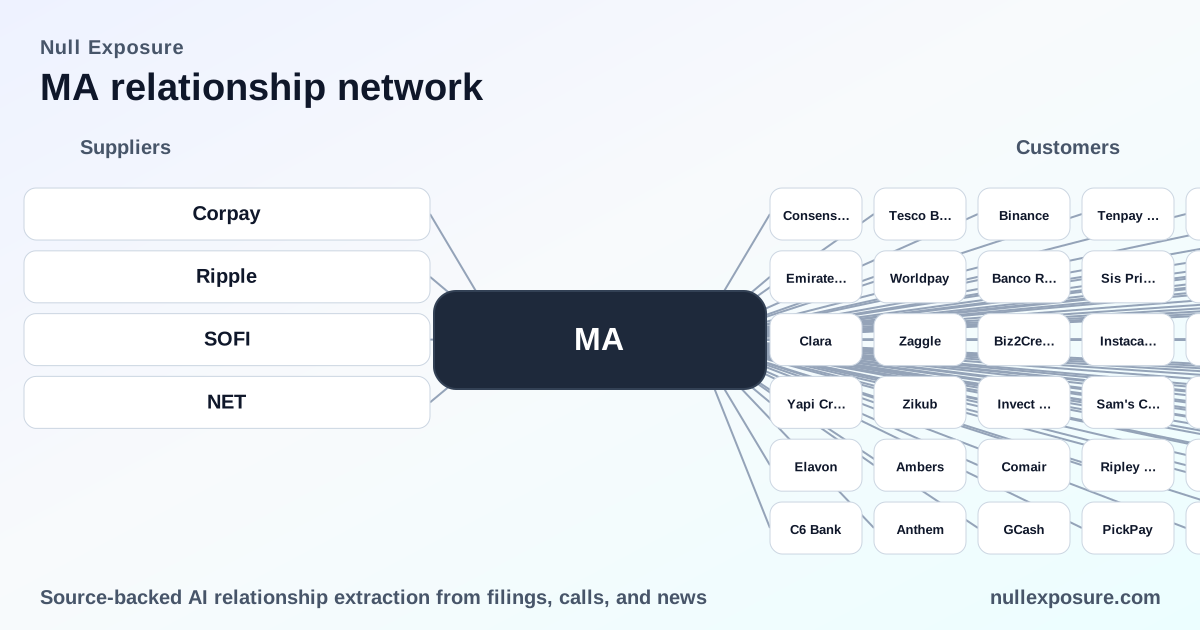
Mastercard’s supplier map: strategic rails, stablecoin settlement, and cybersecurity partners that change the revenue mix
Mastercard monetizes a global payments network by routing transactions, charging network and service fees, and expanding into value-added settlement and risk services. Recent supplier relationships extend core transaction economics into cross-border FX and digital asset settlement, while bolstering merchant and small‑business cybersecurity — all of which drive incremental fee-based revenue and platform stickiness. For investors focused on partner-driven growth, these relationships reveal how Mastercard converts infrastructure scale into diversified, higher‑margin streams. Learn more about supplier coverage and relationship signals at https://nullexposure.com/.
Why these partners matter: a short investor-centric read
Mastercard’s supplier relationships are not ancillary — they are extensions of the network that unlock new settlement rails, reduce friction for issuers and merchants, and create product-led monetization. The current mix shows three themes: (1) digital‑asset and stablecoin settlement, (2) cross‑border payables and FX services, and (3) cybersecurity and infrastructure resilience for small business customers.
Company-level constraints and operating posture reinforce how Mastercard contracts and scales:
- Contracting posture: Mastercard operates with both long‑tenor committed facilities and short‑term liquidity programs, enabling flexible capital management and supplier engagement across time horizons.
- Concentration and role: The supplier set spans fintech rails, payments processors, and cybersecurity vendors, indicating a diversified provider base rather than concentration risk.
- Criticality and maturity: Partners that enable settlement (stablecoins, Ripple) are strategically critical to product evolution, while cybersecurity partnerships shore up operational trust for merchants.
These signals combine into a business model that leverages deep network effects with controlled third‑party dependency — a company that integrates suppliers where they add differentiated settlement capability or scale customer protection.
Explore how these signals map across Mastercard’s supplier relationships at https://nullexposure.com/ — our coverage breaks down partner roles and commercial relevance.
Relationship-by-relationship: the essentials investors need
Corpay
Mastercard referenced a partnership involving Corpay in its 2025 Q4 earnings call, describing a cross‑border payment solution being leveraged by Capital Bank in Mexico that uses Mastercard and Corpay rails to move funds. This positions Corpay as a payments/FX service provider in Mastercard’s cross‑border flows that supports issuer and merchant access to foreign‑currency settlement. (Mastercard 2025 Q4 earnings call, March 2026)
Ripple
Mastercard stated in the 2025 Q4 earnings call that it continues to expand settlement capabilities and is working with Ripple to support digital‑asset settlement options. This is a direct signal that Mastercard is integrating alternative settlement rails into its network to accelerate settlement speed and enable non‑traditional liquidity sources. (Mastercard 2025 Q4 earnings call, March 2026)
SoFi Technologies (SOFI)
A March 2026 Sahm Capital news report noted Mastercard has partnered with SoFi Technologies to enable settlement using SoFiUSD, a fully reserved U.S. dollar stablecoin, on Mastercard’s payments network. That partnership directly ties stablecoin settlement to Mastercard’s rails and creates a potential new fee layer for settlement services and tokenized USD processing. (Sahm Capital, March 5, 2026 — https://www.sahmcapital.com/news/content/mastercard-sofiusd-stablecoin-move-tests-long-term-earnings-story-2026-03-05)
Cloudflare (NET)
Sahm Capital also reported in late February 2026 that Mastercard teamed up with Cloudflare to provide cybersecurity tools to small businesses and government entities, indicating Mastercard is outsourcing select security capabilities to a leading infrastructure provider to protect merchant endpoints and transactional integrity. This partnership strengthens Mastercard’s merchant value proposition and reduces fraud-related loss exposure. (Sahm Capital, February 25, 2026 — https://www.sahmcapital.com/news/content/mastercard-partnerships-reshape-growth-story-in-digital-payments-and-cybersecurity-2026-02-25)
How these partners change the economics and risk profile
These supplier relationships drive three concrete investor implications:
- Revenue diversification and higher‑margin services. Stablecoin and Ripple-enabled settlement represent incremental, platform-level services that command fees separate from interchange — an important path to expand non‑transaction revenue. The SoFiUSD tie specifically underwrites tokenized‑USD settlement that is fully reserved, limiting balance-sheet exposure while enabling fee generation on settlement volume.
- Operational criticality and resiliency. Integrating Corpay for cross‑border flows and Cloudflare for cybersecurity increases operational complexity but reduces friction for enterprise and small‑business customers, strengthening retention and average revenue per customer.
- Regulatory and third‑party service risk. Expanding into digital asset settlement elevates regulatory visibility; at the same time, reliance on external providers for settlement rails and cybersecurity imposes vendor‑management obligations that Mastercard has to manage through contractual and compliance controls.
Key takeaway: these partnerships expand Mastercard’s addressable service set while preserving the core network fee model, but they also bring discrete operational and regulatory responsibilities.
What the company-level constraints tell investors
Mastercard’s financial disclosures and program descriptions show a dual liquidity approach: a five‑year committed unsecured revolving facility alongside an $8 billion commercial paper program with short maturities. That structure signals financial flexibility to fund growth and underwrite supplier integrations while keeping short-term liquidity available for operational needs. Separately, the company flags risks from services provided by third parties, which is a broad governance signal that Mastercard treats supplier services as material to operational risk management rather than peripheral. These are company-level controls — not relationship-specific judgments — but they inform how Mastercard will scale partner integrations.
Bottom line and next steps for investor diligence
Mastercard is using supplier relationships to extend settlement rails, enter tokenized‑USD flows, and harden merchant security — all steps that increase fee capture and platform defensibility. Investors should monitor:
- Volumes routed through SoFiUSD and Ripple-enabled settlement as a forward indicator of non‑interchange revenue growth.
- Commercial terms and contractual lengths for key partners to assess lock‑in and cost exposure.
- Regulatory developments around stablecoins and crypto settlement that could affect monetization.
For a deep dive into partner risk profiles and contractual signals, visit our supplier coverage hub at https://nullexposure.com/. If you want tailored supplier analysis for portfolio due diligence, start here: https://nullexposure.com/.
Concluding, these supplier relationships materially shift how Mastercard captures settlement economics and manage operational risk — making partner execution a central driver of the company’s near‑term revenue trajectory and long‑term competitive positioning. Learn more about how supplier signals translate into investment insights at https://nullexposure.com/.