Mid‑America Apartment Communities (MAA): capital partners, counsel and what they signal for investors
Mid‑America Apartment Communities is a large, publicly traded residential REIT that owns and operates apartment communities across the Southeast and Southwest United States and monetizes through stabilized rental income, development and redevelopment spreads, and opportunistic capital markets activity that leverages long‑dated debt and secured mortgages. MAA funds growth and liquidity through a mix of unsecured senior notes, a revolver, commercial paper and property‑level mortgages, while outsourcing material operating functions to third‑party service providers. For a concise view of supplier relationships and market signals, visit https://nullexposure.com/.
Why the recent financing matters to portfolio managers
MAA announced a priced offering of senior unsecured notes in late February 2026, using major investment banks as joint book‑running managers to distribute long‑dated paper to the market. This transaction is not a routine administrative notice: the use of multiple global banks as underwriters and the existence of large, long‑maturity unsecured debt and secured mortgages underline a capital structure that is both actively managed and materially levered. See the company release reported by Sahm Capital on February 26, 2026 (and summarized on Finviz) for the announcement: https://www.sahmcapital.com/news/content/maa-announces-pricing-of-senior-unsecured-notes-offering-2026-02-26 and https://finviz.com/news/322570/maa-announces-pricing-of-senior-unsecured-notes-offering.
Who underwrote and advised the notes offering
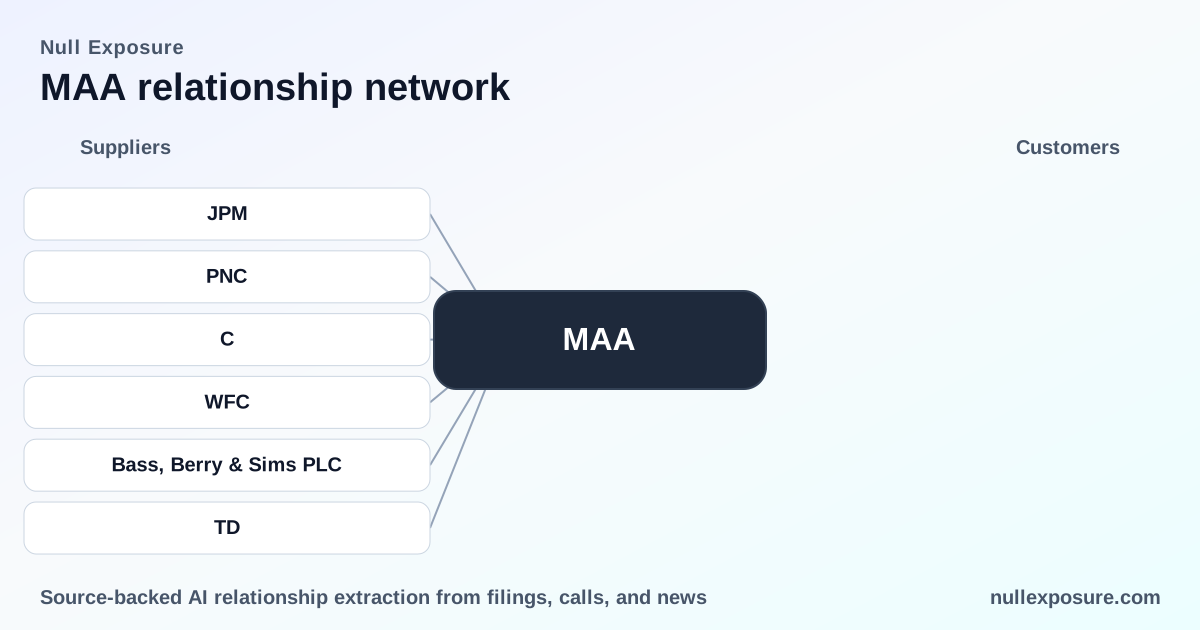
- J.P. Morgan Securities LLC — J.P. Morgan served as one of the joint book‑running managers on MAA’s senior unsecured notes offering, placing institutional distribution muscle behind the deal and supporting primary market execution. Source: company news release reported Feb 26, 2026 (Sahm Capital / Finviz).
- PNC Capital Markets LLC — PNC Capital Markets participated as a joint book‑running manager, contributing regional capital markets distribution for MAA’s issuance. Source: company news release reported Feb 26, 2026 (Sahm Capital / Finviz).
- Citigroup Global Markets Inc. — Citigroup acted as a joint book‑running manager on the offering, providing lead underwriting capabilities for the unsecured note placement. Source: company news release reported Feb 26, 2026 (Finviz / Sahm Capital).
- Wells Fargo Securities, LLC — Wells Fargo Securities was listed among the joint book‑running managers, reinforcing the syndicate’s breadth across U.S. capital markets desks. Source: company news release reported Feb 26, 2026 (Finviz / Sahm Capital).
- TD Securities (USA) LLC — TD Securities (USA) participated as a joint book‑running manager on the transaction, supplying cross‑border distribution and syndication support. Source: company news release reported Feb 26, 2026 (Finviz / Sahm Capital).
- Bass, Berry & Sims PLC — Bass, Berry & Sims served as legal counsel to MAALP for the offering, indicating MAA’s use of established regional counsel to support securitization and note documentation; the announcement also lists underwriters’ counsel. Source: coverage of the offering (Finviz / Sahm Capital).
Constraints and what they reveal about MAA’s operating model
The public disclosures around MAA’s balance sheet and financing cadence create several company‑level signals that investors and operators should treat as durable characteristics of how the business runs:
- Contracting posture is long‑tenored. As of December 31, 2025, MAALP had $4.4 billion of publicly issued unsecured senior notes outstanding with maturities ranging up to 30 years and a weighted average maturity in 2032, and the company carries long‑dated fixed mortgages with maturities in 2049. This structure gives MAA predictable long‑term funding but concentrates interest‑rate and refinancing risk on scheduled maturities.
- Near‑term liquidity is active but managed. MAALP has an unsecured commercial paper program with maturities up to 397 days and a revolving credit facility maturing in January 2030 (with extension options), supplying working capital flexibility for renovations and development pipelines.
- Geography is concentrated in North America. Property listings and portfolio references are focused in U.S. markets (examples include Houston, Denver, Phoenix, Alexandria VA, Charleston SC, Tampa FL, Charlotte NC, Richmond VA), which concentrates operational exposure to U.S. residential cycles and regional rent dynamics.
- MAA is both an acquirer and a service buyer. The company reports meaningful acquisition activity and uses third‑party service providers (property managers, leasing, web hosting, accounting, payroll) for core operations, signalling dependence on external vendors for execution at scale.
- Capital intensity is material. Development and mortgage line items show multi‑hundred‑million dollar spending and secured debt buckets; the firm recorded $272.0 million in development costs in 2025 and carries individual secured mortgages in the ~$170–$190 million range, establishing a >$100m spend band for major projects.
These constraints combine into an operating profile where capital markets access and provider relationships are critical — underwriting syndicates, commercial lenders and service providers are not peripheral suppliers but functional pillars of MAA’s operating model.
For a snapshot of counterparties and to track changes to MAA’s supplier list, see https://nullexposure.com/.
Practical implications for investors and operators
- Credit and refinancing risk: The combination of sizable long‑dated unsecured notes and large secured mortgages requires monitoring of debt maturities and spread movements; underwriter syndicate composition reflects the firm’s access to institutional buyers and therefore its refinancing optionality.
- Vendor dependency: Outsourced property and back‑office functions concentrate operational risk in third parties; vendor continuity and contract terms deserve due diligence during diligence or oversight reviews.
- Regional concentration: Portfolio performance will be shaped by rent growth and supply dynamics in the Southeast/Southwest U.S.; development and redevelopment spend drives near‑term capital needs and execution risk.
If you are evaluating a relationship with MAA — whether underwriting, lending, or providing services — focus on the tenor of commitments, counterparty concentration, and covenants tied to secured assets. Learn more about counterparties and exposure mapping at https://nullexposure.com/.
Bottom line and next steps
MAA runs a capital‑markets driven financing program supported by a broad bank syndicate and established legal counsel, while operating a capital‑intensive regional apartment portfolio that relies on third‑party service providers. For investors, the key signals are long‑dated secured and unsecured liabilities, active short‑term liquidity programs, and concentrated geographic operations that amplify the importance of supplier and underwriter relationships.
For ongoing coverage of MAA’s supplier footprint and to track changes in counterparty roles, visit https://nullexposure.com/ — the simplest next step for investment teams needing an updated supplier map and governance checklist.