Highest Performances Holdings (MAAS): supplier footprint and what it means for investors
Highest Performances Holdings Inc. (MAAS) operates as a China-based financial-technology provider, selling fintech services and asset-management related solutions to financial institutions and other customers. The company monetizes through commercial provision of technology services and platform fees rather than through traditional product sales; investors should treat revenue generation and supplier relationships as the primary levers for near-term operational progress and valuation re-rating. For an independent supplier risk view and deeper supplier mappings, visit https://nullexposure.com/.
One-page snapshot for an investor audience
Highest Performances is a NASDAQ-listed Chinese fintech firm headquartered in Guangzhou with a fiscal year end in June. Key financial and ownership signals that shape supplier risk and commercial runway:
- Zero reported trailing revenue, with diluted EPS of -3.16, indicating the company is not yet producing measurable top-line results under typical reporting windows.
- High insider control: insiders own ~79.8% of shares while institutional ownership is reported at 0%, which concentrates governance and strategic decision-making.
- Valuation and balance signals: Price/Book of 21.12, Price/Sales of 0.369, and EV/Revenue of 16.57 suggest market expectations for future commercialisation despite current revenue absence.
- Public listing and U.S. disclosure posture (CIK 1750264, NASDAQ) give investors access to regulatory filings, but operational transparency will hinge on management reporting and supplier disclosures.
These facts frame how supplier relationships translate into commercial progress: with little current revenue, strategic technology partners are both gateways to scale and points of concentration for execution risk.
The supplier relationships to watch (what the results show)
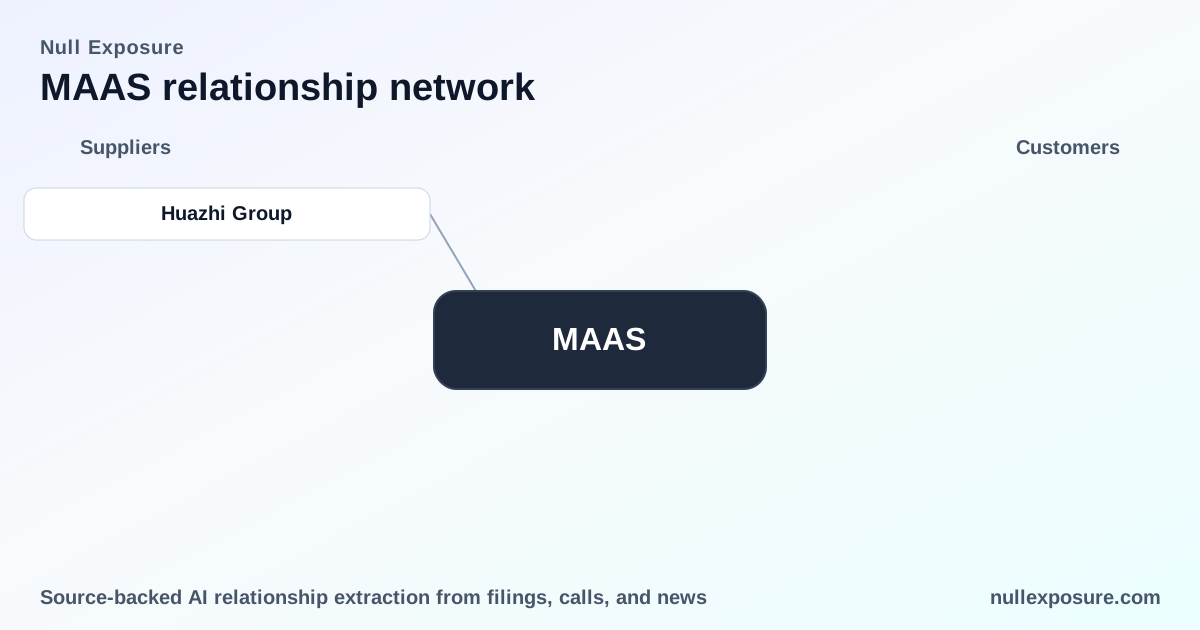
MAAS’s supplier map in the available reporting is compact; the only named partner in recent coverage is Huazhi Group.
Huazhi Group — advanced compute and AI algorithm development
Huazhi Group is reported to supply high-performance computing resources and advanced AI algorithm development to MAAS, positioning the firm to leverage external compute and algorithmic expertise for product development. A March 10, 2026 news report in Asianet News detailed the partnership as a driver cited in trading commentary on MAAS stock, and the same description was echoed in a March 10, 2026 item circulated on StockTwits. (Asianet News, March 10, 2026; StockTwits, March 10, 2026.)
What the supplier roster implies about MAAS’s operating model
MAAS’s current supplier profile—narrow and technology-focused—creates a set of predictable operating characteristics for investors to factor into diligence.
- Contracting posture: With partnerships centered on compute and algorithm development, MAAS behaves as a buyer of specialized technology capabilities rather than as a vertically integrated provider. This contracting posture makes the company dependent on third-party engineering and compute capacity during product development and early commercialization.
- Supplier concentration: The named supplier universe is small. In a firm with zero reported revenue, concentration risk is elevated because a single advanced-technology partner can materially influence time-to-market and product capability.
- Criticality of suppliers: Compute and AI expertise are core inputs for any fintech product that depends on algorithmic decisioning or large-scale data processing. Therefore, these suppliers are operationally critical to MAAS’s ability to demonstrate product-market fit and generate revenue.
- Maturity and go-to-market: The balance-sheet and earnings profile imply MAAS is still in a formative commercial stage; supplier relationships are therefore primarily development and capacity agreements rather than large, recurring vendor contracts with revenue-sharing arrangements.
These are company-level signals: there are no supplier-specific contractual excerpts in the available constraints to assign named limitations or termination clauses to any partner.
If your diligence requires a supplier-level contract review, prioritize operational availability and SLAs from compute providers and the IP assignment terms for algorithm development.
For a practical supplier-risk scorecard and deeper mapping of third-party impact, see https://nullexposure.com/.
Investment implications — what moves the stock
Translate the supplier picture into financial and market consequences.
- Path to revenue is the principal catalyst. Given reported trailing revenue of zero, the primary valuation re-rating requires evidence that supplier-powered products are converting into paying customers.
- Execution risk is front-loaded. High insider ownership and absent institutional endorsement concentrate responsibility for commercialization with management; supplier failures or delays will have outsized effect on valuation.
- Leverage to AI/compute strategy. The Huazhi Group relationship creates optionality: if compute-enabled products demonstrate real-world value, the market can re-rate growth expectations quickly given the current pricing multiples.
- Valuation disconnect requires proof. Multiples such as Price/Book 21.12 and EV/Revenue 16.57 imply substantial future cash flow expectations; absent current revenue, investors must demand near-term commercial milestones and transparent supplier commitments.
A practical checklist for active due diligence:
- Verify the scope, duration, and termination rights in compute/AI agreements.
- Request evidence of IP ownership for algorithms developed under supplier arrangements.
- Seek customer pilot contracts or letters of intent that link supplier-delivered functionality to revenue recognition timelines.
- Monitor insider actions and any changes in institutional ownership as signal of confidence or dilution.
Final takeaways and next steps
MAAS is a technology-dependent fintech with high insider concentration and no reported trailing revenue; its supplier relationships—most notably with Huazhi Group—are pivotal to whether development converts into commercial traction. Investors should treat supplier performance and contractual protections as the primary levers that will determine whether current market valuation is justified.
For an actionable supplier-risk assessment and real-time relationship monitoring, visit https://nullexposure.com/ to see how supplier intelligence alters valuation and operational risk profiles.
If you are considering exposure to MAAS, demand concrete milestones tied to supplier deliverables and verify governance protections for intellectual property; the difference between a proof-of-concept and recurring revenue will determine the investment outcome. Learn more about supplier-driven valuation effects at https://nullexposure.com/.