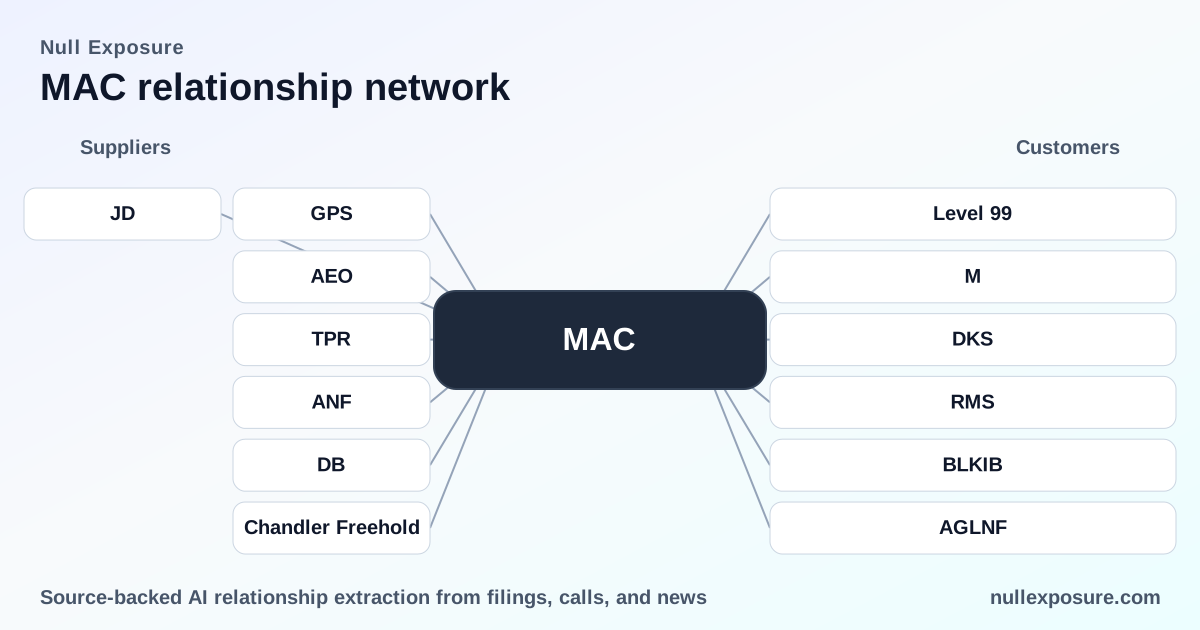
Macerich (MAC): Supplier relationships that matter for mall cashflow and credit
Macerich is a pure-play retail REIT that owns, leases and operates premier shopping centers and mixed-use retail properties in major U.S. markets, and it monetizes through contractual rent collections, percentage rents, property management and selective asset dispositions and redevelopments; its cash generation is reported as FFO and supported by long-duration lease economics and financing facilities. For investors and counterparties, the critical questions are tenant rollouts, anchor performance, and lender counterparties that determine liquidity and refinancing flexibility.
Learn more about the underlying signals and relationship mapping at https://nullexposure.com/.
What management emphasized on the call — retailers driving occupancy and traffic
Management used the 2025 Q3 earnings call to name several retailers whose expansion or repositioning is supportive for Macerich’s occupancy and shopper traffic. These tenant relationships are operationally important for mall-level sales and lease resets.
Gap (GPS)
Macerich singled out Gap as “one of the best examples” of a brand that has re-adapted its merchandising and regained relevance, a positive indicator for mall-level demand where Gap remains a tenant. This comment was made on the company’s 2025 Q3 earnings call in March 2026.
American Eagle (AEO)
Management highlighted American Eagle and its brand extensions (Aerie, OFFLINE) as actively expanding and opening new stores, which implies new lease activity and potential incremental rents within Macerich centers, per the 2025 Q3 earnings call (March 2026).
Coach (TPR)
Coach was listed alongside other apparel and lifestyle brands as part of a multi-brand rollout that supports repeat visitation, a dynamic noted on the 2025 Q3 earnings call (March 2026).
Abercrombie & Fitch (ANF)
Abercrombie & Fitch was specifically cited as part of a cohort of growth retailers, indicating tenant expansion and leasing momentum in Macerich properties, according to the 2025 Q3 earnings call (March 2026).
JD Sports (JD)
Management described JD Sports as having “caught fire in the U.S.” and being on a major rollout, a positive signal for lease-up and category diversification across Macerich assets, as stated on the 2025 Q3 earnings call (March 2026).
Financing counterparties and special financings — where liquidity is sourced
Deutsche Bank New York Branch (DB)
Macerich secured a $900 million revolving credit facility, sourced with Deutsche Bank New York Branch as counterparty and a syndicate of lenders, strengthening near-term liquidity and working capital flexibility; this was reported in a TradingView news item on March 10, 2026.
Chandler Freehold
Macerich’s reported fourth-quarter 2025 FFO disclosed an exclusion for financing expense “in connection with Chandler Freehold,” indicating special-purpose financing or related-party financing adjustments that affect reported FFO comparability, as noted in a March 10, 2026 news summary of the Q4 results (TradingView / Zacks).
(These two items come from the company’s disclosed news and press coverage in March 2026 and represent explicit counterparties and financing line items that matter for credit analysis.)
Operating constraints and what they mean for counterparty risk
Macerich reports non-cancelable operating leases that extend in some cases through 2078, plus three finance leases expiring through 2030. This contractual posture is a company-level signal that shapes the supplier and tenant relationship profile:
- Contracting posture — long-term and stickier cashflows. Long-duration non-cancelable leases indicate predictable base rent roll for affected properties, supporting stable FFO conversion and less volatility from short-term tenant churn.
- Maturity profile — front-loaded financing versus back-loaded lease terms. With leases running decades out, rent rolls are long-dated, but debt and liquidity obligations (including finance leases through 2030) create nearer-term maturity concentration that requires active liability management.
- Criticality — anchor tenants and large-format lessees are economically significant. Long-term leases typically include anchor and category-defining tenants whose performance materially influences mall foot traffic and secondary tenant sales.
- Concentration risk — company-level exposure to retail categories. The long-term lease structure reduces short-run re-leasing flexibility but increases exposure to category shifts among existing anchors; investor diligence should focus on tenant mix and the health of named rollouts.
The lease excerpt is a company-level constraint signal and applies across Macerich’s portfolio rather than being tied to a single tenant.
How these relationships influence investment and operational decisions
- Credit and liquidity: The Deutsche Bank-led revolver improves near-term liquidity but leaves investors focused on covenant terms and syndicate composition; pay attention to the facility’s maturity and any accordion features.
- Earnings quality: Exclusions tied to Chandler Freehold in FFO are material for comparability; analysts should normalize FFO and track recurring versus one-time financing adjustments.
- Tenant-driven upside: Store rollouts by JD Sports, American Eagle, and Coach create near-term leasing opportunities with the potential for rent step-ups and ancillary revenue; retailers singled out by management are operationally important drivers of occupancy and consumer frequency.
- Risk posture: Long-term leases stabilize base rents but slow portfolio rebalancing; substantial anchor concentration can amplify downside if a category reverses.
If you need a structured supplier-risk scorecard or dollar-level exposure mapping for these counterparties, visit https://nullexposure.com/ for detailed analytics and model-ready signals.
Bottom line — what investors should track now
- Monitor covenant language and utilization of the Deutsche Bank revolver and the syndicate facility reported in March 2026.
- Normalize FFO for Chandler Freehold-related financing adjustments when modeling sustainable distributable cash.
- Track leasing activity and same-center sales for the retailers management highlighted (Gap, American Eagle, Coach, Abercrombie & Fitch, JD Sports); these relationships are immediate levers for stabilization and upside in occupancy.
- Incorporate lease maturity profiles into stress tests — long-dated lease income supports valuation under stable scenarios, but near-term finance leases and debt maturities require active refinancing planning.
For an up-to-date supplier relationship brief and portfolio-level exposure analysis, go to https://nullexposure.com/.
Macerich’s portfolio is structurally suited to capture the benefits of tenant rollouts and redevelopment, but credit and FFO comparability depend on financing cadence and how the company manages lease maturity asymmetries — investors should balance the stability of long-term contractual rents against near-term financing execution risk.