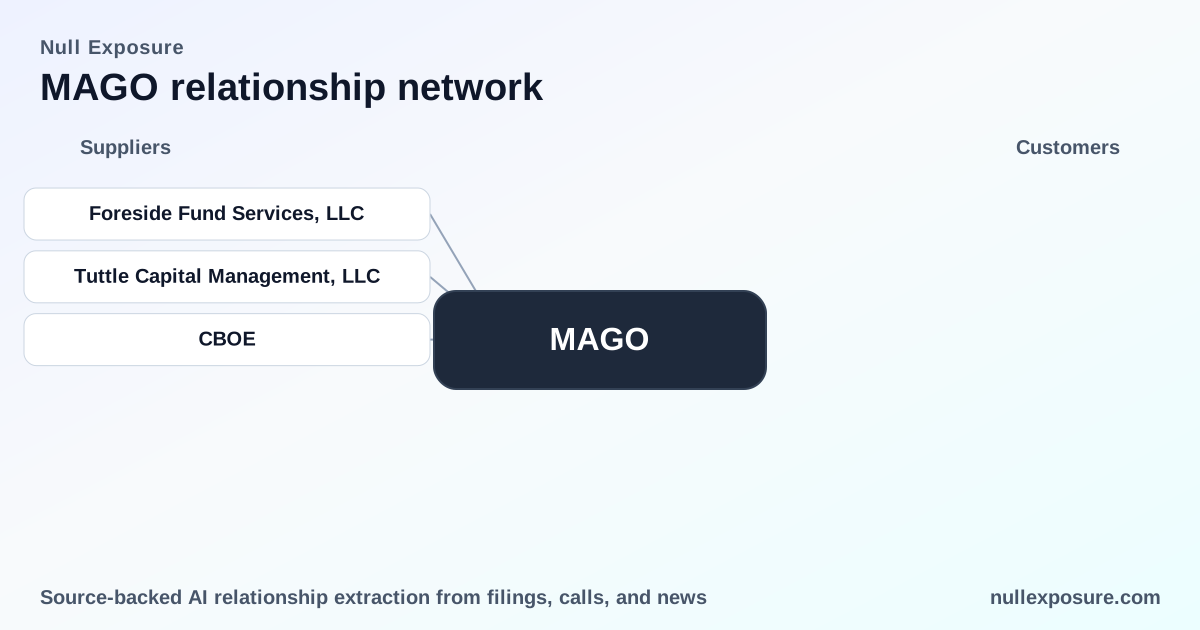
MAGO supplier map: who runs, sells and lists the vehicle
MAGO is an exchange-listed investment vehicle that monetizes through advisory fees and fund-level expenses while relying on a small, purpose-built supplier base: an asset manager as advisor, a distribution agent, and an exchange listing. Investors should evaluate MAGO by treating its supplier set as the primary operational backbone—advisor execution quality, distribution reach, and exchange liquidity determine both growth potential and operational risk.
Explore supplier intelligence and relationship detail at https://nullexposure.com/ to track how these partners affect fund economics.
How MAGO makes money and where suppliers fit in
MAGO generates revenue indirectly: management and advisory fees taken from assets under management, and ancillary fund fees that cover administration and distribution. The advisor controls portfolio construction and strategy execution, which drives return patterns that attract assets; the distributor controls the retail and institutional access pathway; and the exchange listing determines intraday liquidity and trade execution quality. Together, these suppliers shape MAGO’s ability to scale and its fee-capture economics.
Overview of the reported supplier relationships
Below are the suppliers identified in public reporting tied to MAGO’s FY2025 launch. Each relationship is stated plainly with the public source.
Tuttle Capital Management, LLC — the advisor
MAGO is advised by Tuttle Capital Management, LLC, which is responsible for portfolio management, strategy implementation, and the primary revenue interface through advisory fees. Source: Yahoo Finance coverage of Tuttle Capital’s fund launch, March 10, 2026.
Foreside Fund Services, LLC — the distributor
Foreside is named as the distributor for the vehicle, handling investor-facing distribution, regulatory filings related to offering and marketing channels, and intermediary relationships with brokers and platforms. Source: Yahoo Finance coverage of Tuttle Capital’s fund launch, March 10, 2026.
CBOE — the exchange listing
The product is now trading on the CBOE, providing the market venue where secondary-market liquidity, price discovery, and execution quality are formed for MAGO shares. The exchange listing materially affects bid/ask spreads and intraday volume. Source: Yahoo Finance coverage of Tuttle Capital’s fund launch, March 10, 2026.
What the supplier set implies for investors
The supplier roster is compact and functionally complete: advisor, distributor, exchange. That structure creates concentrated operational dependencies—a few partners control the fund’s critical capabilities. Investors should treat these dynamics as top-line drivers.
- Contracting posture: Standard asset-management outsourcing with a single named advisor and distributor implies conventional service agreements and fee arrangements rather than a fragmented operational model.
- Concentration: With three primary entities in public disclosure, operational concentration is high; supplier failure or withdrawal would have immediate, material implications for distribution, portfolio management, or liquidity.
- Criticality: Advisor and exchange are mission-critical for returns and tradability; distributor is mission-critical for retail and intermediary flows.
- Maturity signal: Public reporting around FY2025 and the launch coverage in early 2026 indicate a recently launched vehicle, so operational processes and distribution traction are still in the formative phase.
These company-level signals should frame due diligence even though no explicit contractual constraints were published in the supplier payload.
For a deeper look at MAGO’s supplier relationships and exposure analysis, visit https://nullexposure.com/.
Risk and opportunity profile driven by suppliers
The supplier constellation creates a clear set of risk/reward vectors:
- Execution risk is concentrated. A single advisor determines portfolio outcomes; monitor personnel continuity, historical performance, and compliance track record.
- Distribution scalability depends on Foreside. Distribution agreements and placement relationships will define how quickly assets can scale and thus fee revenue grows.
- Liquidity characteristics derive from the CBOE listing. Trading venue choice affects spreads and capacity to transact large flows without market impact.
Each of these points is actionable: assess the advisor’s team tenure and track record, obtain the distribution memorandum and wholesaling plan, and watch early trading volumes on CBOE for signs of sustainable liquidity.
Practical recommendations for operators and investors
- Demand transparency on the advisory fee schedule and any performance-fee arrangements; fees are the direct monetization lever.
- Request details on the distribution agreement with Foreside—exclusivity, termination rights, and compensation structures determine go-to-market velocity.
- Monitor CBOE trading metrics: daily ADV, spread, and depth are immediate indicators of secondary-market viability.
If you want continuous monitoring of supplier changes and how they impact fund economics, start a subscription at https://nullexposure.com/.
Closing assessment
MAGO’s supplier architecture is concise and serviceable: Tuttle Capital handles portfolio management, Foreside manages distribution, and CBOE provides market access. That alignment is efficient for an ETF-like vehicle but creates high supplier concentration risk during the launch and early scaling phase. Investors should prioritize monitoring advisor continuity, distribution arrangements, and CBOE liquidity as the primary indicators of future performance and fee growth.
For ongoing updates and supplier intelligence relevant to MAGO and comparable vehicles, see https://nullexposure.com/.