Massimo Group (MAMO) — supplier map and what it means for investors
Massimo Group manufactures and sells utility terrain vehicles (UTVs), all‑terrain vehicles (ATVs) and pontoon/tritoon boats, monetizing through wholesale vehicle sales to a dealer network and through in‑house boat production supported by branded engine supply. Revenue is driven by unit sales across seasonal cycles, while margins hinge on supplier economics, dealer floorplan financing and the company’s ability to import components from China. Learn more about supplier risk and relationship intelligence at https://nullexposure.com/.
How Massimo structures its supplier relationships and why it matters to return profiles
Massimo’s operating model combines in‑house manufacturing for pontoon boats with heavy reliance on third‑party manufacturers for ATVs and UTVs. The company imports the bulk of raw materials and finished product components from China and Taiwan, creating a concentrated supplier footprint that directly impacts margins and inventory flows.
- Concentration is acute. Filings indicate that two suppliers accounted for the majority of purchases in FY2024, with one supplier responsible for more than half of total purchases; this level of concentration makes procurement and geopolitical dynamics a principal driver of operational risk.
- Contracting posture is mixed. The company operates under both long‑term property leases and short‑term financing arrangements — a structure that compresses fixed obligations while allowing tactical liquidity management through bank lines.
- Supplier role and criticality are material. Massimo relies on external manufacturers for most vehicle production, while maintaining exclusive supplier relationships for certain components (for example, outboard engines for pontoon boats).
- Treasury strategy is evolving. Massimo has moved to diversify corporate reserves, including a regulated program to deploy Bitcoin treasury capital through a third‑party asset manager.
These operating characteristics explain why investor focus on supplier counterparties, financing partners and treasury counterparties is essential to modeling both downside and upside scenarios.
The relationships you need on your watchlist
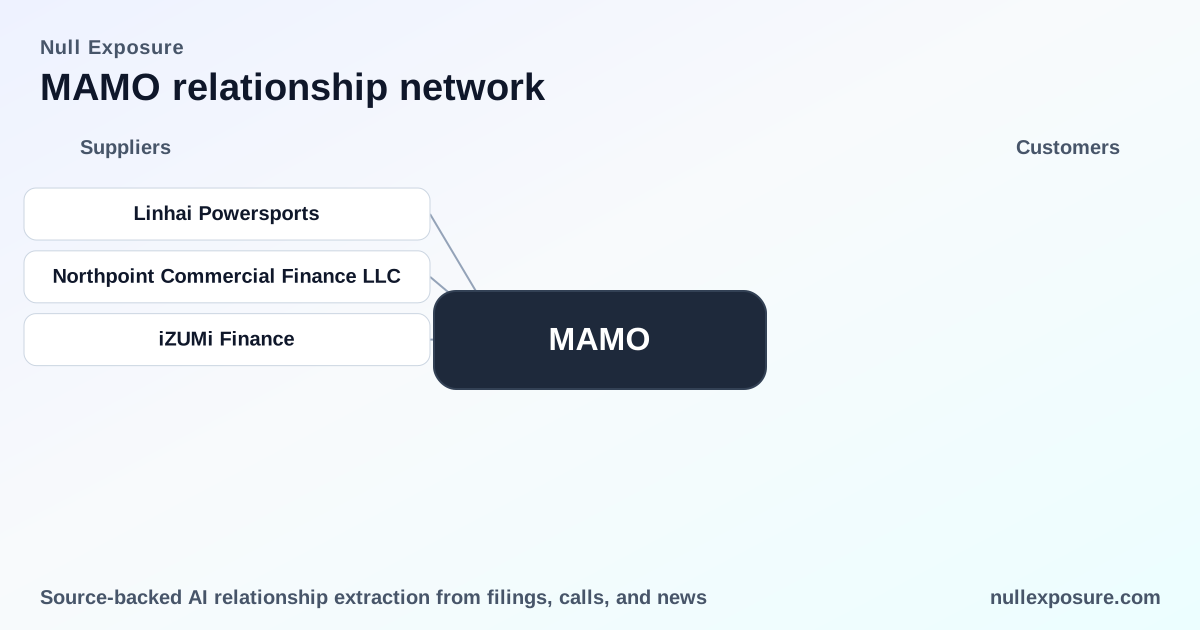
Linhai Powersports — the dominant China supplier
Massimo purchased a majority of its products from Linhai Powersports during 2023 and 2024, and the company identifies Linhai as a state‑owned entity in China; this supplier concentration constitutes a primary procurement dependency for production of ATVs/UTVs. According to Massimo’s FY2024 10‑K, Linhai supplied the majority of product purchases in that period and is located in China (FY2024 10‑K).
Northpoint Commercial Finance LLC — dealer floorplan financier with bite
Massimo’s dealers experienced high rejection rates at floorplan financiers such as Northpoint, which the company links directly to reduced dealer inventory levels and lower sales in certain categories; this makes the floorplan financing environment an indirect but meaningful supply‑chain constraint on Massimo’s sell‑through. The FY2024 10‑K calls out Northpoint as an example of a floorplan provider whose underwriting affected dealer inventory and Massimo’s category sales (FY2024 10‑K).
iZUMi Finance — a partner for regulated digital‑asset liquidity
Massimo announced a strategic collaboration with iZUMi Finance to establish a regulated, principal‑protected digital‑asset liquidity program to execute the company’s long‑term treasury strategy, including the deployment of Bitcoin reserves. This partnership was disclosed in a company press release and multiple news reports in late 2025 / early 2026, describing the program as designed to support corporate treasury diversification into regulated digital‑asset infrastructure (PR Newswire, March 2026; CityBuzz, Dec 2025).
What constraints and corporate signals tell investors about operational flexibility
The filings and extracted constraint evidence sketch a clear operating posture for Massimo:
- Leases with multi‑year tenors. The company renewed a material lease on August 1, 2024, for an additional five years through July 31, 2029, at a monthly rent of $145,750 — a fixed occupancy cost that increases operating leverage in challenged demand cycles (company lease disclosure).
- Short‑term liquidity tools in place. A one‑year line of credit from Cathay Bank, obtained May 13, 2024, provides up to $15.0 million at prime + 0.75%, signaling reliance on bank credit for working capital flexibility rather than on long‑dated secured finance (credit facility disclosure).
- Geographic sourcing concentrated in APAC. Massimo imports the majority of its finished products and most raw materials from China (and some from Taiwan); top suppliers located in China supplied approximately 79% and 68% (by cost) of product purchases in FY2024 and FY2023 respectively, underscoring trade‑ and logistics‑sensitive exposure (FY2024 10‑K excerpts).
- High supplier materiality. Two suppliers accounted for roughly 82% of product purchases in FY2024, with individual supplier shares of 54% and 18%, making supplier disruption a single‑point risk to production continuity (company purchasing disclosures).
- Mixed supplier roles. While Massimo manufactures its pontoon boats in Dallas and maintains an exclusive engine arrangement with a branded supplier, it depends on third‑party manufacturers for most ATVs/UTVs—this split creates different control levers across product lines (10‑K manufacturer disclosures).
- Related‑party service relationships. The company has used related‑party leases for warehouse and office footprint, indicating capital allocation choices that favor operational continuity with familiar counterparties (lease disclosure).
These constraints combine to create a high‑conviction signal of supplier concentration risk and fixed‑cost leverage, with treasury diversification representing an offsetting but speculative attempt to improve liquidity returns.
Learn more about mapping supplier concentration and counterparty risk at https://nullexposure.com/.
Investment implications and actionable monitoring
For investors and operators, the interplay of procurement concentration, dealer financing friction and an active treasury program yields a clear checklist:
- Prioritize monitoring of China‑based supplier continuity and volumes, particularly shipments from Linhai and other top suppliers, as these directly forecast production capability and gross margin stability.
- Track dealer floorplan acceptance trends and Northpoint’s underwriting posture; sustained rejection rates compress dealer inventories and will suppress top‑line unit growth more rapidly than market demand signals alone.
- Evaluate the governance and counterparty risk of the iZUMi arrangement: the treasury program introduces novel asset class exposure and counterparty concentration that should be assessed for custody, regulatory protections and principal‑protection mechanics.
- Incorporate lease and facility obligations (multi‑year property rent plus a one‑year $15M credit facility) into downside liquidity scenarios; these fixed obligations reduce runway during cyclical declines.
Actionable step: add supplier shipments and dealer floorplan acceptance metrics to your operating model’s leading indicators and stress test the company’s ability to meet lease and working capital needs under a slower‑recovery scenario.
Conclusion — concise judgement and next steps
Massimo’s business is operationally leveraged to a small number of key APAC suppliers (notably Linhai) and to the credit conditions facing its dealer base. The company’s treasury pivot into regulated Bitcoin liquidity through iZUMi introduces a non‑core counterparty relationship that changes balance‑sheet optionality but also adds a new risk dimension. Investors should treat supplier concentration and dealer financing dynamics as primary variables when underwriting both upside and downside outcomes.
For a deeper supplier risk profile and to integrate these relationships into portfolio monitoring tools, visit https://nullexposure.com/.