Manhattan Associates (MANH): Supplier relationships and what they mean for investors
Manhattan Associates sells supply-chain and omnichannel software, monetizing through software subscriptions, cloud-hosted services and implementation/maintenance contracts that convert large enterprise deployments into recurring revenue. Its business model is capital-light on the customer side but capital-intensive on the vendor side, because sustained cloud and infrastructure commitments are required to run hosted offerings and marketplace integrations. For investors evaluating MANH’s supplier posture, the practical questions are: who supplies that cloud and go-to-market plumbing, how material are the multi-year commitments, and whether partner placements expand sales channels or simply add cost. Learn more on the firm’s supplier map at https://nullexposure.com/.
The operating constraints that shape MANH’s supplier risk
MANH runs with multi-year, non-cancellable vendor commitments and a subscription-dominant revenue model, which creates predictable operating leverage but also concentration and vendor-credit exposure. The company discloses approximately $202.7 million of cloud infrastructure contractual obligations over the next five years as of December 31, 2025, signaling meaningful locked-in spend with cloud suppliers rather than purely pay-as-you-go flexibility. According to the company’s December 31, 2025 disclosure, those are firm contractual obligations.
MANH also reports entering non-cancellable subscriptions for internal software in the ordinary course of business, which reinforces that a portion of its supplier base is subscription-oriented (supporting internal ops) as well as service-oriented (supporting hosted customer workloads). Collectively, these constraints indicate:
- Contracting posture: long-term commitments create downside if usage or demand falls but underpin SaaS gross margin stability when utilization is strong.
- Concentration and spend: the disclosed $202.7M five-year cloud obligation is a material, company-level spend band (> $100M) and a source of vendor concentration risk.
- Criticality: cloud infrastructure suppliers are operationally critical — outages, pricing moves, or strategic shifts by a cloud supplier would affect MANH service delivery and costs.
- Maturity: these are mature, enterprise-level supplier relationships (non-cancellable multi-year contracts), not ad-hoc spot purchases.
If you want a consolidated view of MANH supplier exposure and partner placements, visit https://nullexposure.com/ to review the supplier map and supporting documentation.
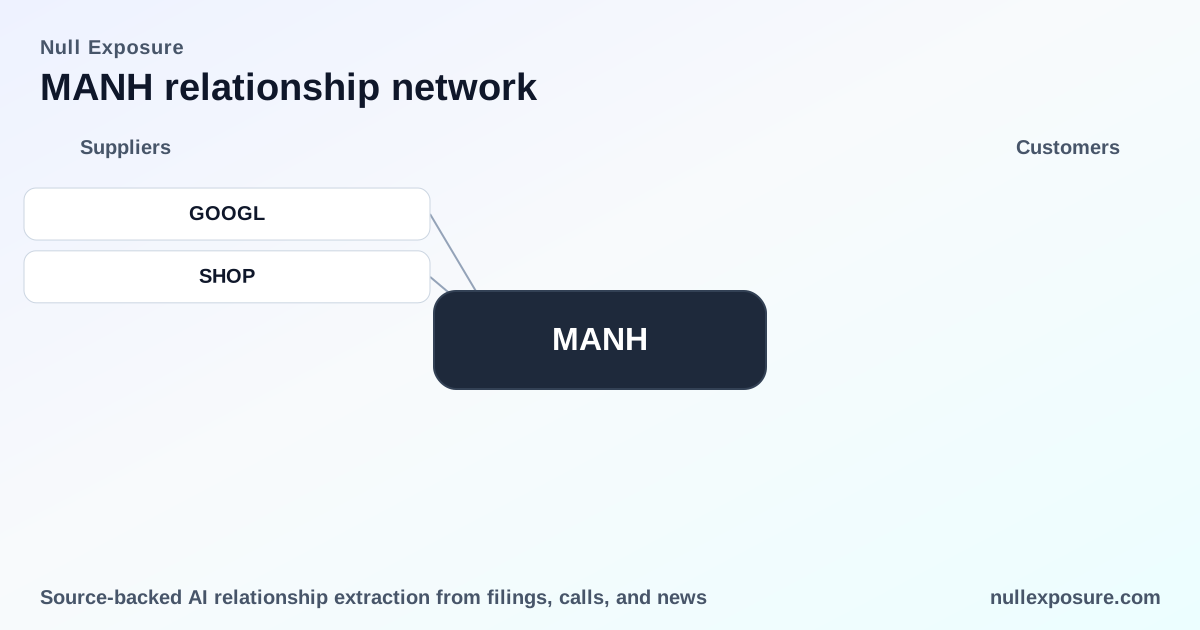
Two named relationships found in public commentary — Google and Shopify
MANH’s latest earnings commentary and investor outreach explicitly highlights two commercial relationships that speak both to distribution strategy and technical integration.
Google — channel and cloud marketplace placement
Manhattan announced that its solutions are available on Google Cloud Marketplace, which signals a formalized commercial and delivery channel via Google Cloud for MANH’s cloud-hosted products. According to the Q2 FY2025 earnings call transcript (reported in March 2026 on AlphaStreet), Manhattan said the listing followed an announcement at their user conference in May. Source: AlphaStreet earnings call transcript, March 10, 2026 (FY2026 commentary).
Shopify — connector to Active Order Management
MANH reported that a connector app to Manhattan Active Order Management is now available in the Shopify App Store, which expands MANH’s reach into the Shopify merchant ecosystem and simplifies integration for mid-market and enterprise merchants using Shopify. This was stated on the same Q2 FY2025 earnings call transcript. Source: AlphaStreet earnings call transcript, March 10, 2026 (FY2026 commentary).
What these partnerships imply for revenue and risk
Both relationships are sales and distribution plays with different strategic functions:
- The Google Cloud Marketplace placement is both commercial and operational. It lowers friction for cloud procurement, can simplify deployment and billing, and likely ties into MANH’s hosted delivery model — but it also deepens the company’s dependence on cloud infrastructure providers that already account for a large portion of MANH’s disclosed five-year cloud contractual obligations.
- The Shopify connector is an ecosystem growth lever, making it easier for merchants to adopt MANH’s order management product and potentially accelerating ARR growth in the mid-market channel.
From an investor perspective, those partner placements are net positives for top-line distribution and product availability, but they must be read alongside the constraints: the company has significant non-cancellable cloud commitments and routine subscription obligations for internal software, which compress optionality. If cloud pricing or terms shift, MANH’s gross margin could be pressured even as distribution expands.
For a deeper supplier exposure profile and supplier-by-supplier intelligence, see the supplier mapping at https://nullexposure.com/.
How to weigh upside vs. supplier concentration
Investors should balance the commercial upside from marketplace listings and connector integrations with the structural supplier risk created by multi-year cloud obligations:
- Upside: marketplace placement and app-store connectors reduce sales friction, accelerate implementations, and can boost ARR retention as integrations become standardized.
- Risk: $202.7M in cloud contractual spend over five years is a non-trivial fixed commitment that reduces flexibility to renegotiate, and the long-term, non-cancellable nature of many contracts increases sensitivity to demand volatility.
- Governance lens: confirm that commercial terms with cloud providers include favorable pass-throughs or co-marketing commitments that justify the locked-in spend, and watch for any single-supplier concentration clauses.
Key takeaways and investor actions
- MANH monetizes primarily through recurring software subscriptions and hosted services; supplier relationships therefore directly affect gross margin and service continuity.
- The company reported roughly $202.7M of cloud infrastructure contractual obligations through the next five years as of December 31, 2025, indicating material multi-year vendor commitments with limited near-term flexibility. (Company disclosure, period ended December 31, 2025.)
- Google Cloud Marketplace placement is a strategic distribution and delivery channel that can lower sales friction but further ties MANH to cloud-provider economics (AlphaStreet earnings call, March 10, 2026).
- Shopify connector expands addressable market and simplifies merchant adoption of Manhattan Active Order Management (AlphaStreet earnings call, March 10, 2026).
- For investors building a thesis, prioritize diligence on contract terms with cloud suppliers, read-throughs from marketplace channel economics to customer acquisition cost, and the degree to which partner co-sell/co-market agreements can offset incremental cloud spend.
If you want a consolidated supplier risk dashboard and relationship intelligence for MANH or comparables, explore the supplier mapping tools at https://nullexposure.com/. For bespoke supplier diligence or to see how MANH’s cloud spend compares to peers, visit https://nullexposure.com/ to commission a tailored review.
In short: MANH’s partner placements enhance distribution and product availability, but the company’s long-term cloud commitments are a material constraint that investors must model explicitly.