Marriott (MAR) — What the FY2026 debt syndication says about supplier relations and capital access
Marriott International runs and franchises a global portfolio of hotel brands and monetizes primarily through room revenue, franchise and management fees, and a fast-growing loyalty ecosystem (Bonvoy) that drives ancillary revenue and partner deals. The company maintains access to capital markets to fund loyalty investments and portfolio growth; its FY2026 debt syndication, arranged with major banks as co-lead underwriters, is a direct expression of that financing strategy. For investors and supplier-side operators, the bank syndicate is both a mirror of Marriott’s market standing and a practical lever that shapes contract terms, counterparty selection, and cash-flow timing. Explore deeper analysis and tracking tools at https://nullexposure.com/.
The financing event you should watch — not just another bond deal
Marriott’s FY2026 issuance was placed with multiple co-lead underwriters rather than a single arranger, which is a deliberate choice to broaden distribution and dilute execution risk. That placement strategy reduces concentration of underwriting exposure while signaling lender confidence in Marriott’s credit profile. For vendors and operational partners, this is consequential: broader bank support translates into sustained liquidity for brand initiatives (loyalty investments, technology upgrades, and capital expenditures) that directly affect supplier demand and payment flows.
Who Marriott worked with — the counterparties in this syndicate
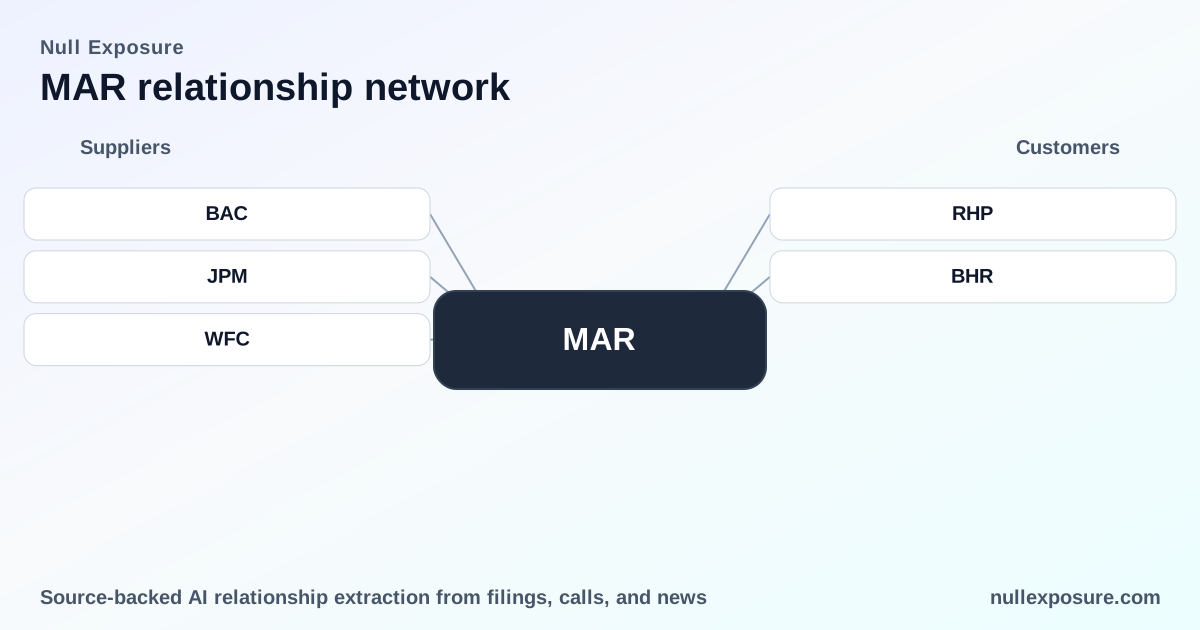
BofA Securities
BofA Securities acted as a co-lead underwriter on Marriott’s FY2026 debt offering, contributing to a syndicate that underwrites liquidity needs and supports the company’s funding access across cycles; the transaction was reported in a Sahm Capital piece dated February 25, 2026 (Sahm Capital, 2026-02-25: https://www.sahmcapital.com/news/content/marriott-balances-new-debt-offering-with-fresh-bonvoy-loyalty-initiatives-2026-02-25).
J.P. Morgan Securities
J.P. Morgan Securities joined as a co-lead underwriter on the same FY2026 issuance, helping distribute the paper and affirming broad market support for Marriott’s credit, according to the same February 2026 coverage (Sahm Capital, 2026-02-25: https://www.sahmcapital.com/news/content/marriott-balances-new-debt-offering-with-fresh-bonvoy-loyalty-initiatives-2026-02-25).
Wells Fargo Securities
Wells Fargo Securities completed the trio of co-lead underwriters for Marriott’s FY2026 debt issuance, signaling diversified banking relationships that underpin Marriott’s access to capital and execution flexibility (Sahm Capital, 2026-02-25: https://www.sahmcapital.com/news/content/marriott-balances-new-debt-offering-with-fresh-bonvoy-loyalty-initiatives-2026-02-25).
What the syndicate composition reveals about Marriott’s operating model
- Contracting posture: Marriott leverages global investment banks as financing suppliers on a syndicated basis, indicating a preference for broad-market distribution over single-lender concentration. This posture preserves negotiation leverage with individual banks while securing scale execution.
- Concentration: The use of multiple co-leads is consistent with a low supplier concentration strategy for capital markets relationships; Marriott spreads execution risk across top-tier global banks.
- Criticality: Access to the syndicated debt market is strategically critical for Marriott because capital underwrites loyalty investment cycles and brand refresh initiatives that drive revenue per available room (RevPAR) over time.
- Maturity of relationships: The participation of established long-term banking partners suggests mature, repeatable relationships rather than ad-hoc financing ties; this creates predictability for counterparties and suppliers who rely on Marriott’s investment cadence.
- Operational implication: For suppliers, this structure signals stable cash-flow backing for strategic contracts (IT, loyalty partners, brand services) but also means suppliers should expect rigorous credit and contract terms comparable to other large corporate customers.
If you track supplier counterparty risk or want continuous monitoring of how these capital relationships evolve, see options at https://nullexposure.com/.
Investment implications and supplier-level risks
- Positive read: The three-bank syndicate highlights market confidence in Marriott’s credit profile; that confidence reduces the probability of financing-driven disruptions to operations and supports ongoing investments in Bonvoy and hotel upgrades.
- Operationally relevant risk: Syndicated finance terms can include covenants and amortization profiles that constrain discretionary capital spend; vendors should model scenarios where covenant tightness affects payment timing or the cadence of capital projects.
- Counterparty opportunity: Suppliers who provide loyalty integrations, tech platforms, or standardized renovation services are well positioned because Marriott’s financing strategy underpins multi-year investment programs.
- Watch list: Monitor interest-rate trends and covenant language in subsequent filings; changes there represent the most direct risk to supplier revenue timing even when headline underwriting support remains strong.
Practical takeaways for investors and operators
- Broad underwriting syndicates are a strength — they lower execution risk and signal credit access that supports Marriott’s strategic investments.
- Suppliers gain predictability from diversified bank relationships, but should remain alert to covenant-driven capital constraints that can shift timing for payments and project approvals.
- Operator strategy should reflect Marriott’s capital cadence: align project bids and contract terms to the company’s financing calendar to capture windows of higher capital availability.
For a full view of supplier relationships and continuous updates on how financing partners influence counterparty risk, visit https://nullexposure.com/.
Bottom line
Marriott’s FY2026 debt syndication, executed through BofA Securities, J.P. Morgan Securities, and Wells Fargo Securities, is a practical affirmation of the company’s market standing and a structural enabler for its loyalty and brand investment agenda (Sahm Capital, Feb 25, 2026). For investors and supplier-side operators, the key signal is clear: diversified, mature banking relationships reduce execution risk and support an ongoing spend profile, but contractual covenants and macro rate dynamics remain the primary levers that could alter supplier outcomes. If you want to map these supplier relationships back to exposure and operational timelines, start here: https://nullexposure.com/.