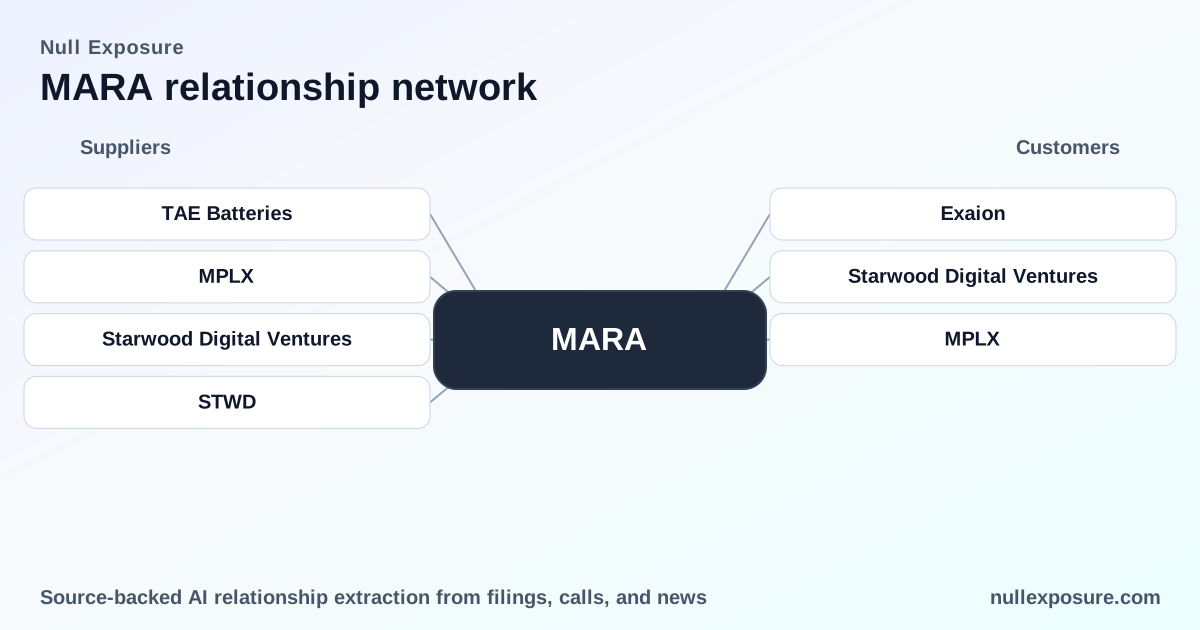
Marathon Digital (MARA) supplier relationships: what investors should price into the story
Marathon Digital operates and monetizes a vertically integrated digital infrastructure platform anchored in large-scale bitcoin mining and expanding data center capacity. The company generates revenue from mined bitcoin and hosting services while pursuing an asset-light scaling strategy through strategic supplier and development partnerships that supply fuel, battery-backed load balancing, and third‑party data center development capacity. Investors should value Marathon not only as a miner, but as a developer/operator leveraging partnerships to compress time-to-market for hyperscale and AI-capable facilities.
For a concise view of supplier relationships and how they change operational leverage, visit https://nullexposure.com/.
How the supplier map changes the operational equation
Marathon’s supplier relationships show two concurrent strategic tracks: (1) securing stable, contracted energy input and physical site development for large campuses; and (2) deploying advanced power-management technologies inside facilities to minimize downtime and maximize usable compute density. Both tracks materially affect capital intensity, operating margin, and project timing. Power supply and developer partners determine project criticality; battery and load‑balancing vendors determine uptime and effective capacity.
TAE Batteries: fast-switching battery tech to smooth internal load
Marathon has publicly discussed a partnership with TAE Batteries to deploy advanced battery technology that can switch at sub-millisecond rates and enable load balancing within data centers. This relationship is framed as a capability play to stabilize power delivery and increase effective utilization of deployed compute equipment. According to Marathon’s Q4 2025 earnings call, the company leverages TAE’s sub-millisecond switching technology to balance load within its data centers (2025 Q4 earnings call transcript). A subsequent company disclosure repeated the role of TAE Batteries as a fast switching solution for internal load balancing (FY2026 earnings commentary reported in March 2026).
MPLX LP: LOI for natural gas supply to on‑site generation in West Texas
Marathon has an LOI with MPLX LP to secure natural gas supply for planned gas-fired generation and adjacent data center campuses in West Texas — an initial target of roughly 400 MW with scalability discussed up to 1.5 GW. Under the terms described in the regional report, Marathon would own and operate generation and data centers while MPLX supplies gas and receives electricity under a tolling arrangement, subject to definitive agreements and approvals. This commercial framework shifts fuel price exposure and delivery risk to a supplier while preserving Marathon’s asset ownership and operational control over electricity conversion (regional business report, Nov. 6, 2025).
Starwood Digital Ventures: development partner for hyperscale and AI facilities
Marathon announced a strategic partnership with Starwood Digital Ventures, Starwood Capital Group’s data center development platform, positioning Marathon to accelerate delivery of hyperscale, enterprise and AI-capable digital infrastructure. The collaboration brings an experienced data center developer onto Marathon’s site and delivery timeline, reducing build-to-operate risk and improving time-to-revenue for new campuses (earnings call commentary and subsequent press coverage in FY2026).
Starwood (STWD): strategic partnership announced broadly with Starwood entities
Public filings and press distribution reflect a broader strategic partnership announcement between Marathon and Starwood (STWD) to accelerate delivery of cutting-edge digital infrastructure, corroborating the developer relationship above and indicating institutional developer backing for Marathon’s expansion strategy (GlobeNewswire distribution noted on financial news aggregators, FY2026).
What the explicit licensing signal implies for contracting posture
Marathon has signaled that it will continue to license the use of intellectual property rights owned and controlled by others, which is a company-level contracting posture rather than a relationship-specific obligation. This licensing posture indicates Marathon is prepared to adopt third-party technologies (such as battery switching or other operational IP) rather than building every capability in-house. Practically, that reduces capital and time requirements for productizing new operational features but increases dependency on external vendors for critical functionality.
How these relationships translate into financial and operational constraints
- Concentration and criticality: MPLX as a gas supplier and Starwood as a development partner are high‑impact relationships — delays or contract failure here would directly delay large MW starts and revenue recognition. Power supply agreements and developer execution are principal gating factors for ramping capacity.
- Contracting posture: The company’s stated willingness to license IP is consistent with an asset-plus-partner model: Marathon retains ownership of generation and data centers while outsourcing specialized tech and development expertise.
- Maturity and optionality: Many of the relationships are anchored by LOIs and strategic partnership announcements rather than fully executed long-term supply contracts; this creates optionality on scale but requires active execution to convert capacity into cash flow.
- Operational leverage: Battery-based load balancing (TAE) increases effective uptime and density, improving margin per MW when deployed at scale.
Investor implications — risk/reward roadmap
- Upside: If Starwood accelerates delivery and MPLX converts LOI terms into firm supply contracts, Marathon can accelerate revenue growth from hosted compute and mining throughput while retaining upside from asset ownership. TAE’s load balancing enhances usable capacity and potential operating margin.
- Downside: Execution risk is concentrated around conversion of LOIs to definitive agreements and on-time delivery from developer partners. Licensing of critical IP reduces upfront capex but adds vendor dependency that can be operationally consequential if service levels decline.
- Valuation levers: Model sensitivity should prioritize the timing of MW commissioning, fuel/tolling economics under MPLX, and realized uptime gains attributable to battery integration.
For a near-term operational scorecard and supplier risk heatmap, review the consolidated supplier view at https://nullexposure.com/.
Closing takeaways and recommended next steps
- Key takeaway: Marathon’s supplier relationships reflect a hybrid strategy: control of asset ownership with tactical outsourcing of developer execution and specialized operational technology. That structure accelerates scale while concentrating execution risk in a small set of partners.
- Action: Investors should monitor definitive agreements with MPLX and deliverables from Starwood for confirmation of timing, and seek operational KPIs tied to TAE battery deployments to quantify uptime improvements.
Explore the full supplier intelligence suite and recent updates at https://nullexposure.com/ for ongoing monitoring of contract conversion and partner performance.