Marine Petroleum Trust (MARPS): A concise supplier-profile for investors
Marine Petroleum Trust operates as a royalty and working-interest holder that monetizes oil and gas production by collecting proceeds from properties operated by third parties and distributing cash to holders. The trust does not run field operations; instead it contracts or licenses acreage and relies on outside oil and gas companies to produce, sell and account for volumes, while a transfer agent handles distributions. Revenue is realized at market clearing prices on short-term or spot contracts, so investor returns track commodity cycles, counterparty execution and lease economics rather than internal operating leverage. For a quick view of the platform and related supplier signals, visit https://nullexposure.com/.
How MARPS actually makes money — the operating and monetization summary
Marine’s business model is fee-lite and asset-oriented: it owns royalty/lease interests and collects cash flows from produced hydrocarbons that third-party operators deliver to market. Company disclosures state that “Substantially all of the oil and natural gas produced from the leases are being sold under short-term or multi-month contracts at market clearing prices or on the spot market.” That contracting posture drives two structural consequences:
- Revenue sensitivity to spot commodity prices — no long-term fixed-price shields; cash flows move with daily market dynamics.
- Low operating overhead and reliance on counterparties — the trust’s role is financial collection and distribution, not field operations.
Another corporate-level detail: Marine confirms that “All aspects of Marine's operations are conducted by third parties,” and the transfer agent, Equiniti Trust Company LLC, processes and pays distributions. This delineation of responsibilities reduces in-house execution risk but increases counterparty and operational-oversight risk, since production, sales and royalty calculations are outsourced to lessees and service providers.
What the supplier relationships in the record tell investors
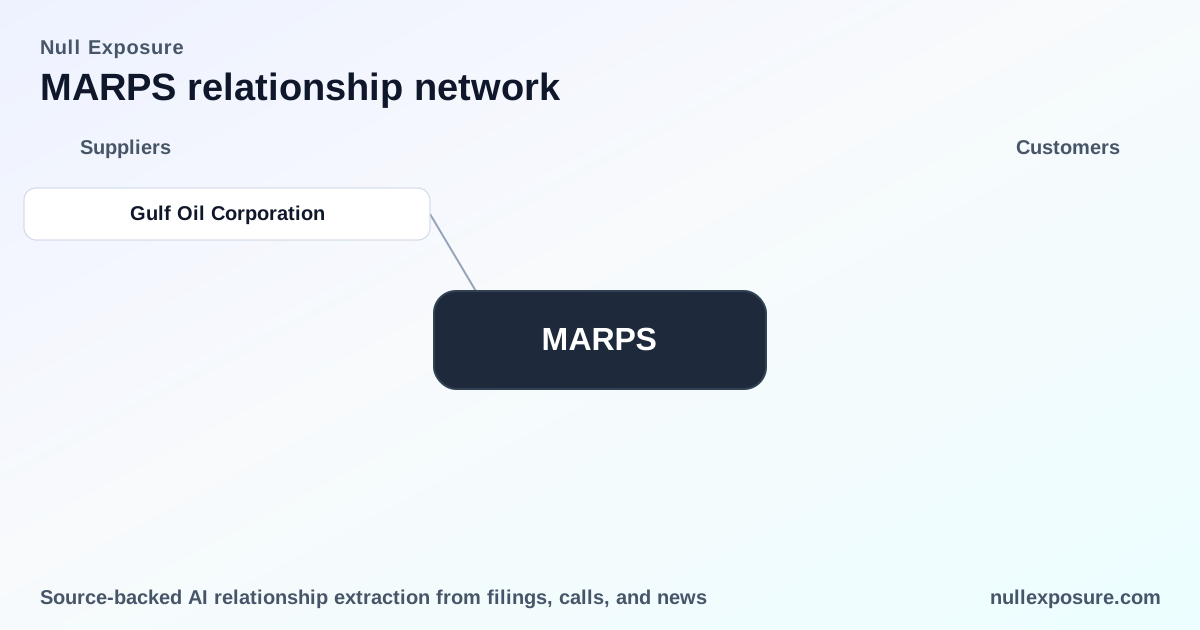
The public results list one supplier relationship. Each relationship below is summarized plainly with its source.
Gulf Oil Corporation
InvestorPlace reported that the original arrangement for certain interests was “pursuant to license agreements and amendments” with Gulf Oil Corporation; this indicates Gulf Oil is referenced in historical license documentation connected to Marine’s assets (InvestorPlace, March 2022: https://investorplace.com/2022/03/what-is-the-marine-petroleum-trust-marps-and-why-is-it-up-today/).
A full list of counterparties is not present in the scraped results, but Gulf Oil’s mention in media coverage signals a historical contractual link or license arrangement referenced in public commentary.
What the relationship footprint implies for risk and concentration
There are two company-level constraints disclosed that are central to underwriting MARPS exposure:
- Short-term contract posture — The trust’s production is sold under short-term or multi-month contracts and on the spot market, so cash flow volatility is high when prices swing. The filing language is explicit: “Substantially all of the oil and natural gas produced from the leases are being sold under short-term or multi-month contracts at market clearing prices or on the spot market.” This is a structural characteristic, not a temporary policy.
- Third-party service reliance — “All aspects of Marine's operations are conducted by third parties,” and Equiniti Trust Company LLC administers distributions, making the trust a pass-through economic vehicle dependent on external operators and administrative agents.
From an investor perspective, these traits produce a clear risk/return profile: low operating expense and capital intensity, high revenue cyclicality, and outsized dependence on lessee performance and market pricing. Monitor counterparty credit, lease terms, and the transfer agent’s payment mechanics because payment timing and accuracy are material to investor returns.
For more context on how third-party supplier postures shape returns across trusts and royalty vehicles, see https://nullexposure.com/ for comparative notes.
Practical monitoring checklist for investors and operators
Investors should track a compact set of inputs that move Marine’s cash flows:
- Commodity price trends and volatility (WTI/Brent and regional differentials).
- Lease and license amendments filed with regulators or mentioned in company filings or coverage (counterparties like Gulf Oil when named).
- Operator performance: reported production volumes, liftings, and sales timing from lessees.
- Transfer agent notices and distribution histories from Equiniti Trust Company LLC for payment timing and accuracy.
- Contract renewal cadence and the emergence of any multi-year hedges (absence of hedges is itself a risk factor).
Key takeaway: the trust is structurally exposed to market swings and counterparty execution; active monitoring of lessee disclosures and distribution notices is essential.
If you want ongoing supplier intelligence and comparative supplier analytics for trust-like assets, explore our resource hub at https://nullexposure.com/.
Strategic implications for portfolio allocation
For allocators, MARPS fits two roles depending on risk appetite:
- As a commodity proxy with direct exposure to oil and gas prices without operator capital commitments — suitable for short-duration tactical exposure.
- As a yield-like cash flow vehicle whose distributions can be attractive in a stable-price environment but are not stable in a low-price shock.
Risks that justify position sizing discipline: counterparty concentration, short-term contractual pricing, and reliance on third-party operations and distribution processing. The presence of historical license arrangements with parties such as Gulf Oil underscores the need to review the underlying lease documents and any amendments to gauge counterparty obligations and default remedies.
Final directions for investors
Marine Petroleum Trust is a clean, low-overhead cash-flow vehicle whose returns are driven by external operators and spot-market realizations. Understand the counterparty map and watch distributions and production notices closely. For detailed comparisons, ongoing tracking and supplier-level commentary, return to https://nullexposure.com/ — use the site to cross-reference similar trust structures and supplier concentration risks.
If you need a supplier relationship deep-dive or a cross-asset comparison built on public filings and media coverage, our portal at https://nullexposure.com/ provides curated, investor-focused analysis and alerts.