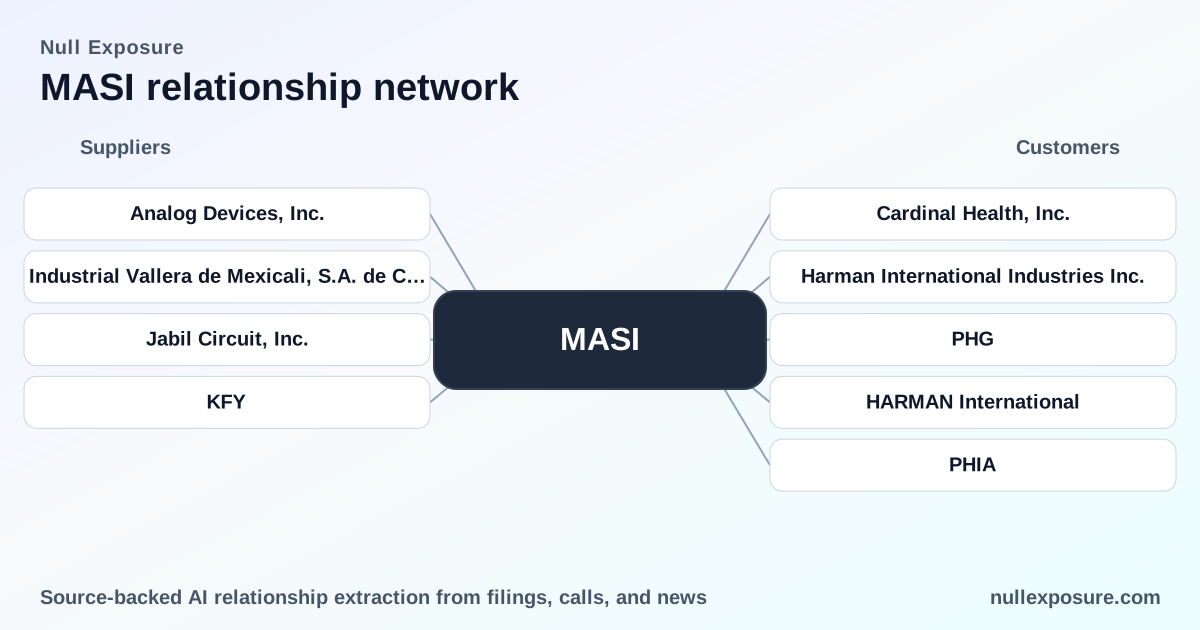
MASI Supplier Map: what investors need to know about manufacturing partners and dependency
Masimo (ticker MASI) designs medical hardware and outsources significant manufacturing and supply functions to third parties; it monetizes by selling proprietary devices and consumables while relying on contract manufacturers and long-term purchase agreements to secure components and subassemblies. The company’s commercial model blends high-margin intellectual property with capital-light manufacturing relationships, creating operational leverage but also concentration and logistics risk that investors must price into valuation. For deeper supplier intelligence, visit https://nullexposure.com/.
How Masimo contracts and why that matters for investors
Masimo runs a hybrid operating model: core product design and IP retention at headquarters, paired with third-party contract manufacturing for circuit boards, audio components and other hardware subassemblies. This posture delivers scale and cost predictability, but it also produces concentration of critical inputs, global supply-chain exposure, and contractual purchase commitments that drive near-term cash outflows.
- Contracting posture: Masimo routinely executes long-form manufacturing and purchase agreements with established manufacturers, reducing per-unit cost and transfer of capital outlay.
- Concentration and criticality: The company depends on sole or limited-source suppliers for key chips and components, which makes single-vendor disruptions operationally significant.
- Maturity and spend: Masimo reports sizable committed purchases—$291.2 million in purchase commitments as of December 28, 2024—indicating both predictable demand and locked-in spend that can pressure working capital during downturns.
These are company-level signals drawn from the FY2024 filing and should be treated as core operational constraints that influence supplier negotiation power and downside risk.
For a supplier-by-supplier readout, see the relationship summaries below. If you are evaluating counterparty risk or negotiating exposure, start your workflow at https://nullexposure.com/ for supplier intelligence and workflow tooling.
The supplier roster you will see in the filings (short, actionable summaries)
Analog Devices, Inc.
Masimo maintains a long-dated Manufacturing and Purchase Agreement with Analog Devices that dates back to October 2, 2008, indicating an established supplier relationship for components or subassemblies. According to Masimo’s FY2024 Form 10‑K filed December 28, 2024, this agreement is listed among its material manufacturing contracts, reflecting a durable purchasing arrangement with a major semiconductor supplier.
Industrial Vallera de Mexicali, S.A. de C.V.
Masimo contracts local shelter labor services with Industrial Vallera de Mexicali under an agreement dated December 27, 2000, which suggests utilization of manufacturing or operational facilities in Mexico for assembly or logistics support. The FY2024 Form 10‑K (filed December 28, 2024) lists this Shelter Labor Services Agreement as part of Masimo’s established supplier and service relationships.
Jabil Circuit, Inc.
A long-standing Purchase Agreement dated July 26, 2001, links Masimo to Jabil Circuit for outsourced manufacturing or electronics assembly services, signaling reliance on large contract manufacturers for complex subassemblies. This relationship is referenced in Masimo’s FY2024 Form 10‑K (filed December 28, 2024) and underscores the company’s use of global EMS (electronics manufacturing services) providers to scale production.
Korn Ferry
Korn Ferry served as the executive search advisor to Masimo’s board in the CEO succession process that resulted in the appointment of Katie Szyman, according to contemporary press coverage. A March 10, 2026 news report in MassDevice noted that the board engaged Korn Ferry during the selection process for the new chief executive, reflecting an advisory relationship rather than a manufacturing or supply contract.
What the relationships imply about operating leverage and risk
The contracts reported in the FY2024 filing collectively indicate a manufacturing model that is efficient but materially exposed:
- The use of global contract manufacturers such as Jabil and long-standing component suppliers like Analog Devices is evidence of an outsourced production strategy that scales without heavy CapEx, but it also concentrates operational risk in a handful of partners.
- The Shelter Labor Services Agreement in Mexico indicates operational offshoring to lower-cost geographies, which reduces unit costs but increases exposure to cross-border logistics and labor risks.
- The Korn Ferry engagement is governance-related and does not alter manufacturing risk, but it signals the board’s willingness to use external advisors for strategic leadership transitions.
Together these factors produce a mixed risk-reward profile: strong margin benefits from outsourcing and predictable purchase commitments that support revenue delivery, paired with supply concentration and global logistics exposure that can disrupt delivery and require working-capital buffers.
If you want to translate these relationship signals into counterparty risk scores or supplier concentration metrics, start the analysis at https://nullexposure.com/ to align supplier contracts with cash-flow modeling.
Investment implications and risk checklist
For investors and operators, the key considerations are:
- Operational continuity bias: Long-dated agreements with major suppliers reduce near-term procurement uncertainty but do not eliminate single-source exposure for critical chips.
- Working capital commitment: The $291.2 million of purchase commitments reported as of December 28, 2024 is an explicit liquidity driver that will affect free-cash-flow timing.
- Geographic supply chain: Global supplier footprints and Mexican shelter arrangements lower cost but raise geopolitical, freight, and labor risks that must be stress-tested in downside scenarios.
- Governance signal: Engagements like Korn Ferry’s role in CEO selection demonstrate active board management of leadership risk, which is positive for strategy execution.
Key risk to watch: any interruption at a sole or limited-source supplier for digital signal processors or ADC chips will directly impede product delivery, based on Masimo’s disclosure that such components are critical.
Bottom line and next steps
Masimo’s supplier network is a deliberate extension of its capital-light manufacturing model: it delivers scalable production and cost advantage while concentrating critical inputs with a few large partners. Investors must price in both the upside from margin operational leverage and the downside from supplier concentration, global logistics and purchase-commitment-driven cash flow.
For more granular counterparty profiles and to build a supplier risk model tied to cash flow scenarios, visit https://nullexposure.com/ and begin mapping contractual commitments to balance-sheet impact.