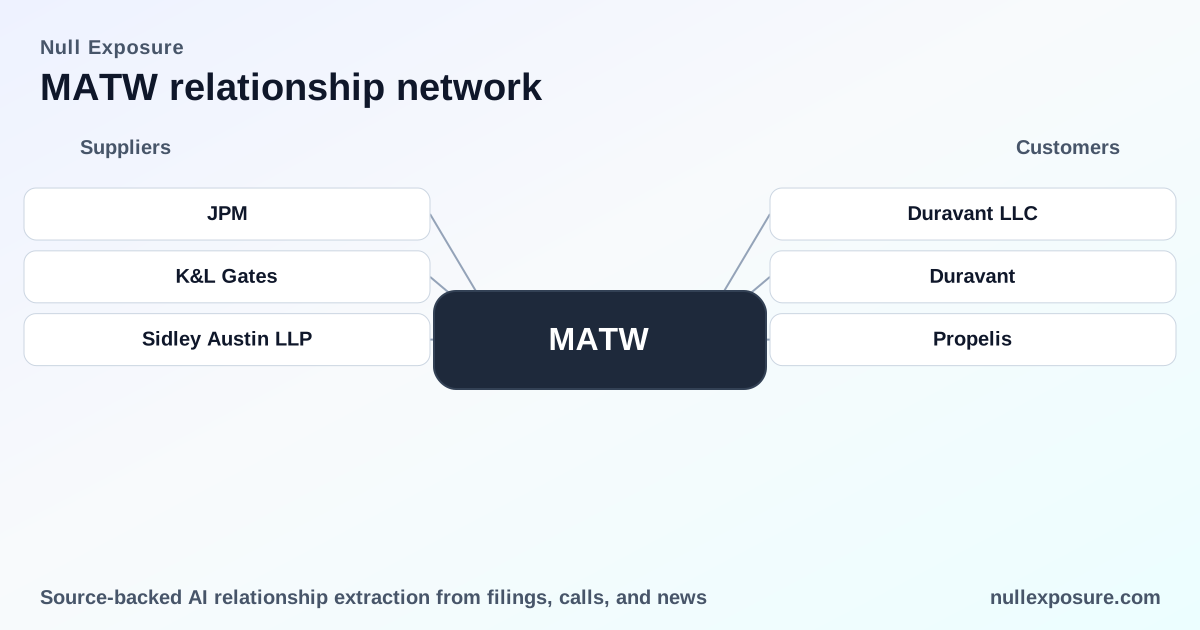
Matthews International (MATW): Supplier relationships shaping near-term strategy and cost profile
Matthews International is a diversified industrial conglomerate that monetizes through three core channels: global brand solutions (signage and brand management), commemoration products (memorialization and cremation services), and industrial technologies (marking and automation). Revenue is generated largely from product sales and recurring aftermarket services, while strategic advisory and legal relationships are engaged episodically to execute M&A, asset dispositions, and corporate governance actions — activities that affect near-term liquidity and capital allocation. Investors should treat recent advisory engagements as transaction-driven cost centers with high short-term criticality but limited ongoing operating dependency.
For a quick lookup of supplier mapping and risk signals, visit https://nullexposure.com/
Why advisory and legal suppliers matter now
Matthews’ recent public notices show the company is actively managing its portfolio through asset sales and shareholder agreements, which elevates the importance of financial and legal advisors over a defined period. These relationships are project-based, concentrated, and mission-critical during deals, but non-recurring in the ordinary course of operations. That contracting posture drives two investor-relevant conclusions:
- Cost concentration: Advisory and legal fees are episodic but material relative to standard SG&A lines during transaction windows.
- Operational criticality: Advisors are critical for deal execution and timing, which directly impact cash proceeds, restructuring outcomes, or settlement terms.
Company-level financial evidence supports a material but bounded exposure to financial institution programs: the amounts owed to a participating financial institution under the Program and included in trade accounts payable were $6.1 million and $3.0 million at September 30, 2025 and 2024, respectively, placing Matthews in the $1M–$10M spend band for such arrangements (high confidence). This is a signal that transaction-related counterparty exposure is meaningful but not systemically large to the balance sheet.
Who is advising Matthews — the relationship map
Below are the active supplier relationships surfaced in public releases, each summarized in plain English with sources.
J.P. Morgan Securities LLC — financial advisor on multiple matters
J.P. Morgan is serving as Matthews International’s financial advisor in at least two recent corporate actions: the sale of a warehouse (public notice March 10, 2026) and the company’s engagement related to an agreement with Barington Capital (news release January 16, 2026). According to the March 10, 2026 Yahoo Finance release, J.P. Morgan was the financial advisor on the warehouse sale; the January 16, 2026 Sahm Capital release confirms J.P. Morgan as financial advisor on the Barington Capital agreement.
Sources: Yahoo Finance, March 10, 2026; Sahm Capital press release, January 16, 2026.
K&L Gates — lead transaction counsel on asset sale
K&L Gates is identified as lead transaction counsel for Matthews International in the March 10, 2026 disclosure about the warehouse sale, indicating K&L Gates is handling the legal work tied to that asset disposition.
Source: Yahoo Finance, March 10, 2026.
Sidley Austin LLP — legal counsel on shareholder agreement activity
Sidley Austin LLP is serving as Matthews’ legal counsel in connection with the company’s agreement with Barington Capital, as disclosed in the January 16, 2026 filing; this positions Sidley to manage the regulatory and compliance dimensions of the shareholder engagement.
Source: Sahm Capital press release, January 16, 2026.
How to interpret these relationships for risk and opportunity
These supplier engagements create a specific, actionable profile for investors and operators:
- Concentration and duration: The supplier roster is narrow and transaction-focused — a small number of large, reputable financial and legal firms are engaged for finite mandates. That reduces counterparty complexity but increases dependence on a few firms during critical windows.
- Cost vs. benefit trade-off: Advisory fees will compress free cash flow in the short term but are aimed at delivering disposal proceeds or governance outcomes that can unlock shareholder value. Track realized proceeds and any contingent liabilities closely.
- Liquidity and payables exposure: The company-level spend-band evidence ($6.1m owed at 9/30/2025) indicates meaningful short-term payable exposure tied to program participation with financial institutions; this is material to near-term working capital planning but not large relative to total revenues.
- Maturity of relationships: These suppliers are engaged in standard corporate finance and legal roles — mature, bilateral relationships that replicate across corporate transactions rather than specialized manufacturing supply chains.
For a concise supplier risk brief and to monitor subsequent disclosures, visit https://nullexposure.com/
What operators and governance teams should do next
- Ensure deal documentation includes fee caps or success-fee alignments to protect free cash flow when transactions are protracted.
- Require periodic fee-to-value reporting from advisors during active mandates so the board and treasury can assess net benefit as deals progress.
- Monitor trade-payable schedules tied to financial institution programs to avoid short-term liquidity squeezes; the company’s reported $6.1m payable in FY2025 is a practical benchmark.
- Maintain bilateral continuity plans: if a primary advisor is conflicted or exits, have a secondary counsel/advisor on retainer to prevent delays.
Bottom line: transaction advisors shape outcomes, not operations
The supplier landscape for Matthews International over the recent reporting window is dominated by high-quality financial and legal advisors engaged on discrete transactions. These relationships are critical to execution and capital allocation decisions, but they are not recurring operating suppliers that determine product delivery or manufacturing performance. Investors should treat advisory engagements as short-duration, high-impact events that warrant focused oversight of fees, timelines, and realized proceeds.
For ongoing supplier intelligence and a practical supplier risk dashboard that maps these relationships to payables exposure, explore https://nullexposure.com/ — it’s the fastest way to translate public disclosures into action.