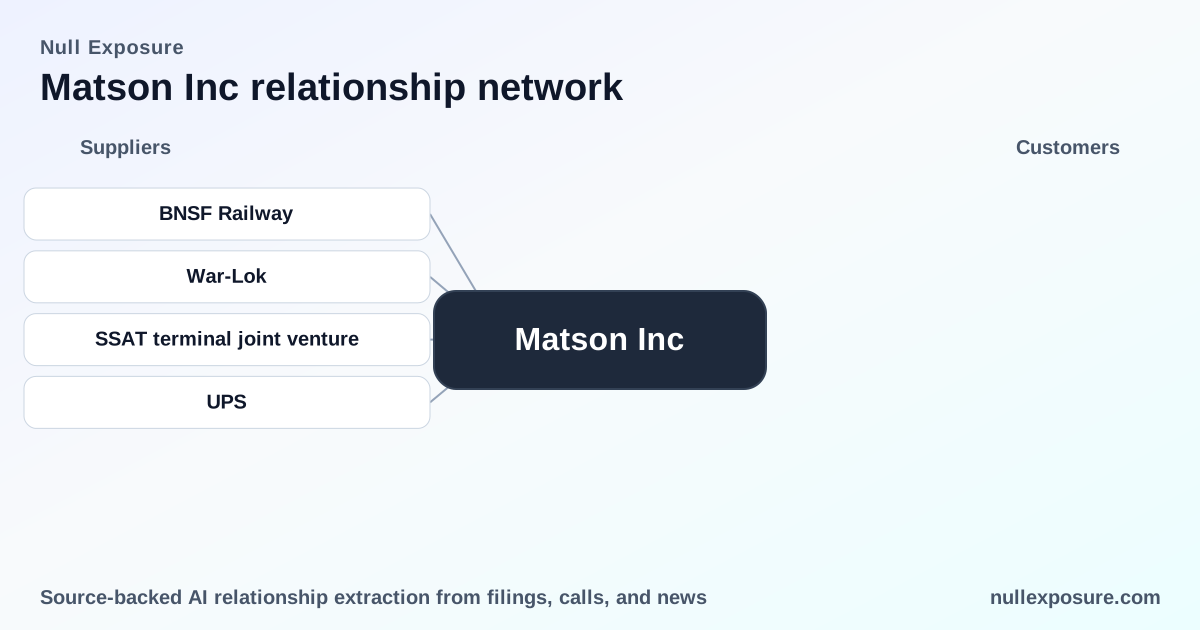
Matson (MATX) supplier relationships: an investor primer on partners, obligations and operational leverage
Matson is a vertically integrated logistics and shipping operator that monetizes through ocean freight, domestic intermodal moves, terminal services and related logistics fees — earning revenue from freight rates, terminal throughput and asset-backed services. For investors, the relevant commercial signal is how Matson converts strategic partnerships and long-lead capital commitments into sustainable service differentiation and margin resilience across transpacific and domestic lanes. For a faster supplier-risk snapshot, visit https://nullexposure.com/.
The short take — why these supplier relationships matter to valuation
Matson’s network economics rely on two levers: service reliability (terminal, intermodal rail and on‑dock handling) and asset investment (vessels and terminals) that control capacity and cost). The supplier relationships highlighted in recent sources strengthen Matson’s inland security and terminal contribution profile while underlining significant ongoing capital commitments. Together these relationships influence short-term service competitiveness and the longer-term capital intensity that underpins the company’s operating leverage.
Partners that move the needle
BNSF Railway — inland security and intermodal routing
Matson has a formalized arrangement with BNSF Railway that positions Matson containers lower in intermodal well cars and integrates inland routing into BNSF’s network between Los Angeles and Chicago; the arrangement is presented as enhancing cargo security and the inland leg of international shipments. A March 2026 Intellectia news release described the BNSF partnership as part of a broader cargo security program launching in Q2 2026. (Source: Intellectia, March 2026 — https://intellectia.ai/news/stock/matson-inc-declares-q1-dividend-of-036-per-share)
War‑Lok — container-level security hardware deployed across LA-to‑BNSF flows
Matson will deploy War‑Lok security devices on every international container moving from Los Angeles into BNSF-network destinations to reduce theft risk and strengthen end-to-end protection; the program is offered at no additional cost to customers and is part of the same Q2 2026 initiative. (Source: Intellectia, March 2026 — https://intellectia.ai/news/stock/matson-inc-declares-q1-dividend-of-036-per-share)
SSAT terminal joint venture — a direct earnings contributor
Matson’s SSAT terminal joint venture contributed measurable EBITDA to fourth-quarter results, with commentary reporting a $9.3 million contribution in the fourth quarter and a year-over-year improvement. This JV demonstrates Matson’s strategy of capturing terminal economics rather than only providing lift. (Source: Benzinga transcript of Matson Q4 2025 earnings call, published March 2026 — https://www.benzinga.com/insights/news/26/02/50851453/transcript-matson-q4-2025-earnings-conference-call)
United Parcel Service (UPS) — a hybrid sea‑to‑land model comparison
Market commentary has framed Matson’s approach as competitive with traditional parcel integrators on expedited sea‑to‑land flows, highlighting a “Matson + UPS Ground” hybrid that leverages Matson’s ocean leg with surface networks for final delivery; the framing underscores industry attention to Matson’s role in cost-competitive, time‑sensitive freight. (Source: FinancialContent/MarketMinute report, February–March 2026 — markets.financialcontent.com/wral article)
What the documented constraints tell investors about Matson’s operating model
The company-level constraint excerpts provide a clear operational profile:
- Contracting posture is mixed but capital-intensive. Evidence shows significant long-term construction obligations for three Jones Act vessels — cited as vessel construction obligations of $814.0 million — indicating a high degree of long‑lead, fixed-capacity commitment that locks in capital spend and creates measurable future depreciation/amortization and financing obligations.
- Relationships are primarily service-provider oriented and operationally critical. Matson’s core cost base and service delivery rely on third‑party terminal, rail, truck and agent services; the company explicitly bills and incurs costs for transportation brokerage and freight forwarding, indicating that external service providers are both cost drivers and delivery points.
- Stage and maturity: active operational partnerships. Multiple excerpts show active contracts and leased terminal facilities (berth, yard, office, storage), which signals ongoing dependency on external infrastructure and active vendor management rather than nascent pilots.
- Spend concentration is non-trivial. The evidence set includes spend bands from the low‑millions (benefit plan contributions) up to >$100 million for vessel construction obligations, indicating material capital expenditure and mid-single/double-digit million recurring supplier spend buckets.
- Criticality and exposure: Because terminals, rail and truck services are core to Matson’s promise to customers, supplier disruption or cost inflation in those areas directly affects service reliability and margin.
These constraint signals are company-level and reflect how Matson organizes procurement, capital planning and vendor risk management rather than being assigned to any single partner unless the excerpt explicitly names them.
How these relationships change the risk/reward profile for investors and operators
- Upside: The BNSF + War‑Lok security program is a competitive moat enhancement — improving cargo security without transferring cost to customers strengthens Matson’s value proposition for shippers sensitive to theft and delay. The SSAT joint venture shows Matson capturing terminal economics, which lifts margin profile when throughput is steady.
- Downside: The $814M vessel build commitments and concentrated reliance on third‑party terminal/rail services increase capital and operational risk: delays or cost overruns on vessel builds, or disruptions in key terminal/service providers, would compress margins and raise incremental cash needs.
- Negotiating posture: Active, service-provider relationships and large capital commitments give Matson operating leverage in pricing and capacity control but also create lock-in that limits rapid cost-freedom — procurement strategies will need to balance long-term vessel economics with short-term supplier flexibility.
For procurement leaders and operators: prioritize SLA clauses for key rail and terminal partners, build redundancy for inland legs, and ensure capital projects have clear milestone-based financing protections.
For a deeper supplier-risk assessment and monitoring playbook, see https://nullexposure.com/ — the platform surfaces relationship-level signals investors use to stress-test supply-side exposure.
Practical takeaways for investment and operations decisions
- Positive signal: Strategic alignment with BNSF and deployment of War‑Lok devices are concrete service differentiators that increase Matson’s position in secure, inland-enabled trade lanes.
- Watch item: The large vessel construction obligations (>$800M) are a liquidity and execution risk that investors must cash‑flow model into scenarios for leverage and capex cadence.
- Operational reality: High dependence on third-party terminal, rail and truck services means Matson’s margin performance is tightly coupled to supplier execution and cost inflation.
If you manage exposure to MATX or similar shipping suppliers, incorporate both the operational partner map and the capital obligation timeline into your scenario analysis. For help operationalizing supplier intelligence into investment models, visit https://nullexposure.com/.
Closing thought: Matson’s current supplier footprint strengthens service differentiation while simultaneously committing the company to significant capital intensity; that duality is the core investment thesis driving near-term optionality and longer-term execution risk. For ongoing coverage and supplier intelligence, see https://nullexposure.com/.