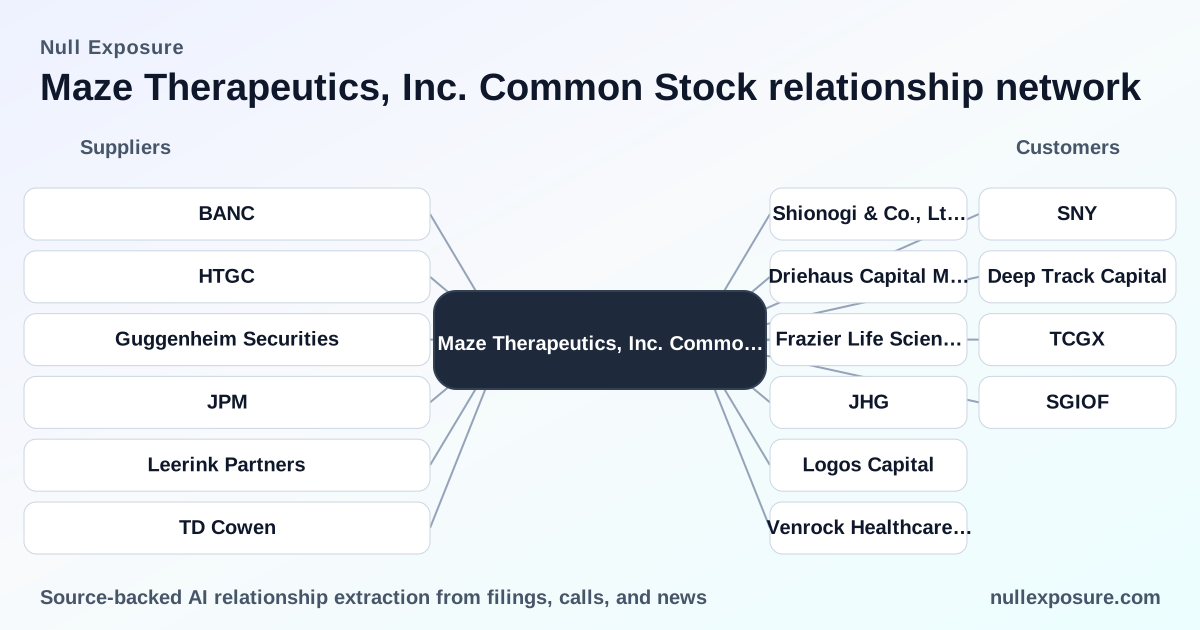
Maze Therapeutics’ supplier and capital partners: what investors need to know
Maze Therapeutics is a clinical‑stage small‑molecule developer focused on renal, cardiovascular and metabolic diseases; the company monetizes by advancing lead programs to clinical proof‑of‑concept and then commercializing directly or via partnerships, funding operations through equity capital and structured debt. Over the past 18 months Maze executed an upsized public offering and a material refinancing that restructured its secured debt profile—transactions that reframe counterparty exposure for operators and credit‑sensitive investors. For a concise snapshot of Maze’s supplier and capital map visit https://nullexposure.com/.
Capital partners reshaped the balance sheet — and the risk profile
Maze executed two visible capital events that matter for supplier relationships and liquidity. In January 2025 the company completed an upsized initial public offering with a syndicate led by J.P. Morgan, TD Cowen, Leerink Partners and Guggenheim Securities, demonstrating institutional demand at IPO pricing (GlobeNewswire, Jan 31, 2025). That underwriting group established the equity base and institutional relationships that enabled public market access.
More recently, Maze restructured secured financing in early 2026, entering a senior secured term loan facility with Hercules Capital for up to $200 million and drawing an initial $40 million tranche, while terminating an earlier loan and security arrangement with Banc of California and releasing that bank’s security interest (The Globe and Mail, February–March 2026). The Hercules facility materially increases Maze’s committed liquidity runway and shifts counterparty credit concentration toward structured‑finance lenders. The termination of Banc of California’s security interest signals a deliberate refinancing and re‑prioritization of secured creditors.
What the underwriting roster tells you about market access
The composition of the bookrunners on Maze’s IPO is a signal of distribution capability and sell‑side conviction at the time of listing. J.P. Morgan and TD Cowen provided top‑tier institutional coverage and retail channel access, while Guggenheim Securities and Leerink Partners contributed biotech specialty placement and research depth (GlobeNewswire, Jan 31, 2025). That combination translated into a diversified capital tap for Maze at IPO and a network that supports follow‑on equity and investor outreach.
Explore how these counterparty relationships map across Maze’s supplier posture at https://nullexposure.com/.
Supplier posture and operational constraints that matter to investors
Maze’s public disclosures describe a third‑party‑centric operating model with several structural implications:
- The company does not own clinical manufacturing facilities and depends on multiple contract manufacturing organizations (CMOs), including foreign CMOs, for clinical and potential commercial supply. This creates an operational dependency where manufacturing relationships are functionally critical to program timelines and regulatory filings.
- Maze also relies on third‑party clinical research organizations (CROs) to conduct clinical trials, outsourcing trial execution rather than conducting in‑house trials.
- For its Compass platform, the firm uses non‑exclusive access to academic and government biobanks and specialized datasets, including the University of Helsinki, Queen Mary University, UK Biobank, Biobank Japan and the Million Veteran Program, plus disease‑specific cohorts such as the Chronic Renal Insufficiency Cohort managed by the National Institute of Diabetes and Digestive and Kidney Diseases.
Company disclosures also identify geographic concentration in manufacturing activity: some contract manufacturing is located in China, which introduces geopolitical and supply‑chain risk vectors in addition to standard CMO execution risk.
Taken together these disclosures describe a highly outsourced, externally contracted model with moderate counterparty concentration (multiple CMOs but reliance on foreign providers), high criticality of suppliers (manufacturing and data access are essential), and an active stage profile (clinical‑stage programs that depend on ongoing third‑party services).
Mid‑analysis takeaway for operational decision‑makers
- Liquidity risk has been reduced by the Hercules facility, but debt covenants and repayment priorities will reframe supplier negotiations for security and payment terms.
- Manufacturing and data access are single points of operational failure: third‑party execution issues or data licensing constraints will directly affect trial timelines and regulatory submissions.
For further mapping of supplier exposure and counterparty materiality, visit https://nullexposure.com/.
Relationship roll call — every reported counterparty
-
Hercules Capital, Inc. (HTGC) — Maze entered a Loan and Security Agreement with Hercules for a senior secured term loan facility of up to $200 million, drawing an initial $40 million tranche with approximately $38.4 million in net proceeds on February 4, 2026, strengthening Maze’s liquidity under a senior secured structure (reported by The Globe and Mail, March 2026).
-
Banc of California (BANC) — Maze terminated its prior Loan and Security Agreement with Banc of California effective February 2, 2026, and the bank’s security interest in the company’s assets was released, signaling a strategic refinancing and creditor re‑ranking (reported by The Globe and Mail, March 2026).
-
Guggenheim Securities — Served as a joint bookrunning manager on Maze’s upsized IPO, providing distribution and syndicate support during the January 31, 2025 offering (GlobeNewswire, Jan 31, 2025).
-
J.P. Morgan (JPM) — Acted as a joint bookrunning manager for the January 2025 IPO, contributing institutional placement and research coverage at the time of Maze’s market debut (GlobeNewswire, Jan 31, 2025).
-
Leerink Partners — Participated as a joint bookrunning manager on the January 2025 offering, bringing biotech sector placement and specialized investor relationships (GlobeNewswire, Jan 31, 2025).
-
TD Cowen — Functioned as a joint bookrunning manager for the January 2025 IPO, supplying both institutional syndication and sell‑side coverage for the transaction (GlobeNewswire, Jan 31, 2025).
Investment implications and risk checklist
- Balance sheet flexibility improved: the Hercules facility provides committed term capacity and an initial draw to fund near‑term operations, reducing immediate dilution pressure but increasing interest and covenant exposure that investors must underwrite.
- Operational execution is outsourced and therefore vendor‑sensitive: outcomes for MZE829, MZE782 and other candidates are contingent on CMO and CRO performance and on maintaining access to third‑party genetic and clinical datasets.
- Geopolitical and regulatory exposure: reliance on Chinese contract manufacturers and government/academic data sources creates scenario risk tied to trade policy, export controls and data‑access regulation.
- Counterparty concentration has shifted: the exit of Banc of California from a secured position and the entrance of Hercules recast secured creditor priorities; underwriters from the IPO remain a distribution channel for any future equity raises.
Final read: what operators and investors should do next
Operators should secure redundancy in manufacturing partners, harden data‑access agreements with biobanks, and model covenant outcomes under the Hercules facility. Investors should track milestone‑driven liquidity consumption and the company’s cadence of preclinical and clinical readouts that will determine future capital markets access.
For an integrated view of Maze’s supplier, underwriting and creditor network, and to build a counterparty‑aware monitoring plan, go to https://nullexposure.com/.