MBIA Inc — supplier relationships and operational constraints investors should price today
MBIA Inc. underwrites financial insurance for public markets and monetizes through insurance premiums, investment income on reserves, and risk transfer via reinsurance and selective balance-sheet transactions. The company's supplier posture is defined by two functional layers: outsourced operational services (security and IT monitoring) that support day-to-day resiliency, and large-scale reinsurance arrangements that materially shift underwriting risk off the balance sheet. For investors and counterparties, the commercial and counterparty profile of MBIA is best evaluated through those two lenses.
Explore deeper supplier intelligence at https://nullexposure.com/.
Why MBIA’s supplier map matters for capital allocation
MBIA runs a capital-intensive insurance model where counterparty selection and reinsurance structure directly govern solvency, earnings volatility, and required reserves. Outsourced security services reduce internal technology burden but increase operational dependency on vendors; reinsurance cessions materially change net exposure and require active counterparty monitoring. MBIA reports ceded insurance in force of roughly $1.5 billion (2024), which signals a substantial external spend and counterparty surface for reinsurers and service providers alike. Investors should treat MBIA’s supplier relationships as an extension of its underwriting and liquidity management strategy rather than as incidental procurement.
Contracting posture, concentration and criticality — how MBIA operates
- MBIA contracts third parties for continuous security monitoring and remediation, indicating a preference for outsourced operational risk management over in‑house build-outs. This contracting posture reduces fixed costs but increases vendor operational risk exposure.
- Reinsurance is a material method for synthetic capacity and capital relief. The company cedes significant portions of insurance in force (reported at $1.5B for 2024), creating concentrated counterparty risk with reinsurers and placing a premium on counterparties’ credit quality and ratings.
- These relationships are operationally critical: reinsurance affects solvency metrics and loss-taking capacity while security services affect incident response and regulatory compliance. The maturity profile is mixed — property and lease arrangements show long-duration commitments, while service and reinsurance contracts typically have renewal dynamics tied to market cycles and ratings.
Public relationships investors should factor into diligence
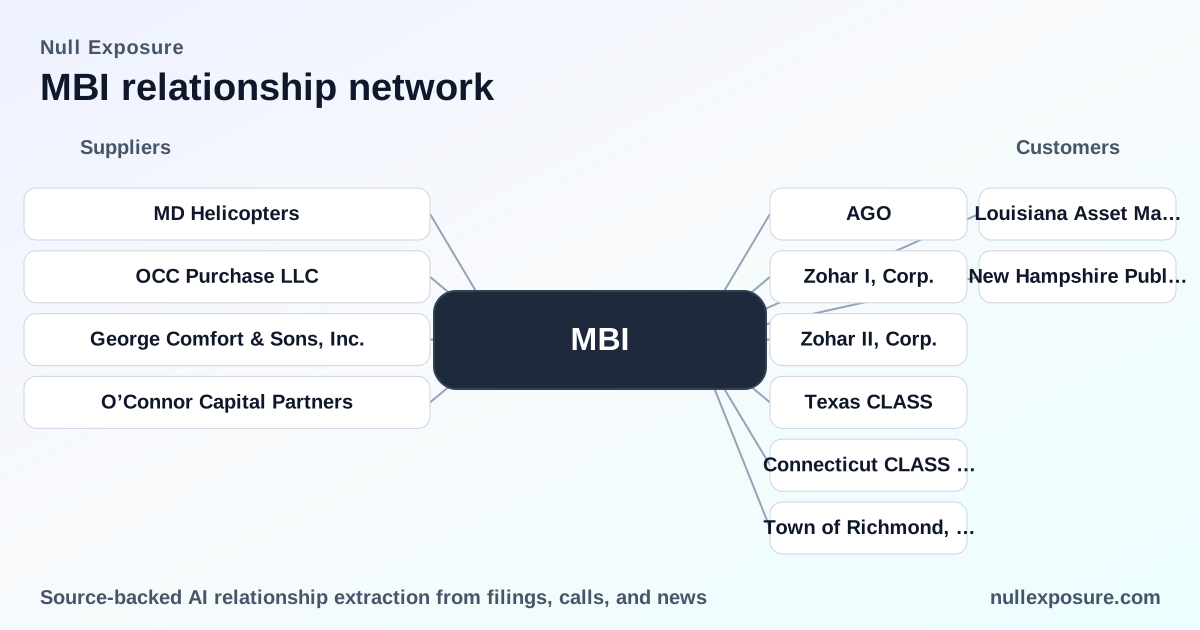
Below I summarize every supplier/counterparty relationship surfaced in the public record for MBIA in the provided results, with direct source references.
MD Helicopters
MBIA Insurance participated as a member of a creditor consortium led by Bardin Hill that agreed to purchase MD Helicopters’ assets in the company’s Chapter 11 process. This transaction reflects MBIA’s willingness to deploy capital in asset recovery and creditor-led buyouts as part of its broader risk-management toolbox. According to Vertical Magazine’s report on March 10, 2026, the consortium pledged new capital to strengthen MD Helicopters’ financial position.
OCC Purchase LLC
MBIA relocated its headquarters to The Centre at Purchase, a property owned by OCC Purchase LLC, indicating a long-term landlord relationship tied to corporate real estate and occupancy costs. A lohud.com story from April 21, 2014 documented MBIA’s move and named OCC Purchase LLC as the property owner.
George Comfort & Sons, Inc.
George Comfort & Sons is identified as a joint-venture partner in OCC Purchase LLC, placing it within MBIA’s landlord ecosystem for the Centre at Purchase headquarters. The lohud.com article dated April 21, 2014 lists George Comfort & Sons as a venture participant in the ownership group for the Centre at Purchase.
O’Connor Capital Partners
O’Connor Capital Partners is the co-investor alongside George Comfort in OCC Purchase LLC, and therefore a commercial landlord/capital partner in MBIA’s headquarters arrangement. The same April 21, 2014 lohud.com report names O’Connor Capital Partners as a member of the venture that owns The Centre at Purchase.
What the constraints reveal about MBIA’s operating model
The public constraint signals provide clear commercial intelligence at the company level:
- Service-provider dependency: MBIA explicitly outsources security monitoring and remediation and acknowledges operational risks from vendors and intermediaries. That contracting choice signals a reliance on third-party controls for cyber resilience and an exposure vector that requires vendor-risk governance from investors and counterparties.
- Material reinsurance cessions: The company-reported cession of roughly $1.5 billion in insurance in force (2024) is consistent with a spend band above $100 million for risk-transfer activity. This is not a peripheral function — reinsurance shapes MBIA’s effective exposure and capital efficiency and creates concentrated counterparty credit exposure.
- Negotiation and maturity implications: Outsourcing operational functions implies MBIA favors variable-cost, vendor-driven models for technology and security, while property commitments (headquarters move) reflect longer-duration financial relationships. Investors should separate short‑term, market‑priced reinsurance exposures from longer-term contractual commitments when stress-testing MBIA’s counterparty risk.
Explore MBIA supplier intelligence and comparative supplier risk analytics at https://nullexposure.com/.
How investors and operators should act on this map
- Treat reinsurance counterparties as balance-sheet counterparts: model counterparty rating deterioration and reinsurance reinstatement triggers, because MBIA’s right to reassume ceded business exists under specified conditions.
- Add vendor-operational scenarios to cyber and business-continuity stress tests: the company outsources monitoring and remediation functions, so a vendor failure or security incident could have outsized operational impact.
- For strategic counterparties such as landlords and asset purchasers, include contract duration and embedded capital commitments in valuation models; MBIA’s headquarters move evidences long-term occupancy relationships that affect fixed-cost base.
Bottom line: where the risk‑adjusted opportunity lies
MBIA is not a pure-play insurer divorced from supplier dynamics; its operating leverage is a function of how it selects reinsurers, outsources operational services, and structures property and asset investments. For investors, the critical inputs are reinsurer credit quality, vendor resiliency and the contractual terms that govern reassumption of ceded business. For operators and counterparties, MBIA’s profile signals disciplined risk-transfer behavior and a willingness to deploy capital into restructuring and asset recovery transactions.
If you evaluate counterparties or manage supplier risk for portfolio companies, start from MBIA’s reinsurance and vendor footprint and work outward. For continued supplier-level intelligence and tailored diligence, visit https://nullexposure.com/.
Key takeaways:
- Reinsurance is a principal lever in MBIA’s capital and exposure management; ceded insurance in force (~$1.5B in 2024) drives counterparty concentration risk.
- Operational outsourcing (security/IT monitoring) increases vendor dependency and requires active vendor governance.
- Public relationships include MD Helicopters (asset purchaser role) and a property/landlord group (OCC Purchase LLC, George Comfort & Sons, O’Connor Capital) tied to MBIA’s headquarters move.
For proprietary queries or to commission supplier risk analysis tailored to MBIA exposure scenarios, visit https://nullexposure.com/ for next steps.