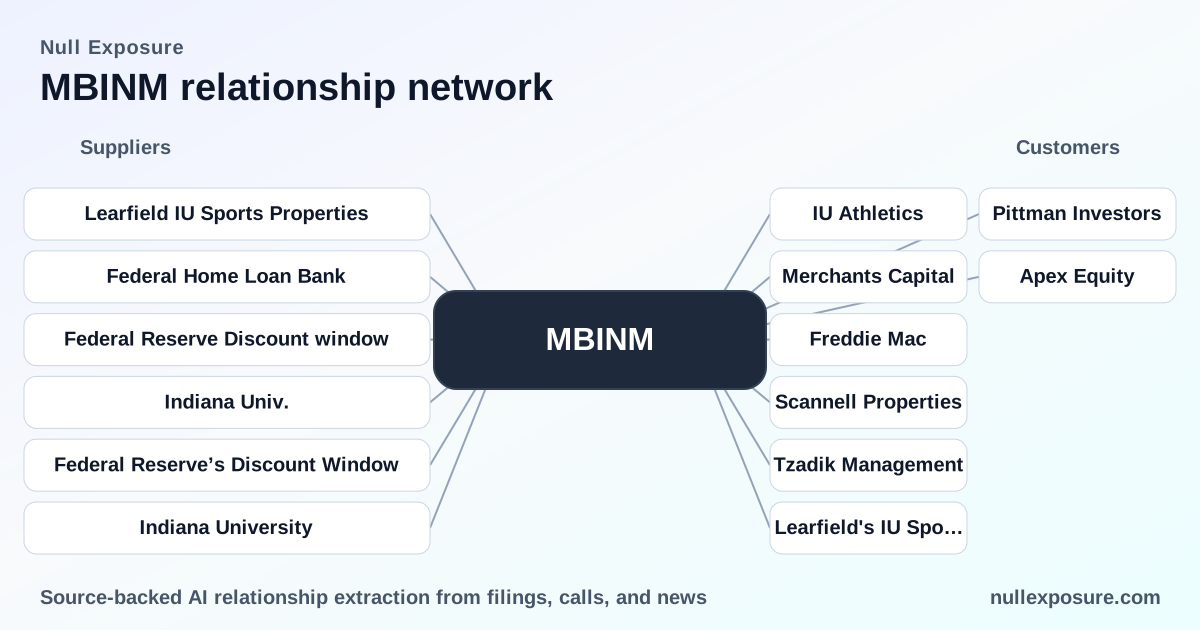
MBINM supplier relationships: liquidity backstops, brand deals, and what they mean for operational risk
Merchants Bancorp (MBINM) operates as a regional commercial bank that monetizes through traditional banking activities — lending, deposit gathering and fee income — while selectively monetizing brand value via sponsorships and naming rights. The company’s supplier profile is dominated by liquidity counterparties and service vendors that underpin core banking operations and a recently announced long-term marketing partnership that monetizes local brand recognition. Investors should evaluate both the funding and brand arrangements in the context of operational concentration and third‑party dependency. For further supplier intelligence and continuous monitoring, visit https://nullexposure.com/.
Why supplier relationships matter for bank investors
Banks run on two linked pillars: funding and operations. Counterparties that provide liquidity capacity are mission‑critical and directly affect solvency and growth optionality, while third‑party vendors that deliver core processing, servicing and digital channels drive day‑to‑day franchise performance. MBINM’s public disclosures and contemporary reporting show both types of relationships are active and materially consequential.
- Liquidity relationships provide immediate balance sheet flexibility and act as lenders of last resort for short‑term stress.
- Marketing and sponsorship relationships convert local franchise strength into fee and reputation value over the long term.
Visit https://nullexposure.com/ for a structured supplier risk profile and benchmarking tools tailored to financial institutions.
The roll call — every supplier relationship in the public results
Learfield IU Sports Properties
Merchants Bank agreed a 20‑year, $50 million naming‑rights partnership to brand Indiana’s playing surface as “Merchants Bank Field,” converting local brand equity into a long‑dated marketing asset. According to a local report dated August 21–22, 2025, the agreement was announced with Learfield IU Sports Properties handling the rights. (YouAreCurrent, Aug 22, 2025).
Indiana University (Memorial Stadium naming)
Indiana University confirmed the stadium naming element of the $50 million, 20‑year agreement, which renames the field at Memorial Stadium and embeds Merchants Bank into a high‑visibility community asset. Sports Business Journal covered the agreement on August 21, 2025, noting the commercial and community significance of the deal (Sports Business Journal, Aug 21, 2025). A separate local report echoed the same terms (YouAreCurrent, Aug 22, 2025).
Federal Home Loan Bank (funding counterparty)
Merchants disclosed sizeable unused borrowing capacity with the Federal Home Loan Bank: $5.9 billion in combined unused capacity with the FHLB and the Fed Discount Window, representing roughly 30% of total assets as of September 30, 2025, highlighting the FHLB as a strategically important funding partner. This figure was reported in the company’s third‑quarter 2025 release. (PR Newswire, Q3 2025 earnings release).
Federal Reserve Discount Window / Federal Reserve’s Discount Window (lender‑of‑last‑resort access)
Public reporting and industry coverage repeatedly cite the Federal Reserve’s Discount Window as a funding backstop for MBINM — company commentary and media coverage referenced $5 billion–$5.9 billion of available credit from the Discount Window and the FHLB in the same reporting window, underscoring active access to central‑bank liquidity facilities. (PR Newswire, Q3 2025 earnings release; TheRealDeal, Aug 20, 2025).
Note: Several news items reference the same liquidity relationships across different outlets; the combined reporting establishes both the scale and redundancy of MBINM’s funding channels (PR Newswire, TheRealDeal, Aug–Sep 2025).
What the relationships imply about MBINM’s operating model
MBINM’s supplier mix communicates a conservative, dependency‑aware posture:
- Contracting posture: The bank maintains formal access to large, high‑quality liquidity providers (FHLB and the Federal Reserve Discount Window), reflecting a banking model that secures redundancy for funding rather than relying solely on market deposits.
- Concentration and criticality: Access to the FHLB/Discount Window is critical to capital and liquidity resilience; those relationships are top‑tier counterparties and constitute significant operational concentration given their role as lenders of last resort.
- Maturity and duration: The naming‑rights sponsorship is a 20‑year commercial contract, indicating a long‑dated marketing commitment that spreads cost and brand upside over two decades; funding lines are longstanding institutional arrangements available as needed.
- Service dependency: Company disclosures identify core processing and digital banking as outsourced functions, highlighting active vendor relationships that are essential to operation continuity.
These points align with company‑level constraints disclosed in filings: third‑party service interruptions could be material; the company acts as a buyer of credit protection and uses operating leases; vendor cybersecurity and governance are actively monitored; and the bank depends on third parties for core systems and servicing.
Key risk takeaways for investors
- Funding resilience is strong but creates a dependency concentration. The combined unused capacity with the FHLB and the Discount Window represents meaningful optionality, but reliance on lender‑of‑last‑resort backstops creates a structural dependency that is material if funding markets deteriorate.
- Operational outsourcing elevates vendor risk. Board‑approved third‑party risk policies and periodic cybersecurity assessments are in place, yet disclosures state that prolonged third‑party interruptions could materially affect financial results.
- Long‑dated brand commitments change expense and revenue profiles. The 20‑year, $50 million naming rights agreement converts marketing spend into a long‑lived asset with reputational benefits, but it also commits capital over a multi‑decade horizon.
For targeted supplier due diligence, see https://nullexposure.com/ for coverage and monitoring tools.
Practical next steps for portfolio managers and operators
- Demand periodic confirmation of unused borrowing capacity levels and the contractual terms that govern FHLB and Discount Window access.
- Require vendor continuity plans and evidence of cybersecurity assessments for third‑party providers of core processing and digital services.
- Treat long‑term sponsorships as strategic investments: assess brand ROI under downside scenarios where franchise reach or deposit flows weaken.
For a full supplier mapping and continuous alerts on counterparties, visit https://nullexposure.com/.
Conclusion: MBINM’s public supplier footprint combines robust liquidity backstops with operational vendor dependencies and a substantial, long-term marketing commitment. Investors should value the funding redundancy but actively scrutinize third‑party operational controls and the long‑term economics of the naming‑rights agreement when sizing exposures.