Moleculin Biotech (MBRX): Supplier relationships that define product risk and capital strategy
Moleculin Biotech is a clinical-stage oncology and antiviral developer that monetizes through licensing of IP, sponsored research partnerships, and recurrent capital markets activity to fund operations and trials. The company outsources practically all manufacturing and early‑stage research to third parties and funds those collaborations through equity raises and warrant exercises; that combination makes supplier relationships both operationally critical and commercially material to value realization. For investors and operators evaluating Moleculin as a supplier counterparty, the most important takeaways are concentration of manufacturing, an exclusive licensing relationship tied to core chemistry, and the company’s reliance on investment banks and IR firms to secure ongoing liquidity. Learn more or track other supplier exposures at https://nullexposure.com/.
How Moleculin runs its supplier ecosystem — the operating model in plain English
Moleculin operates with a highly outsourced posture: no in‑house manufacturing, broad use of contract research organizations, and a mix of licensed IP plus sponsored research to advance candidates. That posture creates compact advantages (lower fixed cost, faster trial scale-up) and concentrated risks (single‑source suppliers for critical APIs, limited internal fallback options).
- Contracting posture: Moleculin contracts out manufacturing and trial execution and records accrued expenses for these third parties, signaling routine use of external service providers rather than vertical integration.
- Concentration and criticality: The company discloses a single source for the active pharmaceutical ingredient (API) for its lead candidate, Annamycin; loss of that supplier would cause delays while a replacement is found. This single-supplier dynamic is operationally critical and elevates supplier‑risk premia for investors.
- Maturity and spend profile: Sponsored research with academic partners (notably MD Anderson) has been significant; the company recognized roughly $2.0 million in expenses under these agreements in 2024, placing core supplier spend comfortably in the $1m–$10m band.
- Commercial model signals: Licensing arrangements convey downstream royalty potential; Moleculin holds royalty‑bearing rights from a university licensor for a key portfolio, which aligns incentives between academic IP holders and the company.
These characteristics mean that supplier diligence for Moleculin is as much about intellectual property and research continuity as it is about traditional manufacturing capacity and quality.
Relationship readouts — who does Moleculin rely on and what they do
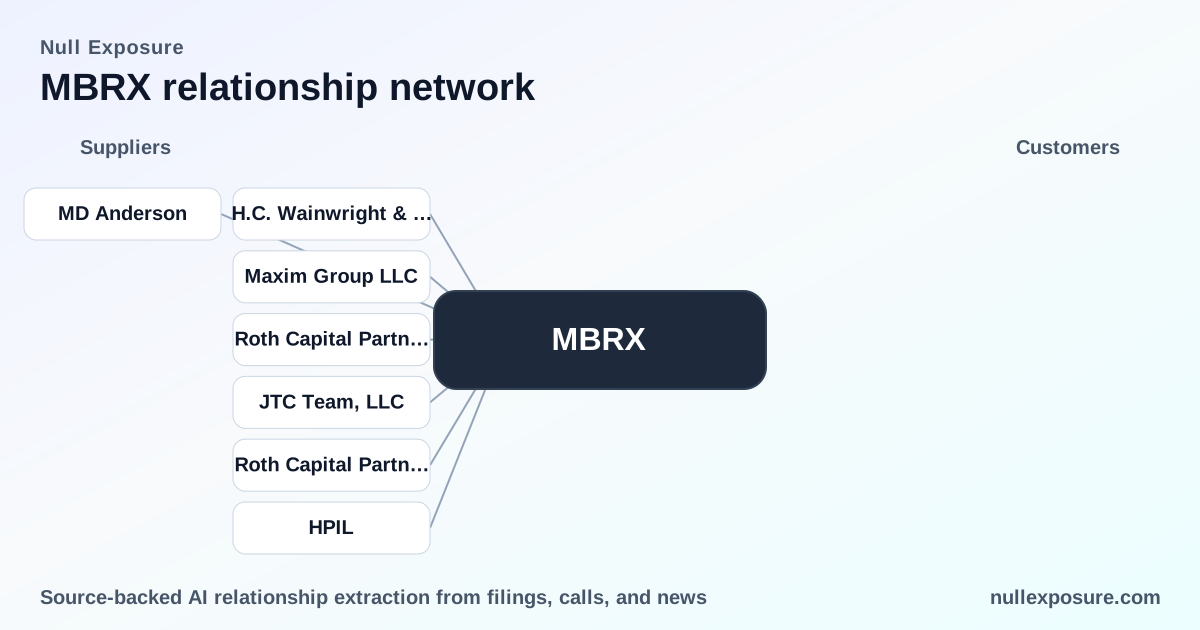
Below are every relationship captured in recent disclosures and press coverage. Each entry is a concise, investor‑oriented read with the source noted.
H.C. Wainwright & Co.
H.C. Wainwright served as the exclusive placement agent on Moleculin’s public offering used to raise liquidity in early 2026, underscoring the company’s reliance on boutique investment banks for capital raises. According to a Quantisnow release on March 10, 2026, H.C. Wainwright acted as the exclusive placement agent for the offering (FY2026).
Maxim Group LLC
Maxim Group acted as a financial advisor on financing activity, including advisory roles referenced across transactions in FY2025–FY2026; this signals use of multiple advisory relationships to syndicate and advise on capital markets transactions. A QuiverQuant notice (FY2025) and a Quantisnow summary (FY2026) list Maxim Group as a financial advisor.
Roth Capital Partners
Roth Capital Partners has functioned as a financial advisor and was named in reports about immediate warrant exercises and public offerings, indicating a repeated advisory role on corporate financing matters. QuiverQuant’s FY2025 filing notes Roth Capital Partners as a financial advisor on a warrant exercise transaction and Quantisnow cites Roth in FY2026.
JTC Team, LLC
JTC Team operates as Moleculin’s investor relations contact and press liaison across multiple press releases, which centralizes external communications and investor outreach through a single IR firm. Globenewswire press releases (January–February 2026) and a BioSpace release (FY2026) identify JTC Team, LLC and Jenene Thomas as the listed investor contact.
HPI (HPIL)
Moleculin disclosed that proceeds from equity offerings will sponsor research at HPI, making HPI a sponsored‑research partner or funded collaborator in the development plan. A Quantisnow release (March 10, 2026) states that net proceeds from the offering were intended to sponsor research at MD Anderson and HPI (FY2026).
MD Anderson
MD Anderson is both a licensing and sponsored‑research partner: Moleculin holds a royalty‑bearing, worldwide exclusive license to MD Anderson’s patent and technology rights for the WP1066 portfolio and concurrently runs sponsored research agreements with the institution. Company filings and disclosures describe the license arrangement and sponsored research, and the company recorded roughly $2.0 million in expenses under agreements mainly related to MD Anderson for 2024 (company filing disclosures and Quantisnow, FY2026).
What this means for investors and operators — risk and opportunity distilled
The supplier fabric around Moleculin is dominated by three dynamics: manufacturing concentration, academic licensing/research dependence, and capital‑markets reliance. Each has clear implications.
- Operational risk is concentrated. The single‑source API disclosure for Annamycin elevates near‑term execution risk. If the named API supplier exits, clinical timelines will slip while a GMP replacement is qualified.
- IP and research partnerships are central to value. The exclusive license from MD Anderson for the WP1066 portfolio and the multi‑million dollar sponsored‑research spend make academic relationships core to the company’s pipeline progression and potential future royalties.
- Capital access drives strategy. Frequent use of placement agents and financial advisors (H.C. Wainwright, Roth, Maxim) and the exercise of warrants to secure proceeds show that Moleculin’s operational runway is materially driven by capital markets activity rather than product revenues.
Key investor takeaways are straightforward: monitor supplier diversification for API manufacturing, track the status and renewal of the MD Anderson sponsored‑research agreements, and factor transaction costs and dilution from future financings into cash‑runway scenarios.
If you are evaluating counterparty risk or preparing supplier audits, prioritize confirmation of alternate API manufacturers, review the MD Anderson license terms for milestone/royalty triggers, and include the IR firm (JTC Team) and capital advisors in stakeholder mapping. Explore tooling and continuous monitoring for these relationships at https://nullexposure.com/.
Actionable next steps for diligence
- Obtain current verification that alternate GMP API suppliers exist and can be qualified within acceptable timelines.
- Review the MD Anderson license (royalty rates, exclusivity carve‑outs, sublicensing rights) and the timeline for sponsored research extensions.
- Review recent financing terms and advisor engagements to model likely dilution under stress scenarios.
For ongoing monitoring and a consolidated view of Moleculin’s supplier exposures, visit https://nullexposure.com/ — the site aggregates relationship signals and constraint indicators useful for underwriting and portfolio surveillance.
Closing assessment
Moleculin’s supplier map is coherent with a clinical‑stage biotech that outsources development and relies on academia and capital markets to progress candidates. The chief risks—single‑source API manufacturing and concentrated academic dependence—are addressable but material, and they should be priced into any investment or contractor bid. Operational teams and investors should prioritize supplier redundancy planning and maintain active oversight of MD Anderson agreements and financing trajectories.