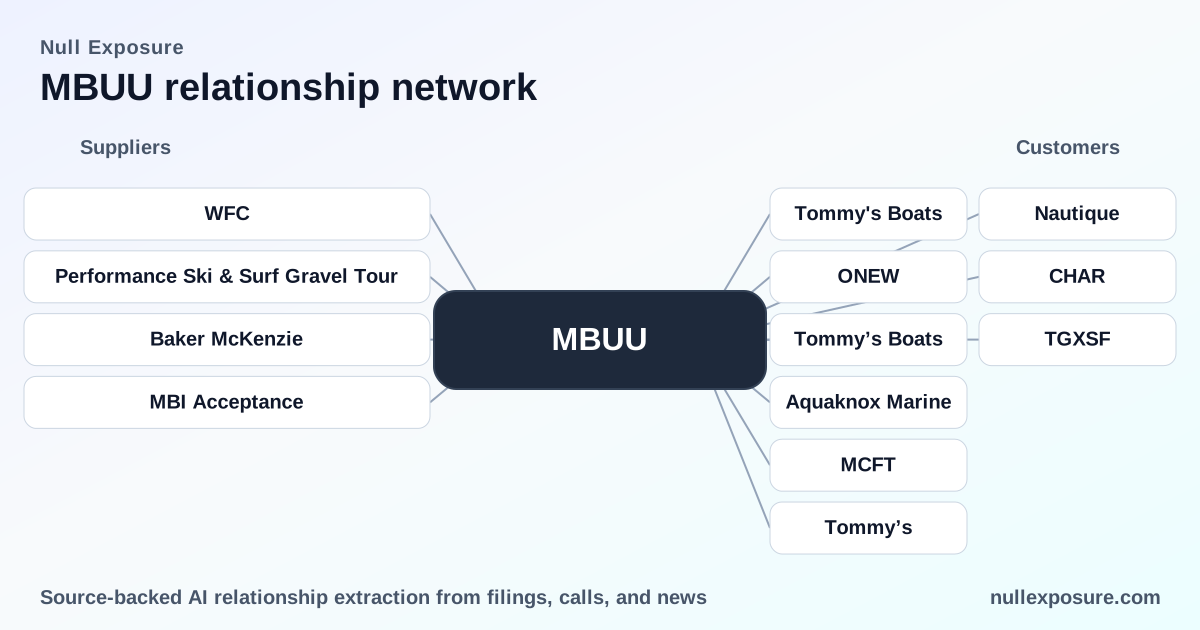
MBUU Supplier Profile: Strategic Relationships and Operational Constraints
Malibu Boats (MBUU) operates as a vertically-focused recreational marine manufacturer that monetizes through boat sales across multiple brands and by capturing finance margin through a white‑label lending vehicle. The company accelerates growth with targeted acquisitions funded and advised by large financial partners, and it offsets dealer friction with in‑house financing to improve conversion and aftermarket opportunities. For investors, the supplier story is less about raw‑material contracts and more about supply flexibility, global sourcing exposure, and reliance on third‑party advisors and service providers.
Read more company relationship intelligence at https://nullexposure.com/ for a consolidated view of counterparties and exposures.
Quick take: what matters to an investor evaluating MBUU suppliers
MBUU runs a short-term contracting posture for most component suppliers, sources a meaningful but not dominant share of costs internationally, and uses external service providers for specialization (e.g., legal, cybersecurity, M&A advisory). Those characteristics translate into operational flexibility and manifest external risk vectors—notably tariff and logistics exposure and dependency on professional advisors during strategic transactions.
Operating model and business‑model constraints you should factor into valuation
- Contracting posture (short‑term): Management discloses it historically avoids long‑term supplier commitments except for engines and outboard motors. That structure preserves price flexibility and capacity to re‑source, but it elevates exposure to commodity inflation, supplier capacity shocks, and single‑sourcing surprises.
- Geography and supply concentration (global exposure): About 18–20% of cost of sales are sourced from outside the U.S., creating direct tariff and cross‑border logistics sensitivity that feeds gross‑margin volatility during trade disruptions.
- Third‑party service reliance: The company systematically engages external professional service providers for legal, cybersecurity, and other specialist roles, which reduces fixed overhead but creates outsourcing dependency for high‑impact functions.
These are company‑level signals: they describe MBUU’s operating posture and supplier risk profile separate from any single counterparty.
Who MBUU is working with now — concise, referenced notes
Below are every relationship captured in the recent results, with a one‑ to two‑sentence plain‑English note on role and relevance.
Wells Fargo — strategic financial adviser on M&A
Wells Fargo served as the exclusive financial advisor to Malibu Boats in the company’s acquisition activity tied to the Saxdor deal, signaling use of large‑scale investment banking capability for strategic expansion. This engagement was reported in a Sahm Capital news release covering the March 2026 transaction announcement.
Baker McKenzie — legal counsel on transactions
Baker McKenzie acted as legal counsel in the same acquisition process, providing cross‑border transactional and regulatory support that underpins Malibu’s international expansion. Sahm Capital’s March 2026 release names Baker McKenzie in that advisory role.
Performance Ski & Surf Gravel Tour — brand and marketing partner
Malibu Boats partnered with the Performance Ski & Surf Gravel Tour to promote product usage and brand visibility, towing riders behind the M230 across wakeboard, wakesurf and foil disciplines as part of customer engagement and experiential marketing. This partnership was described in a GlobeNewswire release in February 2026 recognizing customer satisfaction initiatives.
MBI Acceptance — white‑label financing partner (in‑house program)
MBI Acceptance represents Malibu’s white‑label financing capability, rolled out across the company’s brands to improve the customer purchase experience and support dealer conversion; management highlights this as an ongoing strategic distribution and margin capture lever. That program and its dealer rollout were discussed in Malibu’s fiscal Q2 2026 results reported via GlobeNewswire and summarized in a Manila Times article in February 2026.
What these relationships signal about supplier risk and strategic optionality
- Advisory and legal partners (Wells Fargo, Baker McKenzie): The use of top‑tier advisers for M&A underscores management’s appetite for inorganic growth and the need for sophisticated counterparties to manage deal execution and regulatory complexity. That external advisory spend is non‑recurring but critical for successful integration and cross‑border risk mitigation.
- Marketing and channel partnerships (Performance Ski & Surf): Tactical brand partnerships support demand generation and product positioning rather than core supply, but they increase the importance of reliable product delivery and seasonal supply planning.
- Captive/white‑label financing (MBI Acceptance): Owning the financing channel increases lifetime customer value and dealer stickiness, shifting some counterparty risk from third‑party lenders to Malibu’s balance sheet and credit processes.
Key takeaway: Malibu’s supplier and partner mix maximizes market reach and strategic flexibility while concentrating operational risk in short‑term sourcing and global supply chains.
Read a full counterparty risk profile and track updates at https://nullexposure.com/.
Investor implications and monitoring checklist
MBUU’s structure creates both upside and vulnerability. On the positive side, white‑label financing and active M&A advisory relationships are value enhancers, improving gross margins and accelerating brand scale. On the risk side, short supplier contracts plus ~18–20% foreign procurement expose margins to tariff, FX, and logistics shocks. Reliance on service providers reduces internal fixed cost but increases execution risk for cybersecurity and legal compliance.
Watch these triggers closely:
- Procurement metrics: vendor concentration and engine/outboard contract terms.
- Tariff and freight trends affecting the 18–20% of externally sourced cost of sales.
- Rollout progress and credit metrics for MBI Acceptance—performance here converts sales into finance income.
- Any change in advisory counsel or escalation in legal/regulatory issues around acquisitions.
Bottom line: what to do next
MBUU’s supplier posture is deliberately flexible and backed by scale‑oriented financial and legal partners, but investors should price in supply volatility and cross‑border exposure when modeling margins. For a concise, ongoing view of MBUU counterparties, agreements, and constraint signals, visit https://nullexposure.com/ and sign up for alerts.
Actionable next steps:
- Monitor quarterly disclosures for changes to supplier contract durations and percentage of non‑U.S. sourcing.
- Track MBI Acceptance delinquency and penetration rates as a driver of future finance income.
- Follow advisory/legal engagement disclosures around any additional M&A to assess integration risk.
For an up‑to‑date supplier network and to receive alerts when these counterparties or constraints change, go to https://nullexposure.com/.