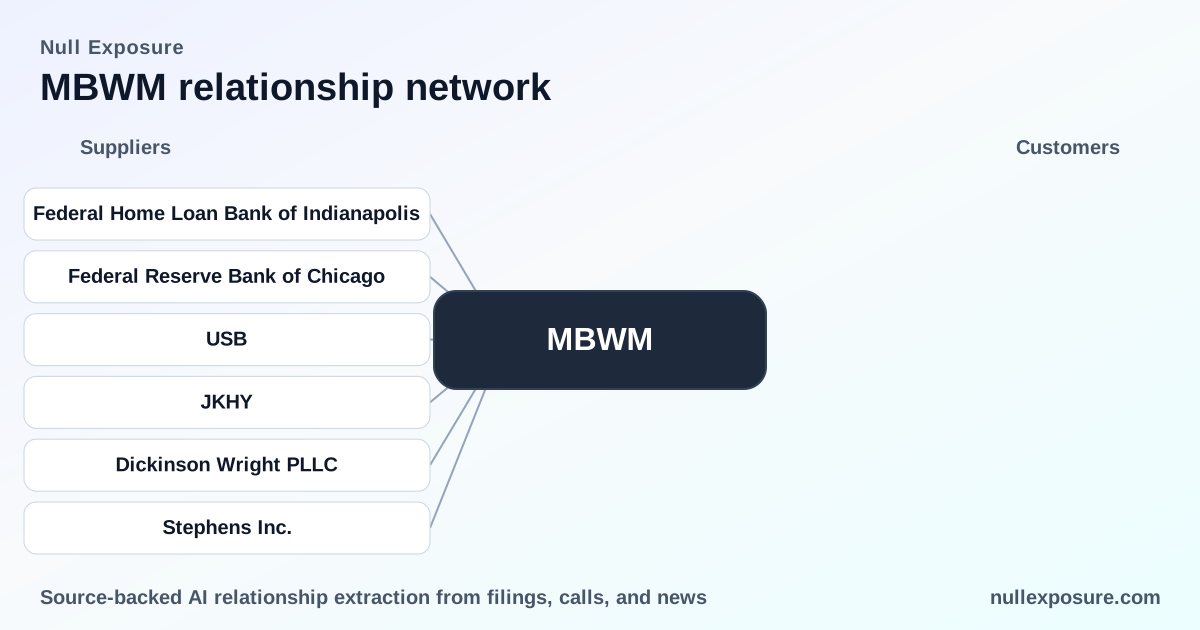
MBWM Supplier Landscape: Key counterparties, dependencies, and what investors should price in
Mercantile Bank of Michigan (MBWM) operates as a regional commercial bank that monetizes through net interest margin on lending and asset yields, supplemented by fee income; its supplier footprint reflects typical banking dependencies—liquidity lines, central bank balances, core technology migration, and professional advisors. MBWM’s supplier relationships indicate a funding mix that leans on both correspondent lending and central bank balances, plus a planned technology upgrade that will reset operational risk and vendor concentration over the next 18 months. For deeper supplier risk profiles and exposure mapping, visit the Null Exposure homepage: https://nullexposure.com/.
How these relationships translate to shareholder economics
MBWM’s funding and clearing partners directly influence interest expense, liquidity flexibility and the stability of funding costs. Lower advance balances from the Federal Home Loan Bank of Indianapolis reduced interest expense in 2025, while balances at the Federal Reserve Bank of Chicago contribute a steady interest-income base. The planned core conversion to Jack Henry is a material operational event with cost, schedule, and integration risk that will determine near-term efficiency gains. Mid-deal financing from U.S. Bank indicates reliance on external term financing to execute acquisitions. For an operational supplier map and counterparty concentration report, see https://nullexposure.com/.
Counterparties and what they mean for MBWM
Federal Home Loan Bank of Indianapolis
Federal Home Loan Bank advances are a source of wholesale funding for MBWM; interest expense on these advances declined in 4Q2025 and through 2025 due to a lower average balance, which supports an improved funding cost profile for that period. This was disclosed in MBWM’s 2025 Q4 earnings call.
Federal Reserve Bank of Chicago
MBWM holds significant funds on deposit with the Federal Reserve Bank of Chicago, and interest income on other earning assets is materially driven by those deposits, providing a stable, low-risk yield component to the bank’s asset mix, as noted in the 2025 Q4 earnings call.
U.S. Bank (USB)
MBWM secured a $30.0 million term loan from U.S. Bank to fund the EFIN merger and working capital, signaling reliance on third‑party commercial lending to finance inorganic growth and short-term capital needs. This transaction was reported by TradingView in March 2026 as part of MBWM’s FY2026 financing activity.
Jack Henry (JKHY)
MBWM will upgrade its core banking system to Jack Henry, leveraging Eastern Michigan Financial’s long experience to operationalize the conversion targeted for completion by Q1 2027; this is a strategic vendor decision that will centralize core processing and is a potential source of near-term integration risk and long-term operational leverage, according to a Pulse2 report on the merger announcement in FY2025.
Dickinson Wright PLLC
Dickinson Wright served as Mercantile’s legal advisor on the merger, providing transactional legal services and regulatory support during deal execution, as reported in the Pulse2 announcement of the Mercantile and Eastern Michigan Financial merger in FY2025.
Stephens Inc.
Stephens Inc. acted as financial advisor to Mercantile, executing valuation, structuring and sale-side advisory services; this relationship reduces execution risk on M&A strategy but also signals external dependence for deal origination and structuring, according to the same FY2025 Pulse2 coverage.
Company-level constraints and operational posture
MBWM’s disclosed constraints offer direct insight into how it manages third-party risk and balance sheet hedging:
- MBWM contracts external managed detection and response services to monitor information systems 24/7 and provide instantaneous alerting for cybersecurity events, which indicates a defensive contracting posture and recognition of cyber as a critical operational risk.
- The bank uses interest rate swaps with commercial customers and offsets those swaps with correspondent banks, demonstrating active balance-sheet management and a hedging strategy that introduces counterparty exposure to correspondent banks.
These are company-level signals—they describe MBWM’s operational model: outsourced security monitoring, active derivative use for hedging, and correspondent relationships for risk transfer. Together they imply moderate supplier concentration (core banking with Jack Henry, liquidity via FHLB/US Bank), criticality of select vendors, and an operational maturity that relies on established financial counterparties and specialized service providers.
Key investment implications and risk vectors
- Funding flexibility improved in 2025 as FHLB advances declined, lowering interest expense; however, reliance on term loans for acquisitions adds refinancing and covenant risk.
- Core conversion (Jack Henry) is a binary operational event—success drives efficiency; failure risks service disruption and incremental costs.
- Cybersecurity is outsourced but treated as mission-critical, which reduces staffing costs but concentrates security dependence on third-party performance guarantees and SLAs.
- Swap activity and correspondent offsets signal active duration management, which compresses reported margin volatility but creates counterparty concentration risk with correspondent banks.
For a deeper quantitative exposure analysis and supplier concentration scoring, visit our platform: https://nullexposure.com/.
Short checklist for due diligence on MBWM supplier risk
- Confirm the structure and covenants of the U.S. Bank term loan and its interplay with merger financing.
- Validate the timing and cutover plan for Jack Henry migration and third-party vendor support.
- Review swap counterparty exposure and any credit support annexes with correspondent banks.
- Examine MDR contract SLAs, incident history, and escalation paths to assess cyber resiliency.
Final takeaways and next steps
MBWM’s supplier map is purposeful: liquidity and hedging relationships optimize net interest margin, while the Jack Henry core conversion is designed to deliver operational scale. Legal and financial advisors reduced transactional friction on the merger, but the bank’s reliance on outside cybersecurity and correspondent swap counterparties concentrates operational and counterparty risk in a small set of external firms. Investors should weight improved funding dynamics against integration and refinancing exposure when modeling forward earnings.
For tailored counterparty exposure reports and detailed supplier scoring on MBWM, visit Null Exposure: https://nullexposure.com/.