Metropolitan Bank (MCB) — supplier relationships and what they signal for investors
Metropolitan Bank Holding Corp. operates as a regional bank holding company that originates loans, gathers deposits, and accesses capital markets to fund balance-sheet growth; it monetizes through net interest income, fee revenue and periodic capital raises that support liquidity and regulatory capital ratios. For an investor evaluating MCB’s supplier posture, the relevant signals are its use of established capital markets underwriters, an external credit- and risk-assessment relationship, and a formal third‑party risk program that governs critical outsourced functions. Learn more or run a focused supplier exposure review at https://nullexposure.com/.
Why supplier relationships matter for a bank holding company
Banks are service businesses built on counterparties and infrastructure. Supplier relationships for a bank are simultaneously operational, regulatory and reputation-critical — underwriters and ratings agencies affect funding access and market confidence while outsourced operations (for example FX conversion) are operationally critical and require strong oversight.
Key operating-model characteristics to weigh:
- Contracting posture: MCB runs a formal Third‑Party Risk Management (TPRM) program that vets and monitors providers, indicating a structured contracting and oversight stance rather than ad hoc outsourcing.
- Criticality and concentration: The company outsources FX conversion to correspondent banks, a high‑criticality function where single‑vendor or narrow‑market concentration could create operational vulnerability.
- Maturity of vendor governance: The existence of an identified TPRM officer and ongoing independent audits signals an enterprise‑level, mature approach to vendor governance.
- Market-channel partnerships: Use of established book‑running managers for public offerings demonstrates active management of capital‑markets relationships to maintain liquidity and investor access.
These characteristics combine to present a supplier posture that is structured and governance‑driven, but with operational dependencies that require monitoring — particularly for FX flows and capital‑markets execution. If you need a deeper, supplier-level review for underwriting or counterparty exposure, see https://nullexposure.com/.
What MCB’s specific supplier relationships tell investors
Below are the relationships surfaced in the public record; each entry includes a concise, plain‑English take and the original source.
-
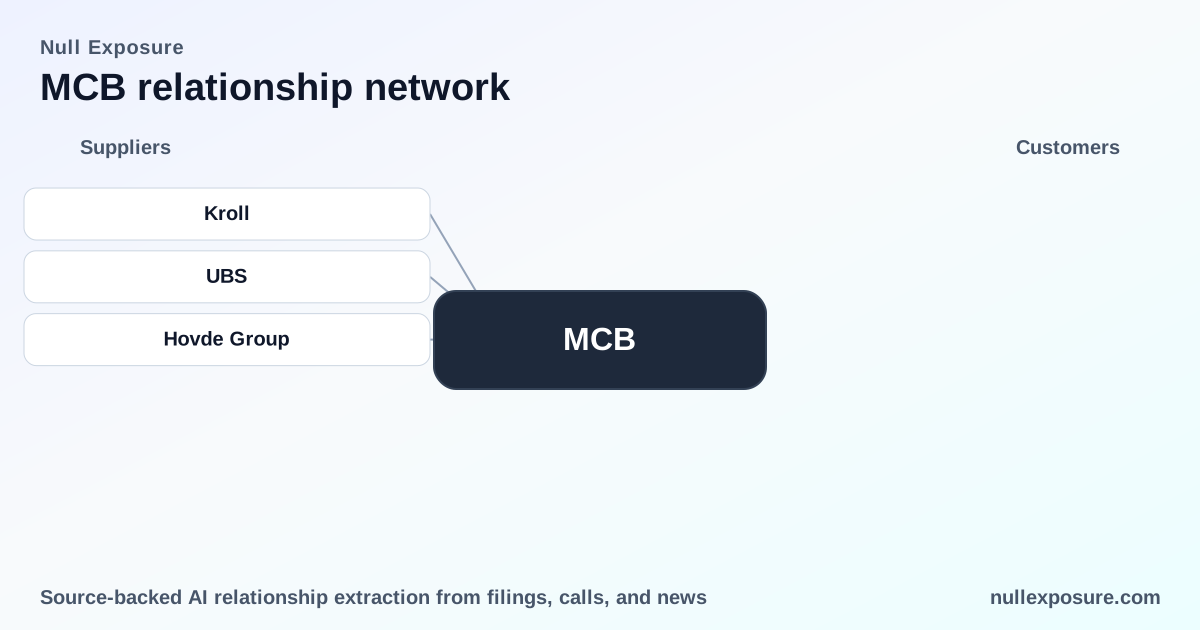
Kroll — Kroll affirmed a BBB+ deposit rating for the company on January 29, 2025, an input that contributes to market perceptions of MCB’s creditworthiness and cost of funds; this rating was noted in coverage tied to the company’s 2025 earnings release schedule. According to a FinancialContent distribution referencing the firm’s earnings notice, Kroll maintained the BBB+ deposit rating (FinancialContent/BiZwire, Jan 2026). https://markets.financialcontent.com/gatehouse.rrstar/article/bizwire-2026-1-9-metropolitan-bank-holding-corp-schedules-fourth-quarter-and-full-year-2025-earnings-release-and-conference-call-dates
-
UBS Investment Bank — UBS served as a joint book‑running manager on MCB’s public offering, signaling the bank’s use of a top‑tier capital markets partner to execute equity or debt issuance and bolster market liquidity. The underwriter selection was disclosed in coverage of the offering pricing (Intellectia, FY2026). https://intellectia.ai/news/stock/metropolitan-bank-announces-pricing-of-public-offering
-
Hovde Group — Hovde Group also served as a joint book‑running manager alongside UBS, indicating a blended underwriting syndicate that pairs a larger global bank with a specialist boutique to execute the transaction and support distribution. This placement was described in the same offering coverage (Intellectia, FY2026). https://intellectia.ai/news/stock/metropolitan-bank-announces-pricing-of-public-offering
How these relationships affect capital access and operational risk
Together, these supplier interactions reveal a two‑track supplier strategy: market-access partnerships with underwriters to manage funding and liquidity, and outsourced operational services governed through a TPRM function. That combination produces the following investor implications:
- Funding and liquidity: Using UBS and Hovde as joint book‑running managers demonstrates access to both broad distribution and specialist placement capabilities, which lowers execution friction when MCB raises capital and supports secondary liquidity for shareholders.
- Credit signal: An external affirmation such as Kroll’s BBB+ deposit rating provides an independent market signal that influences depositors and wholesale funders; investors should track subsequent rating actions for directional insight into funding cost trends.
- Operational dependency: Outsourcing FX conversion to correspondent banks is operationally important; the company’s TPRM program mitigates but does not eliminate counterparty operational risk, settlement risk, or concentration risk if the set of correspondent providers is narrow.
- Governance strength: Regular independent audits and an identified TPRM officer indicate disciplined vendor governance that reduces the likelihood of unmanaged third‑party exposures escalating into regulatory or operational incidents.
If you want to convert these signals into an actionable exposure map for underwriting or portfolio monitoring, start a tailored review at https://nullexposure.com/.
A short due‑diligence checklist for investors
- Confirm the terms and fees of recent underwritten offerings and whether managerial support included market stabilization or sell‑down commitments.
- Review the scope and cadence of the TPRM program: frequency of independent audits, remediation timelines and escalation paths to the board.
- Validate the correspondent bank roster for FX conversion and the degree of concentration across providers; ask for contingency arrangements for disrupted FX rails.
- Track rating timelines from agencies like Kroll and any associated outlook changes tied to regulatory capital or asset quality movements.
Final assessment and next steps
MCB’s supplier picture is balanced between capital‑market sophistication and operational outsourcing. The engagement of reputable underwriters (UBS and Hovde) strengthens funding optionality and market confidence, while Kroll’s BBB+ affirmation provides a positive credit anchor. The formal TPRM program and independent audits indicate a mature vendor governance posture, but the reliance on correspondent banks for FX conversion requires active monitoring for concentration and settlement risk.
For investors and operators conducting counterparty or vendor exposure analysis, prioritize verification of correspondent‑bank concentration and TPRM execution records. To commission a targeted supplier exposure assessment or to integrate these supplier signals into your investment due diligence, visit https://nullexposure.com/.
Bold takeaway: MCB combines credible capital‑markets partners and disciplined vendor governance, but operational dependencies on correspondent banks for FX conversion create a concentrated point of exposure that needs active oversight.