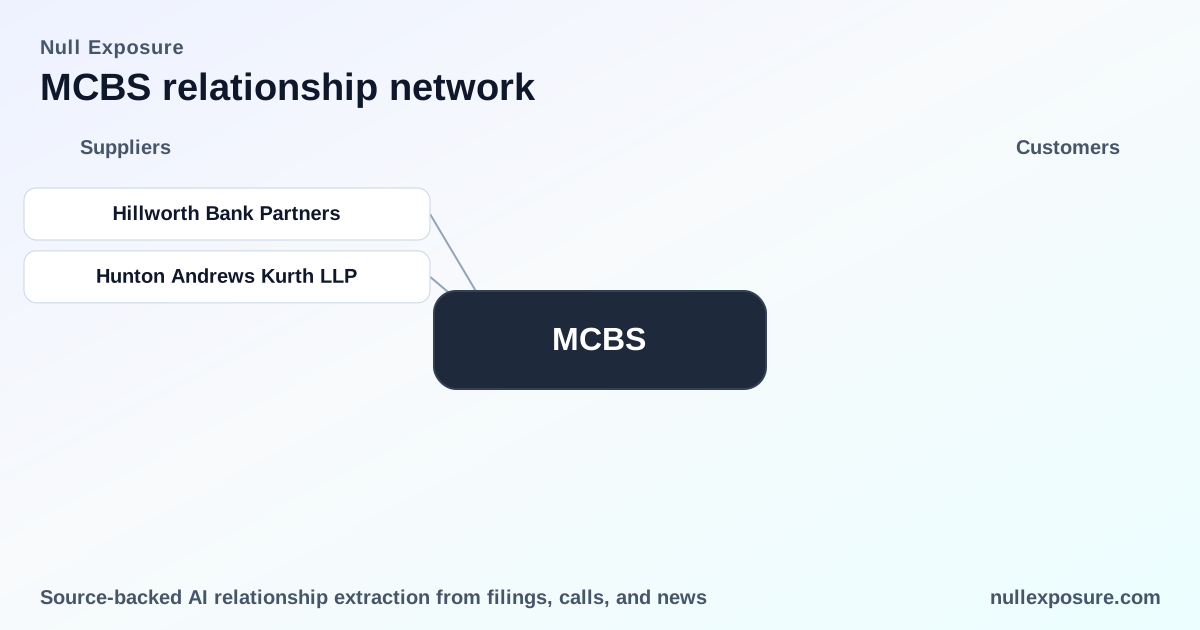
MCBS supplier map: counsel, advisors and contract signals investors should price
MetroCity Bankshares (MCBS) operates as a banking organization with branch-based retail distribution and an active balance-sheet management function; it monetizes through interest margin and fee income while managing liquidity with wholesale funding and hedging programs. The public record for supplier relationships is narrow but strategic: external financial advisors and national legal counsel for a transaction, plus long-dated real‑estate leases, Federal Home Loan Bank and Federal Reserve access, and active interest-rate hedges that shape funding cost and earnings volatility. For immediate access to the underlying coverage and relationship tracking, visit https://nullexposure.com/.
What the visible suppliers reveal about how MCBS runs the firm
MCBS’s disclosed suppliers and the related footnote language create a concise picture of operating posture that investors can translate into risk and return drivers.
- Contracting posture — long-term occupancy commitments. The company has operating leases for branch locations with terms extending through October 2033 and typical initial terms up to ten years with renewal options. This signals a deliberate branch footprint strategy with multi-year fixed cost exposure reported in lease footnotes to its financial statements for the periods ending 2024.
- Funding counterparties — institutional government channels matter. MCBS reported Federal Home Loan Bank (FHLB) advances and substantial Federal Reserve Discount Window availability as of December 31, 2024 and 2023, showing reliance on wholesale, government‑linked liquidity corridors.
- Risk management — active interest‑rate hedging. The company has swap agreements designated as cash‑flow hedges of deposit accounts indexed to the Federal Funds Effective Rate and states the hedges are highly effective and expected to remain so for their remaining terms.
- Spend scale — material but not outsized facility costs. Lease cost disclosures place operating lease spend in the $1 million–$10 million band, which aligns with a regional bank operating model where real‑estate costs are meaningful but subordinate to funding and credit line risk.
Collectively, these signals describe a bank with structural fixed costs, reliance on government-linked wholesale liquidity, and an implemented hedging program—factors that determine sensitivity to rate cycles, branch strategy durability, and short‑term survivability under stress.
Advisor and counsel named in public notices
Below are the specific external suppliers named in the public coverage provided for MCBS.
-
Hillworth Bank Partners acted as the financial advisor to MetroCity and rendered a fairness opinion to its board of directors in connection with the announced transaction. This role confirms Hillworth’s position as the primary transaction advisor in the deal process (SahmCapital news release, Nov 14, 2025: https://www.sahmcapital.com/news/content/metrocity-bankshares-inc-and-first-ic-corporation-announce-expected-closing-date-2025-11-14). Hillworth provided a formal fairness opinion for the board.
-
Hunton Andrews Kurth LLP served as legal counsel to MetroCity in the announced transaction, providing outside counsel support for regulatory and transactional matters (SahmCapital news release, Nov 14, 2025: https://www.sahmcapital.com/news/content/metrocity-bankshares-inc-and-first-ic-corporation-announce-expected-closing-date-2025-11-14). Hunton handled the legal workstream for the company.
These two relationships are transactional and operationally significant for corporate actions; their presence in public notices confirms external reliance for deal execution and legal risk mitigation.
How the contractual constraints translate into investor risk factors
The footnote language and constraint excerpts provide clear, investable signals about concentration, criticality, and maturity.
-
Concentration and criticality: Reliance on FHLB advances and material availability in the Federal Reserve Discount Window indicate that MCBS’s liquidity profile is partly dependent on institutional government facilities. This structure reduces refinancing risk in normal cycles but creates counterparty concentration tied to bank-system utilities and associated covenant or collateral demands. The company reported total FHLB advances of $375,000 and Discount Window availability figures in its year‑end 2024 notes, underscoring those lines of support.
-
Maturity profile: Long-dated branch leases through 2033 show a multi-year fixed‑cost base, increasing operating leverage in a persistent low-rate environment and adding exit costs if the franchise needs to shrink or re‑optimize physical distribution.
-
Hedging maturity and effectiveness: The explicit designation of swaps as cash‑flow hedges for deposit accounts and the company’s statement that these hedges are highly effective is a direct signal of active balance‑sheet risk management. For investors, this reduces headline earnings volatility from short-term rate moves but creates basis risk and counterparty exposure embedded in swap counterparties and collateral requirements.
-
Spend profile: Operating lease cost entries place the company’s branch real‑estate spend in the $1M–$10M band, which is material enough to affect operating leverage but not large enough to dominate capital allocation decisions.
For deeper diligence on these points, review the company’s lease schedules, hedging agreements, and FHLB advance covenants in the next quarterly filing cycle; our platform tracks these items in near‑real time at https://nullexposure.com/.
Investment implications: what to price in now
Price MCBS with three structural elements front‑of‑mind. First, liquidity optionality from FHLB and the Discount Window is a strategic asset that reduces the probability of a cash‑flow crisis but concentrates dependency on government-sponsored facilities. Second, fixed branch commitments imply that any revenue compression will hit operating leverage and depress margins faster than for a branch-light competitor. Third, active hedging reduces short-term earnings volatility but introduces counterparty and basis considerations that impact economic capital and stress‑testing outcomes.
These dimensions affect valuations and credit spreads: banks with similar lease footprints but lower access to government facilities should trade with wider funding spreads; banks with similar wholesale access but fewer fixed costs should command premium multiples. Analysts must interrogate the scale and terms of the swap collateral and the precise maturity ladder of the FHLB advances to refine those relative-value conclusions.
Practical next steps for analysts and operators
- Pull the lease schedule and the notes describing renewal options in the latest 10‑K/10‑Q to quantify embedded exit costs and contingent rental obligations.
- Obtain the full text of the swap agreements and collateral provisions to model margin compression scenarios and counterparty exposure.
- Review FHLB advance covenants and collateral requirements to stress-test liquidity under deposit flight scenarios.
For structured monitoring of these relationships and ongoing supplier signals, visit our research hub at https://nullexposure.com/. For portfolio-level subscription and alerting on MCBS supplier changes, sign up at https://nullexposure.com/.
Bottom line
MCBS’s disclosed supplier footprint is compact but strategically significant: advisory and legal counsel for transactions, long-dated branch leases, reliance on government liquidity lines, and an active hedging program. Investors should price in the cost of fixed-branch commitments and the benefits and concentration risk of government-linked funding while using detailed hedging and lease schedules to refine earnings‑at‑risk under rate and deposit shocks. For continuous coverage and alerts on MCBS and its supplier relationships, go to https://nullexposure.com/.