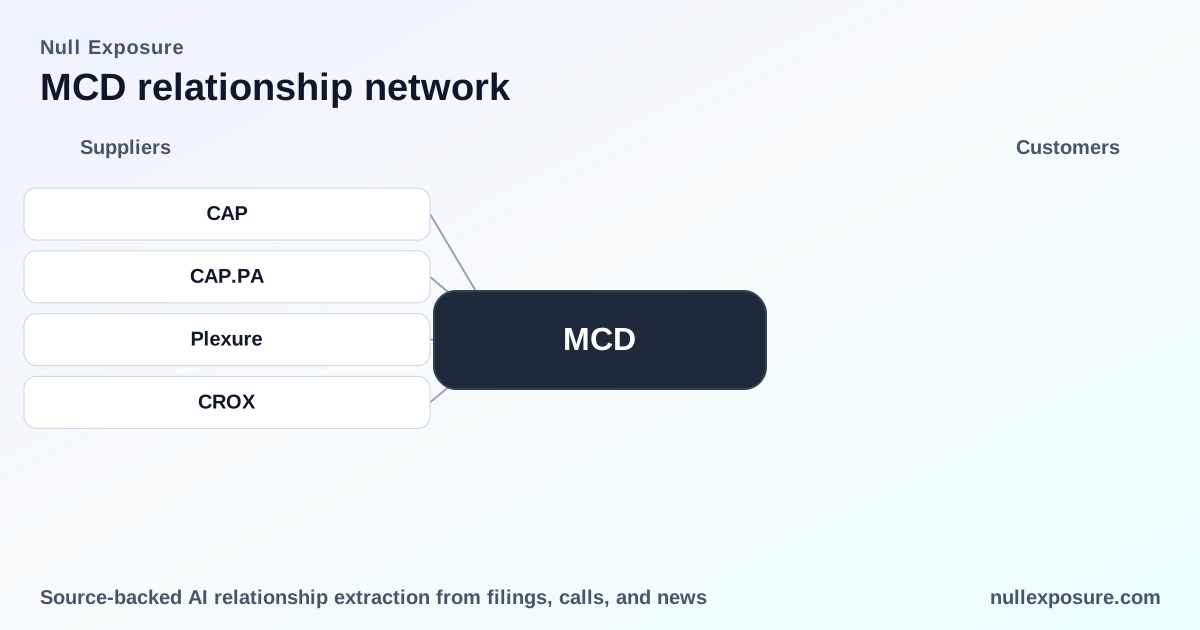
McDonald’s (MCD) supplier map — what investors need to know
McDonald’s operates as a global franchisor and restaurant operator that monetizes through franchise fees, rental and service income, and system-wide sales growth while preserving operating leverage via a capital-light model. Its supplier relationships are a strategic lever: technology partners drive higher digital sales and throughput, consumer-brand collaborations lift traffic and relevance, and a broad mix of food and packaging vendors supports day‑to‑day operations. For a quick, consolidated view of supplier exposures and news-driven changes, visit https://nullexposure.com/.
Why supplier relationships matter for a franchisor with scale
McDonald’s scale—Market Cap ≈ $233 billion and Revenue TTM ≈ $26.9 billion—gives it bargaining power with large vendors but also creates operational complexity across 100+ markets. The company’s economics depend on consistent menu execution, rapid digital capability rollouts and episodic marketing activations that drive comp sales. Suppliers therefore affect both near-term traffic and long-term margin expansion through automation, digital conversion and co‑brand promotions.
From an investor’s perspective, focus on four practical characteristics of McDonald’s supplier posture:
- Contracting posture: McDonald’s is predominantly a franchisor; it negotiates large strategic agreements centrally while franchisees purchase many everyday inputs locally. This creates a dual procurement model where corporate agreements set standards and franchisees handle execution.
- Concentration and maturity: Core food and packaging supply chains are mature and diversified; strategic tech and digital vendors are more concentrated and carry higher execution risk when scaled globally.
- Criticality: Technology partners that support digital ordering, crew tools and store automation are mission‑critical for accelerating sales and margin targets under the “Accelerating the Arches” program.
- Commercial tempo: Expect a mix of long-term strategic contracts (multi‑year technology partnerships) and short-duration promotional tie‑ups (brand collaborations) that influence seasonal traffic.
Company-level disclosures confirm that McDonald’s and its franchisees purchase food, packaging, equipment and other goods from numerous independent suppliers, which underlines the hybrid central/local procurement dynamic that shapes supplier risk and negotiating leverage.
Supplier relationships reflected in recent coverage
Below I cover each relationship mentioned in the latest supplier scope results and what it means for investors.
Capgemini — renewed multi‑year technology partnership
Capgemini extended a global technology partnership to modernize McDonald’s guest and crew platforms and to accelerate automation and digital initiatives under the company’s “Accelerating the Arches” agenda; the deal was reported as a five‑year renewal in FY2026 and is positioned to reduce execution risk on tech investments and support long‑term margin improvement. Source: MarketBeat reporting on a FY2026 filing (March 2026) and related news coverage (IBTimes March 2026) that note the renewed Capgemini collaboration.
Links: https://www.marketbeat.com/instant-alerts/filing-orion-porfolio-solutions-llc-buys-5407-shares-of-mcdonalds-corporation-mcd-2026-03-05/ and https://www.ibtimes.com.au/mcdonalds-stock-mcd-slips-32427-investors-take-profits-after-recent-highs-1862858
Plexure — supporting international digital expansion
Plexure is referenced in the context of benefiting from McDonald’s international expansion and localized digital launches (including Japan), indicating Plexure’s products or services are tied to loyalty/engagement efforts as McDonald’s scales digital programs globally in FY2026. Source: InsiderMonkey coverage of PAR Technology’s Q4 2025 call that discusses market wins and McDonald’s-related international rollouts (reported in March 2026).
Link: https://www.insidermonkey.com/blog/par-technology-corporation-nysepar-q4-2025-earnings-call-transcript-1706187/
Crocs — a limited‑time consumer brand tie‑in
McDonald’s partnered with Crocs on a limited‑time Happy Meal promotion, a consumer‑brand activation aimed at driving family traffic and relevance among younger customers in FY2026. These promotional tie‑ups are low‑duration but can move transaction counts and earned media quickly. Source: MarketBeat instant alert reporting the Crocs collaboration (March 2026).
Link: https://www.marketbeat.com/instant-alerts/filing-lgt-group-foundation-buys-60546-shares-of-mcdonalds-corporation-mcd-2026-03-09/
What the relationships tell investors about execution risk and upside
These relationships cluster into two strategic buckets with different investor implications:
- Strategic tech partnerships (e.g., Capgemini, Plexure): These are high‑impact, multi‑year arrangements that determine whether McDonald’s captures expected productivity and digital revenue gains. A credible, long-term partner reduces execution risk on platform modernization and store automation and supports margin expansion that is already visible in operating metrics such as Operating Margin TTM ≈ 45.1%.
- Brand promotions and consumer tie‑ins (e.g., Crocs): These are short-cycle demand drivers that increase transactions and media attention but do not materially shift long-term unit economics. They are important for sustaining brand relevance and can be used tactically around product launches.
Given McDonald’s franchisor model, central strategic contracts matter for standards and technology, while franchisee purchasing choices preserve local flexibility. Investors should treat corporate supplier renewals as leading indicators of margin-enabled investments, and promotions as traffic catalysts.
If you want a consolidated supplier-risk view for portfolio due diligence, start with a tailored scan at https://nullexposure.com/ to spot concentration or one-off dependencies.
Practical monitoring checklist for the next 12 months
Watch the following signals to evaluate whether these supplier relationships translate into durable value:
- Renewal cadence and scale of global tech contracts (duration, scope, and KPIs tied to store automation and digital sales).
- Rollout speed and adoption metrics for guest/crew platforms across major markets; tieouts to same-store sales lift.
- Frequency and ROI of brand collaborations and their impact on transactions and AUVs (average unit volumes).
- Franchisee adoption or resistance to corporate-negotiated supplier standards, which affects supply execution.
Bottom line and investor action points
Capgemini’s five‑year renewal is the most consequential relationship in this tranche — it moves the needle on McDonald’s digital roadmap and margin profile. Plexure’s mentions underscore that international digital rollouts remain a near-term revenue lever, while Crocs-style promotions continue to be useful traffic drivers.
For investors evaluating supplier concentration, contracting posture and execution risk, the mix here is healthy: long-term strategic tech partners complemented by episodic marketing tie‑ups, with the hybrid corporate/franchise procurement model providing both scale and local agility.
If you’d like a deeper supplier exposure report or want to monitor contract renewals and promotional activity that could affect MCD’s guidance and margin outlook, check out https://nullexposure.com/ for tailored intelligence and alerts.
Summary: McDonald’s supplier relationships in FY2026 reinforce its dual focus on digital modernization and brand relevance; track technology rollouts for margin evidence and promotions for traffic surprises. For targeted supplier-risk monitoring, visit https://nullexposure.com/ to set up alerts and concise supplier profiles.