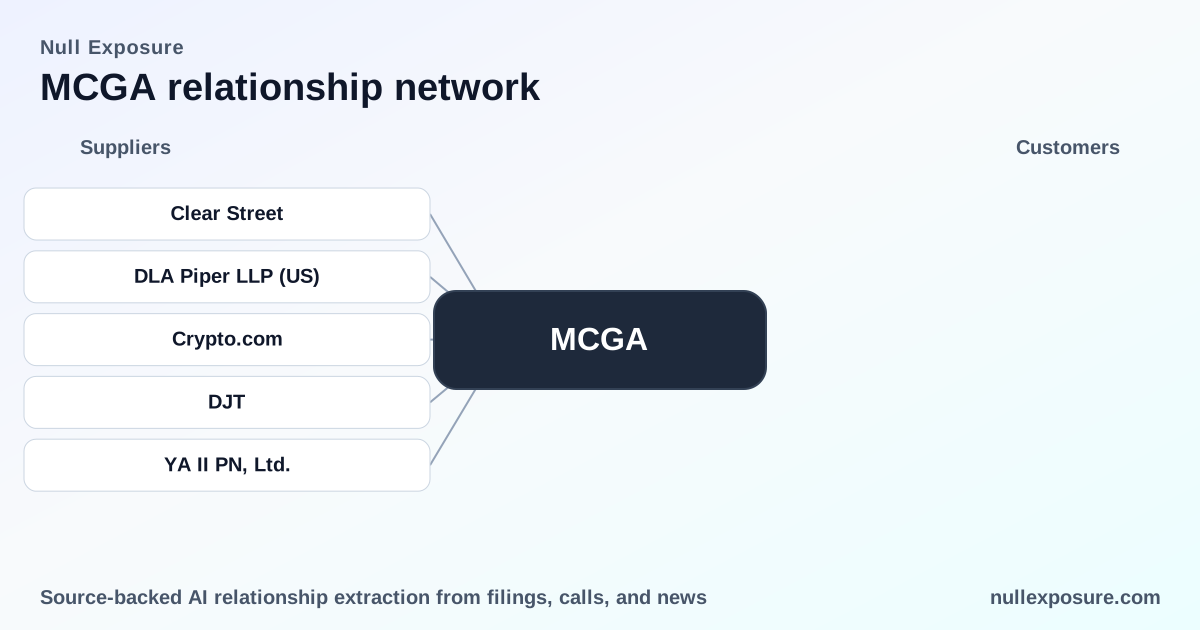
MCGA: Transaction Vehicle, Deal Economics, and the Supplier Map Investors Need to Know
MCGA operates as a special-purpose acquisition vehicle that monetizes by executing a business combination and capturing deal economics—transaction fees, sponsor economics (warrants and equity upside), and financing spreads tied to committed capital lines. The company’s current activity centers on enabling a digital-asset treasury business through a business combination, with third‑party advisors, legal counsel, strategic crypto partners, and committed capital providers underwriting the execution and funding profile. Investors should treat MCGA as a deal-driven enterprise whose valuation and near-term cash flows depend on partner commitments and the successful close of the announced combination. For more context on counterparties and execution risk, visit https://nullexposure.com/.
The operating model in one sentence investors can act on
MCGA runs a sponsor-led acquisition pipeline: it outsources capital markets execution and legal work, secures large external capital commitments, and routes those resources into a target corporate vehicle that will hold digital-asset treasury assets—meaning near-term value realization is execution- and counterparty-dependent.
How to read the supplier list: what it signals about MCGA’s posture
MCGA’s supplier map is compact and functionally concentrated. At the company level this implies: outsourced execution, material funding concentration, and transaction-critical counterparties. Those are company-level signals rather than isolated data points—contracting posture is predominantly externalized, concentration risk is elevated, and the maturity of the engagement is transactional (deal stage) rather than ongoing operating services.
- Contracting posture: MCGA relies on external advisors and counsel to execute capital markets and legal work, indicating a lean internal operating model with dependency on professional services.
- Concentration: The number of principal counterparties is small and the capital commitments described are large, creating single-counterparty funding and execution risk at closing.
- Criticality: Counterparty commitments are core to the transaction economics—failure to close or a counterparty withdrawal would directly impair the strategy.
If you want a quick supplier-risk snapshot and deeper counterparty timelines, explore practical analytics at https://nullexposure.com/.
The counterparties and what each relationship means for investors
Clear Street — exclusive capital markets advisor
Clear Street is serving as MCGA’s exclusive capital markets advisor to Yorkville Acquisition Corp, which positions Clear Street as the lead execution partner for the transaction process and market coordination. According to Globe and Mail press releases in March 2026, Clear Street is explicitly named as the exclusive capital markets advisor to Yorkville Acquisition Corp (trading as MCGA). (Globe and Mail, March 10, 2026.)
DLA Piper LLP (US) — legal counsel to the acquirer
DLA Piper LLP (US) is retained as legal counsel to Yorkville Acquisition Corp, supplying transactional and regulatory legal services that underpin the business combination and securities filings. The appointment is documented in press material published in March 2026. (Globe and Mail, March 10, 2026.)
Crypto.com — strategic asset contributor for a CRO-focused treasury
Crypto.com is a founding partner contributing assets to establish a digital-asset treasury vehicle that will focus on acquiring the Cronos ecosystem’s native token (CRO), providing strategic crypto-market access and token liquidity for the combined entity. This arrangement is described in the March 2026 transaction announcement. (Globe and Mail, March 10, 2026.)
Trump Media & Technology Group (DJT) — founding partner and asset contributor
Trump Media & Technology Group is named as a founding partner contributing assets to the proposed digital-asset treasury company, aligning media-related strategy with crypto treasury objectives and tying the new issuer to a high-profile corporate sponsor (Nasdaq: DJT). This is set out in the business combination disclosures released in March 2026. (Globe and Mail, March 10, 2026.)
YA II PN, Ltd. — committed capital and financing access
YA II PN, Ltd. provides sizable capital commitments to the transaction—reported commitments include $200 million in cash, $220 million in warrants, and access to a $5 billion equity line of credit from a Yorkville affiliate—creating the deal’s principal liquidity backbone. The funding details were reported in contemporaneous coverage and press summaries in March 2026. (Cryptodnes and Globe and Mail reporting, March 2026.)
What the supplier map says about execution risk and upside
The supplier roster is short but high-impact. That concentration is a double-edged sword: it accelerates decision-making and reduces execution friction if counterparties perform, but it also magnifies single-point failure risk. The commercial model gives MCGA asymmetric upside through sponsor economics and structured capital commitments, while downside is tightly correlated with counterparties’ willingness to fund and the legal/regulatory close process governed by retained counsel.
- Upside drivers: sponsor warrants and equity economics, large committed capital that supports scale, and strategic alignment with crypto-market participants that could drive asset appreciation.
- Primary risks: counterparty funding withdrawal, regulatory or legal challenges during the combination process, and concentration of financing in a small set of affiliates.
If you want a side-by-side supplier risk comparison or to monitor any material changes to these commitments, check the provider network and alerts at https://nullexposure.com/.
Due diligence and monitoring checklist for operators and investors
Focus your diligence on three fronts: (1) confirm contractual, unconditional commitments for the cash and equity lines; (2) verify DLA Piper’s engagement scope around regulatory opinions and closing conditions; (3) stress-test the treasury’s token exposure assumptions with Crypto.com and DJT contributions. Monitoring these elements weekly during the run-up to close is essential because the deal’s timing and financial profile are volatile.
Final read: decision points that will move the valuation
The market will price MCGA on two immediate variables: (1) the legal and regulatory clearance pathway (driven by counsel and filings), and (2) the firmness of YA II PN’s commitments and Crypto.com/DJT asset contributions. Positive confirmation of unconditional funding and clean legal close will materially de‑risk the equity; any erosion in those items will transmit directly to valuation and liquidity.
For actionable exposure analysis and ongoing counterparty monitoring, visit https://nullexposure.com/—the resource set is tailored for investors and operators tracking transaction-centric suppliers and funding counterparties.
Key takeaway: MCGA is a transaction-first vehicle whose near-term value is driven by a small set of high-impact relationships—legal counsel, capital markets advisor, strategic crypto contributors, and a principal funding affiliate—so investors must prioritize verification of those commitments before assigning persistent enterprise value.