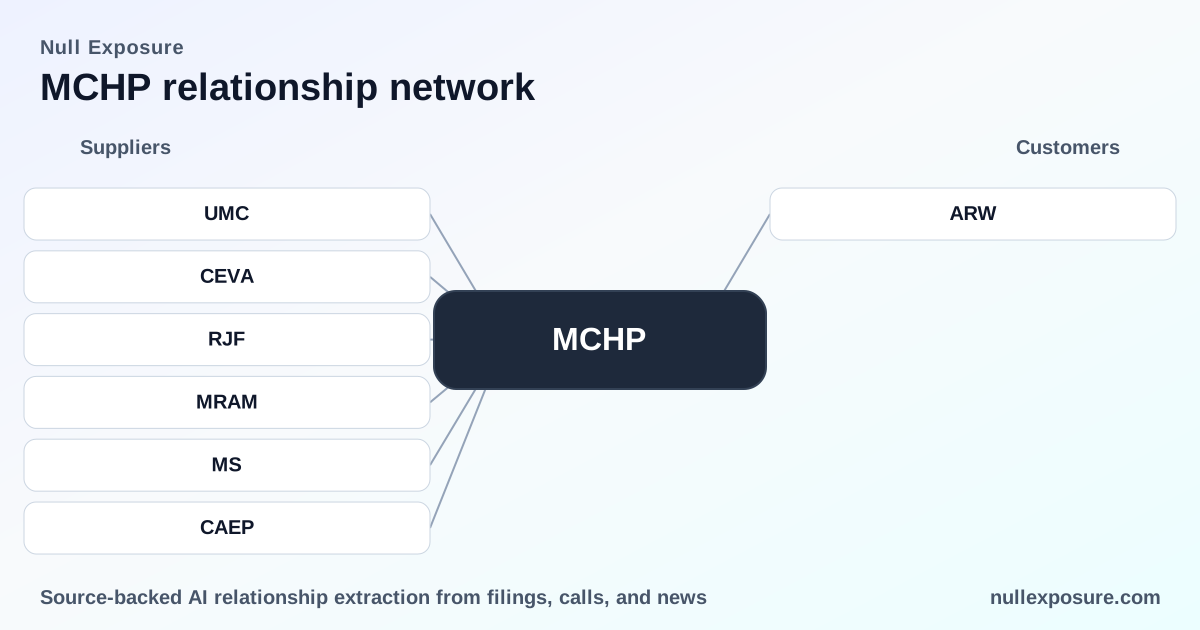
Microchip Technology (MCHP) — supplier relationships that shape product roadmaps and manufacturing risk
Microchip monetizes by designing and selling microcontrollers, mixed-signal and analog ICs, and embedded Flash IP to industrial, automotive and consumer customers while leveraging a hybrid manufacturing model that combines internal fabs with substantial outsourced wafer, assembly and test capacity. Revenue is driven by product breadth (MCUs, connectivity, analog), embedded IP licensing and ecosystem qualification of partner components, with profitability sensitive to fabrication throughput and customer mix. For supplier-risk visibility and partner diligence, review these relationship notes and operating constraints.
Explore deeper supplier intelligence at https://nullexposure.com/.
How Microchip’s supplier stance translates to economics
Microchip’s operating model is outsourced-manufacturing heavy: the company relies on third-party foundries for roughly two-thirds of wafer production and outsources sizeable portions of assembly and test. That configuration delivers scalable revenue exposure to demand cycles while keeping capital intensity lower than fully integrated peers; the trade-off is elevated dependency on external foundry capacity and test/assembly contractors, which directly affects gross margins and delivery lead times. Microchip also monetizes through licensing partnerships and ecosystem endorsements that accelerate customer adoption of its MCU families and adjacent components.
Supplier and partner mentions — what the market is saying
Below are plain-English summaries for each relationship item surfaced in public reporting, with concise source references.
United Microelectronics Corporation (UMC)
Microchip’s SST subsidiary completed all requirements for its embedded SuperFlash Gen 4 with UMC, indicating a foundry qualification milestone that supports product continuity for embedded Flash-based MCUs. According to a TradingView recap of Zacks coverage (reported March 10, 2026), the completion was announced as part of SST and UMC collaboration (https://www.tradingview.com/news/zacks:3288d6283094b:0-can-microchip-s-expanding-portfolio-help-its-stock-deliver-in-2026/).
Ceva Inc. (CEVA) — NeuPro NPU licensing
Microchip signed a comprehensive license for Ceva’s NeuPro NPU portfolio to embed AI acceleration across its product families, signaling a strategic push to make AI a standard feature on new MCUs and connectivity chips. Multiple industry outlets covered the agreement in early 2026, including EET India and EE Times Asia, describing Microchip’s adoption of Ceva NPUs as part of broader AI standardization (https://www.eetindia.co.in/ceva-highlights-breakthrough-year-for-ai-licensing-physical-ai-adoption-in-2025/; https://www.eetasia.com/ceva-highlights-breakthrough-year-for-ai-licensing-physical-ai-adoption-in-2025/).
Everspin Technologies (MRAM)
Everspin qualified its 64Mb STT-MRAM for Microchip’s PIC64 HPSC MPU series, positioning Everspin’s nonvolatile memory as an ecosystem component for Microchip’s processors and supporting customers who require persistent memory options. This partner-qualification detail was discussed in an Everspin earnings call transcript referenced by The Globe and Mail’s Motley Fool content (reported March 10, 2026) (https://www.theglobeandmail.com/investing/markets/markets-news/Motley%20Fool/571408/everspin-mram-q4-2025-earnings-call-transcript/).
Raymond James (RJF) — investor access / webcasts
Raymond James hosted a conference presentation of Microchip and provided a live webcast of the session accessible on Microchip’s investor site, reflecting investor relations outreach rather than a supply relationship. The company’s Glen Newswire release (Feb 27, 2026) noted the webcast availability (https://www.globenewswire.com/news-release/2026/02/27/3246800/0/en/microchip-technology-to-present-at-the-raymond-james-institutional-investors-conference.html).
Morgan Stanley (MS) — investor access / webcasts
Morgan Stanley similarly provided a live webcast for Microchip’s presentation, underlining the company’s active engagement with institutional investors at large-cap technology conferences. Microchip’s investor relations press release documents the webcast availability (published on Microchip IR in early 2026) (https://ir.microchip.com/news-events/press-releases/detail/1369/microchip-technology-to-present-at-the-morgan-stanley-technology-media-telecom-conference).
Cantor (CAEP) — investor access / webcasts
Cantor hosted a Microchip presentation with a live webcast available on Microchip’s site, another example of ongoing sell-side engagement and visibility to institutional buyers (Microchip IR press release, early 2026) (https://ir.microchip.com/news-events/press-releases/detail/1373/microchip-technology-to-present-at-thecantor-global-technology-industrial-growth-conference).
Note: the Raymond James and Cantor items are investor relations touches, not supply-chain dependencies; they matter for capital markets access and messaging rather than manufacturing risk.
What the constraints tell investors about operating risk
The disclosures provide clear, company-level signals about Microchip’s supplier posture:
- Contracting posture — outsourced-heavy but diversified: Microchip outsources a material share of wafer fabrication (about 64% of sales-linked production in FY2025 and FY2024) and relies on third-party assembly/test contractors for roughly a third of those services, implying a deliberate contracting posture that trades capital intensity for supply flexibility.
- Concentration and criticality — foundry dependence is material: Reliance on outside wafer foundries is material to operations; disruptions at key foundries translate directly into product delivery and margin pressure.
- Service-provider reliance and maturity: The mix of in-house capabilities plus long-standing third-party relationships reflects a mature outsourcing model—it reduces cyclical capex volatility but increases vendor management and supply-chain execution risk.
- Operational levers: Because a majority of wafers are produced externally, Microchip’s ability to prioritize customers, secure capacity and manage lead times is a key operational determinant of revenue realization and customer satisfaction.
These constraints are presented as company-level characteristics rather than tied to a specific named supplier unless explicitly stated.
Investment implications and near-term priorities
- Positive — product differentiation through IP and AI enablement: The Ceva NeuPro license positions Microchip to push AI-capable MCUs into higher-value applications, supporting ASP upside and ecosystem stickiness. This is a strategic revenue and roadmap lever.
- Negative — supply-chain concentration risk: The heavy reliance on external foundries and third-party assembly/test creates execution risk during capacity tightness or geopolitical stress that can compress gross margins and elongate lead times.
- Neutral — investor engagement is robust: Frequent sell-side webcasts (Raymond James, Morgan Stanley, Cantor) ensure broad coverage and liquidity but do not change operational risk.
For supplier diligence tied to procurement, engineering or M&A teams, prioritize foundry capacity mapping, assembly/test partner SLAs, and the cadence of partner component qualifications such as Everspin MRAM.
Explore Microchip supplier analytics and tailored exposure reports at https://nullexposure.com/ to accelerate vendor risk assessment.
Recommendations for operators and investors
- For procurement teams: map supplier capacity against wafer roadmap and secure contractual capacity where feasible; prioritize dual-sourcing for critical nodes.
- For investors: monitor capacity booking indicators, gross-margin trajectory, and product qualification announcements (AI-enabled MCU traction is an upside catalyst).
- For product and engineering leads: track ecosystem qualifications (MRAM, NPUs) that materially reduce customer adoption friction.
Get a full supplier-risk profile and ongoing alerts at https://nullexposure.com/ — integrate that intelligence into contract and roadmapping decisions.
Conclusion
Microchip executes a clear hybrid-manufacturing model: broad product monetization via MCUs and IP coupled with meaningful external manufacturing reliance. The recent partner developments — Ceva NPUs, Everspin MRAM qualification and foundry milestones with UMC — are strategically positive for product competitiveness but do not alter the underlying foundry and test/assembly concentration risk. Investors and operators should weight AI and IP-driven upside against the tangible supply-chain dependence that governs near-term delivery and margin performance.