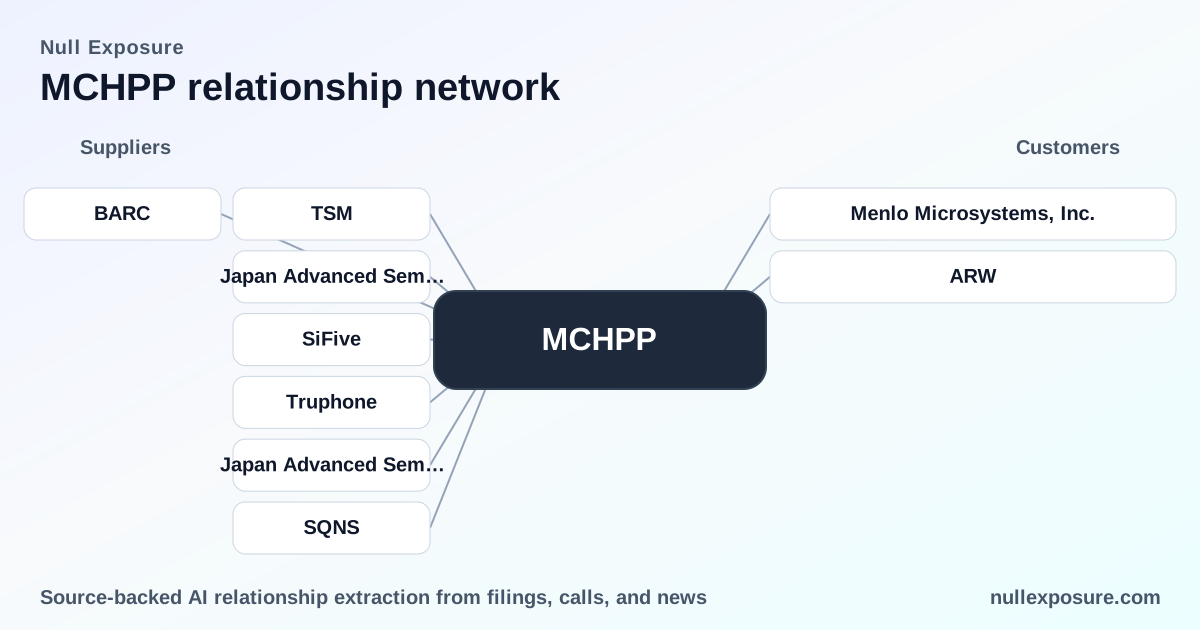
Microchip’s supplier map: how foundries and partners shape investment risk and upside
Microchip Technology (MCHPP) operates as a global supplier of embedded control solutions—microcontrollers, analog and mixed‑signal semiconductors—monetizing primarily through product sales to automotive, industrial, consumer and aerospace customers. The company deliberately outsources a material portion of wafer fabrication while keeping significant testing and assembly in‑house, creating an operating model that scales capacity through external foundries and specialized partners and captures margin through integrated product design and distribution. For investors, the critical lens is supplier concentration and operational leverage: Microchip’s growth and resilience are tightly coupled to a small set of manufacturing and technology partners.
Discover supplier risk analytics and relationship profiles at https://nullexposure.com/.
Why suppliers matter to Microchip’s earnings trajectory
Microchip runs a hybrid manufacturing posture. The company designs and sells chips but deliberately outsources wafer fabrication, using third‑party foundries to meet volume and technology needs while retaining assembly, test and R&D capabilities internally. That structure accelerates product time‑to‑market and reduces capital intensity on fabs, but it also creates concentration and criticality risks because wafer capacity constraints or geopolitical disruptions at a foundry level transmit directly to Microchip’s revenue and gross margin.
Operational signals reinforce the strategy: Microchip reported that roughly 64% of net sales in fiscal 2024–25 were produced at outside wafer foundries, and assembly/test work is split with about 67% performed in internal facilities, leaving the remainder to contractors. The company also uses third‑party cybersecurity and specialist service providers for monitoring and incident response. Those facts define Microchip’s supplier profile: capital‑light fabrication, mixed insourcing for downstream processing, and reliance on external expertise for ancillary services.
Who Microchip is working with — the counterparties that matter
Taiwan Semiconductor Manufacturing Co. (TSMC)
Microchip has expanded its partnership with TSMC to secure 40nm capacity at TSMC’s operations tied to Japan-based manufacturing, strengthening supply for legacy nodes used across automotive and industrial products. A Taipei Times report (April 2024) and an EE Times Asia write‑up describe the deeper engagement to leverage TSMC’s 40nm offering in Japan (https://www.taipeitimes.com/News/biz/archives/2024/04/10/2003816186; https://www.eetasia.com/microchip-expands-partnership-with-tsmc-to-strengthen-ic-manufacturing-capacity/).
Japan Advanced Semiconductor Manufacturing Inc. (JASM)
Microchip will access wafer capacity at JASM—TSMC’s majority‑owned subsidiary in Kumamoto—providing additional 40nm supply to bolster resilience for automotive and networking product lines. EE Times Asia and Taipei Times coverage link Microchip’s capacity sourcing directly to JASM’s Kumamoto fabs (https://www.eetasia.com/microchip-expands-partnership-with-tsmc-to-strengthen-ic-manufacturing-capacity/; https://www.taipeitimes.com/News/biz/archives/2024/04/10/2003816186).
SiFive
Microchip’s product roadmap includes a space‑grade 64‑bit MPU family that integrates SiFive RISC‑V cores, signaling a strategic technology partnership for high‑performance and secure compute in aerospace applications. Microchip’s investor release details the SiFive core inclusion and performance claims (Microchip press release, FY2024: https://ir.microchip.com/news-events/press-releases/detail/1250/microchip-unveils-industrys-highest-performance-64-bit-hpscmicroprocessor-mpu-family-for-a-new-era-of-autonomous-space-computing).
Truphone
Microchip partnered with Truphone to supply global SIM connectivity on development boards, simplifying worldwide cellular testing and prototyping for customers integrating IoT and cellular features. EE Times Asia covered the partnership in the context of a 5G/LTE‑M/NB‑IoT development board initiative (https://www.eetasia.com/microchip-mcu-development-board-connects-to-5g-lte-m-narrowband-iot-networks/).
Sequans (SQNS)
For low‑power cellular connectivity on select microcontroller reference designs, Microchip integrated Sequans’ Monarch 2 radio (GM02S) to support LTE‑M and NB‑IoT connectivity, enabling a turnkey hardware option for 5G IoT developers. The partnership was reported by EE Times Asia in coverage of Microchip’s development kit offerings (https://www.eetasia.com/microchip-mcu-development-board-connects-to-5g-lte-m-narrowband-iot-networks/).
Barclays
Barclays acts as an investment bank and conference host for Microchip’s investor communications; Barclays hosted a live webcast of Microchip’s presentation at its Global Technology Conference, which the company made available via its investor site (GlobeNewswire coverage, Dec 2025; https://www.manilatimes.net/2025/12/09/tmt-newswire/globenewswire/microchip-technology-to-present-at-the-barclays-23rd-annual-global-technology-conference/2239376).
Operating constraints that drive strategic options
Microchip’s supplier profile imposes several firm‑level constraints that investors should treat as structural, not transient:
- Contracting posture: Microchip is a design‑centric company that outsources the majority of wafer fabrication, preserving flexibility but ceding direct control over fab capacity and schedule.
- Concentration: A material portion of production relies on a limited set of foundries; securing 40nm capacity at TSMC/JASM reduces short‑term bottlenecks but retains concentration risk at critical nodes.
- Criticality: Foundry partners are mission‑critical—capacity shifts directly affect revenue and product availability for automotive and industrial customers.
- Maturity of supply relationships: The mix of long‑term foundry engagement and targeted technology partnerships (SiFive, Sequans, Truphone) shows a mature, ecosystem‑driven sourcing model that balances risk transfer with technology access.
Those constraints explain Microchip’s capital allocation choices, product prioritization and public messaging about supply resilience.
What this means for investors: risk, leverage and catalysts
- Supply resilience is the principal execution risk. Microchip’s decision to route significant volume through external foundries improves capital efficiency but creates dependency on third‑party capacity and scheduling. The company’s explicit securing of 40nm capacity addresses that risk for legacy nodes used across automotive and industrial segments.
- Technology partnerships are strategic margin drivers. Integrations such as SiFive cores and Sequans radios accelerate product differentiation in high‑value verticals (space, IoT), enhancing pricing power where customers pay for validated platform solutions.
- Event risks and catalysts are predictable. Watch announcements about additional foundry capacity, capacity ramp schedules at JASM/TSMC, and further M&A or partner integrations; each materially changes throughput and the revenue cadence.
If you are modeling Microchip’s next fiscal year, prioritize scenario sensitivity to foundry availability for 40nm and to the ramp schedules for products integrating third‑party IP.
Explore deeper supplier relationship intelligence at https://nullexposure.com/ — our profiles aggregate partner exposure that matters to enterprise and research investors.
Actionable next steps for investors
- Review Microchip’s next quarterly commentary for capacity‑allocation updates from TSMC/JASM and for product ramp timelines tied to SiFive‑powered MPUs.
- Monitor industry coverage of 40nm capacity allocations in Japan and Taiwan; shortages or releases there will directly affect Microchip’s backlog and margins.
- Subscribe to targeted supplier risk tracking to receive cross‑vendor alerts and historical counterparty performance summaries.
Get complete supplier profiles and alerts at https://nullexposure.com/ — start with the Microchip supplier map and translate counterparties into investment signals.