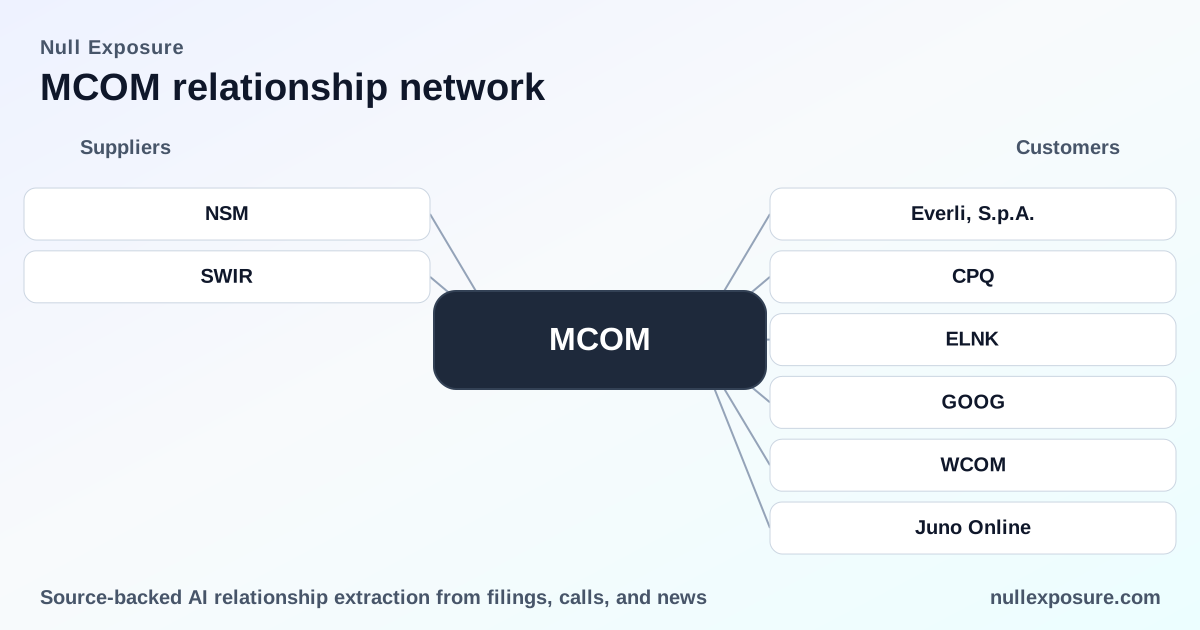
Micromobility.com (MCOM) — supplier footprint and what it signals for investors and operators
Micromobility.com Inc. operates intra-urban transportation services in the United States and Italy, monetizing through micro-mobility operations and related service revenue. The company reports modest revenue (Revenue TTM $1.85M) and a positive profit margin on that revenue, but an EBITDA loss; its commercial model is asset-light and service-driven, with most supplier exposure concentrated in non-material software and advisory relationships rather than large hardware contracts. For capital allocators and procurement teams, the key question is whether supplier risk is a growth constraint or an operational afterthought — the evidence favors the latter.
Explore deeper vendor intelligence at https://nullexposure.com/.
Quick takeaways for investment and sourcing teams
- Supplier exposure is assessed as immaterial to core operations; company records state, “The company has no material suppliers that it relies on for the software and advisory services.”
- Legacy third‑party links exist in public press, but they do not translate to current single-vendor dependency for Micromobility.com.
- Operational risk is driven more by small scale and cash profile than by supplier concentration; revenue scale and negative EBITDA are the primary financial constraints.
What external press links reveal (complete coverage)
National Semiconductor (NSM)
EETimes reported that the shutdown of Metricom's Ricochet wireless network historically impacted National Semiconductor as a supplier of wireless chipsets tied to the Ricochet service; this item is recorded in our relationship results with a fiscal tag of FY2019. The note is a historical supplier mention rather than evidence of an ongoing commercial dependency for Micromobility.com (source: EETimes article on Metricom shutdown — https://www.eetimes.com/metricom-shuts-down-ricochet-wireless-network-move-impacts-national-semi-and-others/).
Sierra Wireless (SWIR)
The same EETimes piece lists Sierra Wireless as a supplier of modems affected by the Ricochet network closure; this is captured in our results under the FY2019 tag and is presented as historical press linkage rather than a current, critical supplier relationship for Micromobility.com (source: EETimes — https://www.eetimes.com/metricom-shuts-down-ricochet-wireless-network-move-impacts-national-semi-and-others/).
Why the press mentions matter — and where they don't
The two relationship entries in the record are press references to legacy network supplier impacts stemming from a third-party network disruption (Metricom/Ricochet). For procurement and legal teams that need to map current vendor criticality, these references are useful as historical context but do not constitute documented, material supplier contracts with Micromobility.com. Company-level disclosures explicitly state the absence of material software or advisory suppliers, which is the dominant signal for current vendor dependency.
If your diligence process requires verification beyond press citations, request contemporaneous supplier lists, master services agreements, and change-of-control clauses from the company to confirm the absence of material single-source providers.
For additional supplier mapping and verification workflows, visit https://nullexposure.com/ for tools and advisory.
Constraints and what they imply for operating model
The constraint extracted from company disclosures reads: “The company has no material suppliers that it relies on for the software and advisory services.” Treat this as a company-level signal that shapes how MCOM contracts and operates:
- Contracting posture — vendor-light and flexible: the company operates with non-material third-party arrangements for software/advisory services, suggesting short-term agreements or modular services rather than long-duration exclusives.
- Concentration — low supplier concentration: no single supplier is disclosed as material, which reduces single-point-of-failure risk in sourcing.
- Criticality — supplier criticality is limited: suppliers are plausibly non-critical or easily replaceable given the company’s disclosure; operational continuity hinges more on capital and fleet operations than on a proprietary software supplier.
- Maturity — immature supplier footprint consistent with small scale: a light external supplier posture is consistent with a small, growing operator that has not yet locked into large enterprise vendors.
These are company-level conclusions supported by the disclosure excerpt rather than relationship-specific findings.
Investment implications and risk checklist
- Financial profile drives priority: with Market Capitalization ~ $0.92M and EBITDA negative, capital constraints and growth execution are the dominant investment risks, not supplier concentration.
- High insider ownership (51%) and zero institutional ownership signals insider control with limited external institutional oversight, which increases governance and liquidity considerations for investors.
- Operational diligence should focus on fleet economics, regulatory exposure in Italy/US, and cash runway, while supplier due diligence remains a secondary line of enquiry given the immateriality signal.
Checklist for buy-side and operators:
- Confirm current vendor roster and contract terms (SLA, termination rights, transition assistance).
- Validate that historical press links (e.g., legacy suppliers cited in EETimes) have no contractual carryover.
- Stress-test continuity plans for fleet operations where hardware or telematics vendors could become critical at scale.
Actionable next steps for operators and procurement
- Request a certified vendor list and copies of any master service agreements before underwriting supplier-related operational claims.
- Build migration clauses into future contracts to maintain agility; short, modular contracts reduce lock‑in risk.
- Monitor capital structure and cash runway; supplier substitution is feasible, but funding gaps are not.
For tailored supplier-risk assessments and to benchmark MCOM versus peer operator supplier postures, consult https://nullexposure.com/ — our platform aggregates the signals you need for procurement and investment decisions.
Closing verdict
Micromobility.com's public record and our constraints extraction indicate a low-risk supplier profile centered on immaterial software and advisory arrangements, while company scale and capital position remain the primary investment risks. Historical press mentions (National Semiconductor, Sierra Wireless) are informative for context but do not reflect current material supplier dependencies; procurement verification is still recommended before scaling commercial commitments.
For more in-depth supplier intelligence and to commission a targeted supplier due diligence brief, visit https://nullexposure.com/.