Seres Therapeutics (MCRB): supplier relationships, operational constraints, and what investors should track
Seres Therapeutics is a clinical‑stage microbiome therapeutics company that develops bacterial consortia to treat disease and currently monetizes primarily through grant funding and partnership receipts while preparing for eventual product commercialization. The balance sheet and recent filings show minimal commercial revenue to date—reflected in $0.789M revenue TTM and a small grant contribution disclosed for SER‑155—so supplier and partner dynamics directly influence Seres’ ability to execute clinical programs and transition to revenue-generating launches. For a rapid vendor risk scorecard and continuous monitoring of counterparty ties, visit https://nullexposure.com/.
One quick takeaway for allocators
Seres runs a heavily outsourced operating model: third‑party manufacturers, distributors and clinical service providers execute core functions, and a terminated long‑term manufacturing agreement with Bacthera AG changes the supplier map in a meaningful way. That mix creates concentrated operational risk that investors and counterparties must price into runway and commercialization assumptions.
Who supplies Seres today — the relationships you need on your radar
-
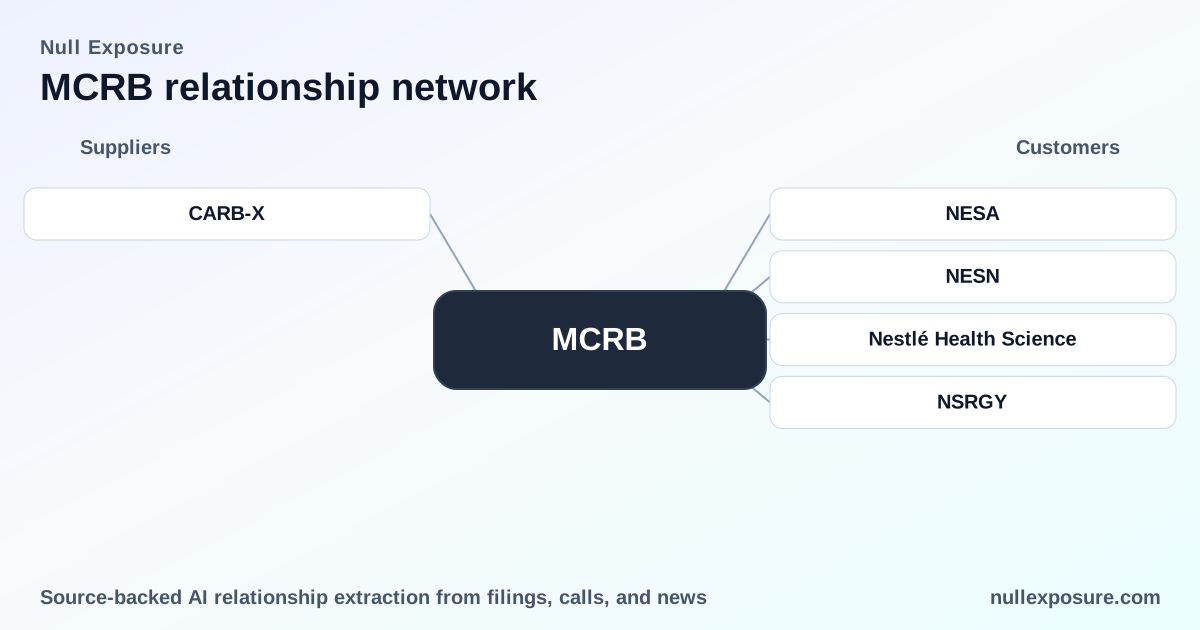
CARB‑X — In FY2025 Seres recognized $0.351 million of grant revenue from CARB‑X for the development of SER‑155, reflecting a grant‑funding relationship that contributes directly to program cash flow for that candidate. This figure was reported in a trading summary of the company’s SEC filing on March 10, 2026. (TradingView synopsis of Seres SEC 10‑Q, 2026‑03‑10)
-
Bacthera AG — Company disclosures around a closing event state that the long‑term manufacturing agreement with Bacthera AG (dated November 8, 2021) was terminated and both parties released claims and milestone obligations as of the closing, with a payment from SPN to Bacthera recorded in connection with that termination. This is documented in the company’s transaction disclosures in its SEC filings. (Company disclosure in SEC filing describing the Bacthera Manufacturing Agreement and Closing)
These two items represent the explicit supplier and contract signals available in public filings and news coverage; CARB‑X is a grant funder, while Bacthera was a named manufacturing counterparty whose long‑term agreement was explicitly terminated in closing documentation.
What the constraints tell us about Seres’ operating model and risk posture
Seres’ public disclosures and extracted constraint excerpts produce a clear operating profile:
-
Outsourced production and services are fundamental to the model. The company states it “relies on third parties for certain aspects of the manufacture of our product candidates,” and continues to depend on CROs, clinical data management organizations, medical institutions and clinical investigators to run trials. This is not an auxiliary arrangement; it is the core operating posture and influences speed to data and cost per trial. (Company filings, FY2025 disclosures)
-
There was an explicit long‑term manufacturing agreement in place that was terminated at closing. The Bacthera Manufacturing Agreement termination is a contractual turning point: the company and Bacthera released one another from liabilities and milestone payment obligations as of the closing date, with SPN involved in a payment to Bacthera. The contractual change reassigns manufacturing risk and timing to new providers or internal arrangements. (Company closing documents in SEC filing)
-
Role concentration: manufacturer / distributor / service provider reliance. The filing language categorizes third parties across manufacturing, distribution and clinical services, indicating multi‑role dependence rather than a dispersed, horizontally integrated supply base. This elevates counterparty criticality: a single manufacturer disruption has outsized impact across trials and potential commercialization. (SEC filing risk disclosures)
-
Maturity and transition risk. The termination of a long‑term manufacturing agreement signals a transition in supplier maturity: Seres must either onboard new manufacturers, expand internal capacity, or negotiate replacements under compressed timelines. That transition typically increases near‑term operating risk and potential cost volatility for drug substance and drug product supply.
Operational implications for investors and operators
-
Short‑term revenue impact is limited but information‑sensitive. The CARB‑X grant of $0.351M in FY2025 is small relative to enterprise value, but it is a clear example of how Seres funds discrete program work today. Grants reduce immediate cash burn for specific candidates and can de‑risk near‑term milestones. (TradingView summary of FY2025 10‑Q disclosure)
-
Manufacturing is the single biggest supplier risk. With the Bacthera agreement terminated, manufacturing continuity and qualification of replacement contractors are the highest‑impact items to validate in diligence. Investors should request supplier transition plans, capacity commitments and regulatory readiness timelines from management.
-
Clinical execution is outsourced and therefore counterparty‑dependent. CRO and clinical site performance, data integrity and timelines are contingent on third‑party partners named generically in filings; investors should extract vendor diversity, contract length, termination rights and performance remedies when evaluating program risk.
If you need a consolidated counterparty map and automated alerts for changes to these supplier relationships, NullExposure provides continuous monitoring and supplier risk scoring — start here: https://nullexposure.com/.
Practical next steps for diligence teams
- Request a supplier list with contract term summaries, critical milestones and termination clauses for manufacturing and distribution.
- Validate replacement manufacturer qualifications, supply batch release history and regulatory inspection status if Bacthera was producing critical components.
- Quantify revenue runways under different supplier disruption scenarios and incorporate supplier replacement lead times into cash‑flow stress tests.
- Confirm grant and partnership funding schedules (like CARB‑X) and whether those grants are one‑time, milestone‑dependent, or extendable.
For a tailored supplier risk analysis that overlays financial exposure with contract maturity and concentration metrics, visit https://nullexposure.com/.
Bottom line
Seres is a development‑stage firm that funds program work through grants and partnerships while outsourcing core operational functions; the Bacthera agreement termination materially changes its manufacturing landscape and elevates supplier concentration risk. CARB‑X grant receipts are useful program funding but not a substitute for manufacturing resilience. For investors and potential partners, the critical questions are supplier continuity, timing of replacement manufacturing, and how those factors affect clinical timelines and cash consumption. For ongoing monitoring and a vendor risk score tailored to biotech supplier networks, see https://nullexposure.com/.