Micropolis Holding Company (MCRP): robotics roll‑out, capital markets strategy, and the partner map investors need to know
Micropolis develops and integrates autonomous mobile robots (AMRs) across the UAE and Saudi Arabia and monetizes through product sales, systems integration, and partnerships that attach its M2 robotic platform to industrial customers and ports; the company supplemented organic growth with a U.S. IPO that was executed on a firm‑commitment basis, creating a clear revenue runway expectation tied to commercial deployments and strategic tech alliances. For investors, the critical question is whether Micropolis can convert partnerships and an IPO capital base into scalable recurring revenue while managing high insider ownership and early‑stage financials.
Discover more at https://nullexposure.com/ for investor tools and supplier intelligence.
Why the relationship map matters to valuation and execution
Micropolis is at an inflection where commercial partnerships and capital markets execution directly determine growth optionality. The company’s public offering, its choice of bookrunner and legal counsel, and the roster of technology and engineering collaborators all signal a go‑to‑market posture that leans on external credibility and advanced compute capability (notably NVIDIA) to accelerate product readiness. Operationally, expect a contracting posture that combines one‑off system sales with longer integration projects; this hybrid model concentrates commercial risk around a small number of early customers and platform partners.
- Capital market posture: The IPO was handled on a firm‑commitment basis with a single lead manager, underscoring a concentrated underwriting relationship that both compresses execution risk and concentrates market signaling around one syndicate.
- Technology scaling: Adoption of high‑performance compute modules is critical for Micropolis’ AMR AI stack and raises supplier concentration risk toward specialized silicon partners.
- Commercial maturity: Revenue is nascent, and profitability is negative, so partnership execution and deployment cadence will determine whether the current market cap justifies forward growth assumptions.
Explore supplier relationship signals and deal context at https://nullexposure.com/.
The partnership list every investor should track
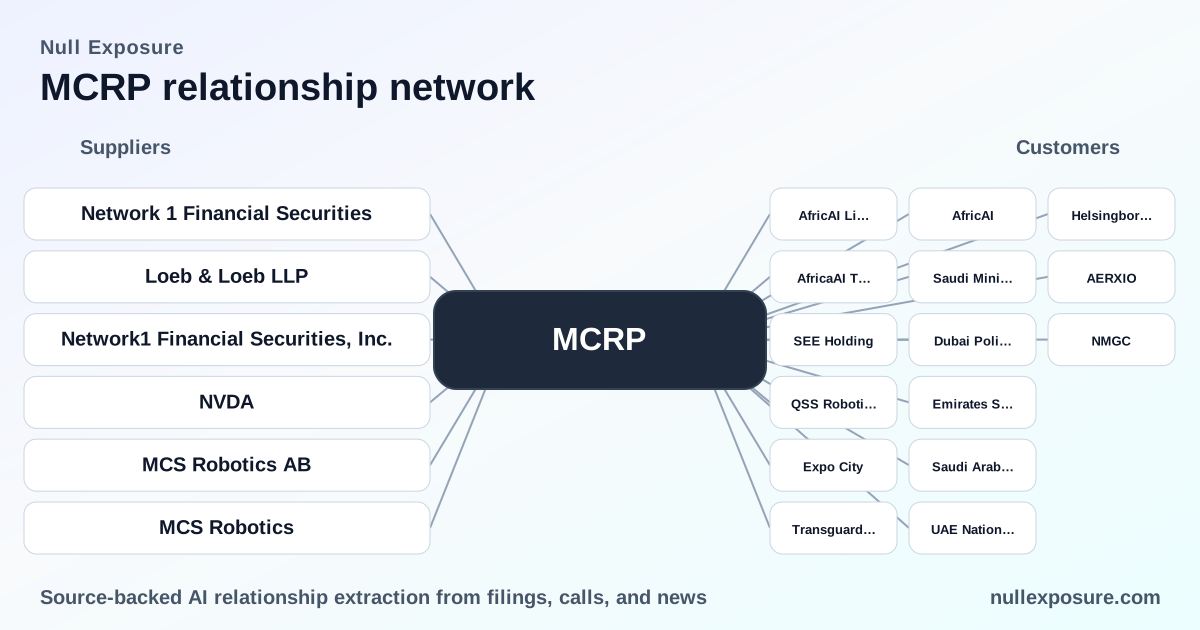
Below are every relationship surfaced in public coverage with a concise plain‑English note and a source reference.
-
Network 1 Financial Securities — According to Renaissance Capital’s IPO coverage (FY2025), Network 1 Financial Securities acted as the sole bookrunner on Micropolis’ U.S. offering, positioning the firm as the primary underwriter tied to IPO execution and aftermarket price discovery. (Renaissance Capital, FY2025)
-
Loeb & Loeb LLP — A media report on the offering notes that Loeb & Loeb served as U.S. securities counsel to Micropolis, handling legal work for the company’s U.S. registration and compliance during the IPO process. (MyStartupWorld coverage of the offering, FY2025)
-
Network1 Financial Securities, Inc. — MyStartupWorld’s recap of the transaction states the offering was conducted on a firm‑commitment basis with Network1 Financial Securities, Inc. as the sole book‑running manager, confirming the underwriting structure and the lender‑arranger’s execution risk assumption. (MyStartupWorld, FY2025)
-
Network 1 Financial Securities (earlier coverage) — Renaissance Capital also reported in an earlier item that Network 1 Financial Securities was the sole bookrunner as Micropolis prepared for its NYSE listing, reinforcing a multi‑item public narrative that the underwriting relationship is highly concentrated. (Renaissance Capital, FY2024)
-
NVIDIA (NVDA) — Industry press notes that Micropolis’ M2 platform introduced an industrial‑grade computing module powered by NVIDIA, signaling reliance on NVIDIA GPU compute for on‑robot AI processing and perception capability. This is a core technology relationship for edge AI performance. (FinViz reporting, FY2026)
-
MCS Robotics AB — FinancialContent coverage describes a partnership where Micropolis and MCS Robotics AB joined with Helsingborgs Hamn AB to co‑develop and test the “Box Cleaner” on the M2 platform, indicating joint product development for port and logistics use cases in Europe. (MarketS FinancialContent, FY2025)
-
MCS Robotics — GlobeNewswire reported that the Box Cleaner was introduced as a Micropolis product developed in collaboration with MCS Robotics, confirming the engineering and go‑to‑market cooperation on sanitation and high‑throughput logistics applications. (GlobeNewswire release, FY2025)
Company‑level operational characteristics and constraints
With no explicit contract constraints listed in public summaries, the following are company‑level signals derived from Micropolis’ financials and disclosed partner activity:
-
Contracting posture: The IPO was executed on a firm‑commitment basis, which implies Micropolis prioritized guaranteed capital over syndicate flexibility and accepts concentrated execution risk with its sole bookrunner. This posture suggests management prefers clean capital delivery to fund near‑term commercialization rather than staggered commitments.
-
Concentration: Insider ownership is very high (77.6%) while institutional ownership is minimal (1.2%), creating concentrated control that can accelerate strategic decisions but reduces market liquidity and institutional governance oversight.
-
Criticality of partners: Technology partners—especially compute suppliers like NVIDIA—are critical to product performance and time‑to‑market; failure or delay in these supplier relationships would materially impact deployment capability.
-
Maturity and scale: Financials show very early commercial scale (Revenue TTM $156,290; negative EBITDA), indicating the company is pre‑scale and dependent on successful pilot conversions and additional capital deployment to reach meaningful recurring revenue.
What investors should watch next
Investors should prioritize three monitoring items: (1) deployment cadence — conversion of pilots (e.g., Box Cleaner tests) into paid contracts; (2) supplier stability — continuity with NVIDIA and engineering partners that affect product differentiation; and (3) capital horizon — how the company uses IPO proceeds and whether additional capital will be required to fund scale. Each of these levers directly affects revenue trajectory and valuation multiple compression or expansion.
For a deeper look at supplier connections and transaction context, visit https://nullexposure.com/.
Bottom line and call to action
Micropolis is a high‑conviction, early‑stage robotics play where strategic partnerships and the capital markets execution are the primary value drivers. The concentrated underwriting and high insider ownership are double‑edged: they deliver funding and decisive control but raise governance and liquidity considerations. Investors should treat partner performance (especially NVIDIA and MCS collaborations) as leading indicators of commercial success.
To track updates on Micropolis’ partner ecosystem and to access structured supplier intelligence, visit https://nullexposure.com/ and subscribe for ongoing analysis and alerts.