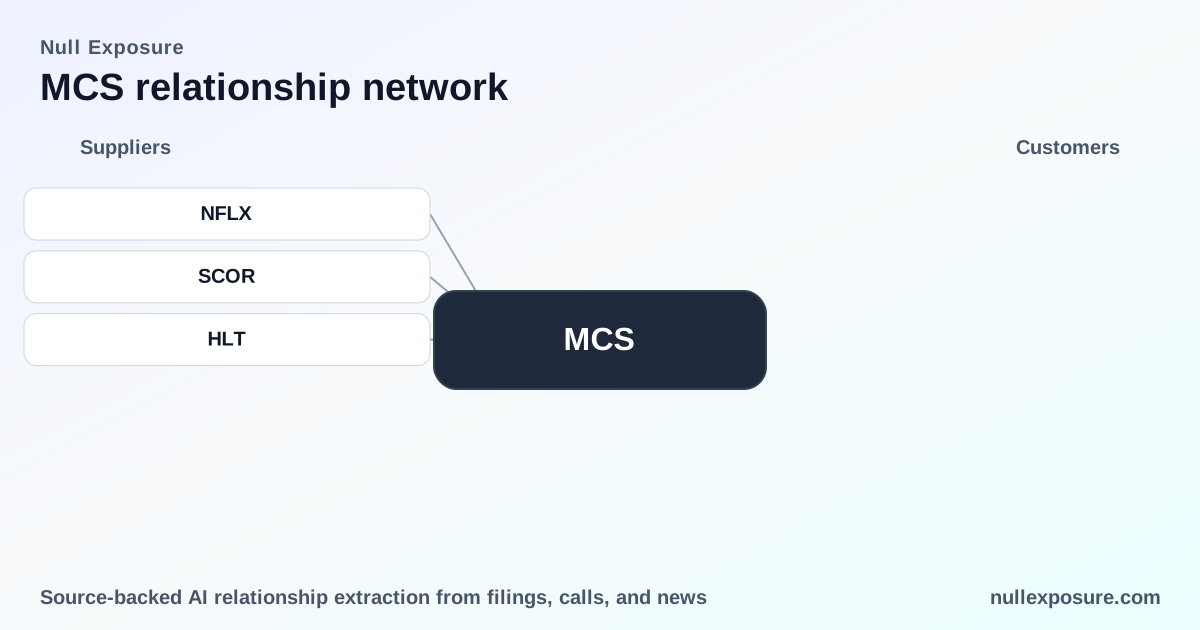
Marcus Corporation (MCS): supplier relationships that move the theater and hotel cash flow needle
Marcus Corporation runs a dual hospitality and exhibition business, monetizing through box office admissions, concessions and event programming at movie theaters, and room revenue plus management fees in its hotels & resorts business. The company sources films on a film-by-film licensing basis from major studios and distributors while operating owned and managed hotel assets under national flags, generating a mix of volatile content-driven revenue and steadier lodging cash flow. If you evaluate supplier exposure for underwriting or operational partnerships, prioritize film licensing cadence, third‑party distribution deals, and hotel brand/management relationships. Learn more at https://nullexposure.com/.
How Marcus contracts with content and brand partners — what investors should know
Marcus’s public disclosures describe a short-term, transactional contracting posture for film supply: the company competes for licenses “on a film-by-film and theatre-by-theatre basis,” which creates recurring negotiation points every release cycle. Company statements also emphasize film supply comes from several national motion picture production and distribution companies, signaling counterparties are large enterprises and the geographic footprint is North America-focused.
- Contracting posture: Short-term film licenses create high revenue volatility tied to release slates and exclusivity windows.
- Counterparty profile: Large studios and distributors are the dominant suppliers, limiting dependency on any single provider but concentrating bargaining power upstream.
- Geography and criticality: The model is North America-centric; film supply and guest demand are critical to theater economics, while hotel performance benefits from national brand affiliation and management contracts.
- Maturity and service relationships: Marcus operates through both ownership and management arrangements; ancillary disclosures (e.g., auditor consents) flag standard corporate governance relationships rather than supplier concentration.
These company-level signals imply high cadence commercial negotiation on the film side, stable but brand-dependent hotel partnerships, and limited supplier lock‑in outside of strong brand agreements. Explore strategic supplier exposure further at https://nullexposure.com/.
Supplier relationships that shape revenue and risk
Netflix — theatrical windows and special releases
Marcus has engaged with Netflix for theatrical runs on special titles that receive a short exclusive cinema window before OTT release; Marcus confirmed it would play Netflix’s Army of the Dead with a one‑week theatrical exclusivity before streaming. This illustrates how selective streaming partnerships can drive incremental box office for specific titles. (Deadline, May 2021: https://deadline.com/2021/05/marcus-ceo-greg-marcus-movie-theaters-arclight-cinemas-pacific-theaters-1234750348/)
Comscore — box office benchmarking and competitive intelligence
Marcus uses third‑party box office measurement from firms like Comscore to benchmark performance; Marcus cited Comscore data showing it outperformed the industry on admission revenues versus pre‑pandemic 2019 levels. Firms such as Comscore provide the competitive context that Marcus uses in investor communications and operational planning. (Deadline, Nov 2021: https://deadline.com/2021/11/marcus-movie-theaters-box-office-1234867019/)
Hilton — brand affiliation and management arrangements
Marcus Hotels & Resorts operates properties under national flags; the company announced a managed rebranding to Hilton’s Tapestry Collection for a property in Minnesota, marking the first Tapestry flag in that state and signaling Marcus’s use of national flags to drive occupancy and ADR. Brand affiliations like Hilton’s support distribution and reservation scale for Marcus’s hotel business. (HospitalityNet announcement, FY2024: https://www.hospitalitynet.org/announcement/41010760.html)
Hilton Milwaukee — capital investment under national brand expectations
Marcus disclosed that a sizable portion of fiscal 2025 capital expenditures related to the Hilton Milwaukee renovation and maintenance across businesses, showing the company funds property-level upgrades to meet brand standards and maintain competitive positioning. This illustrates how hotel brand relationships translate into periodic, material capex cycles. (Q4 2025 earnings call transcript coverage, FY2026: https://www.insidermonkey.com/blog/the-marcus-corporation-nysemcs-q4-2025-earnings-call-transcript-1705266/)
What these relationships mean for value and risk
Marcus’s supplier map shows two parallel risk engines: the film licensing market (high-frequency, studio-driven, content risk) and the hotel branding/management market (lower-frequency, capital-intensive, brand-dependent). Financial metrics underline this hybrid exposure: FY‑TTM revenue of ~$718M with EBITDA around $90M, compressed profit margins, and a trailing P/E near 38, while EV/EBITDA sits at a moderate 8.8 — indicative of a company whose earnings are recovering but remain sensitive to content cycles and lodging occupancy.
Key investment implications:
- Positive: National studio relationships and occasional streaming tie-ins (Netflix) can create box office upside for select titles; hotel brand management provides revenue diversification and recurring fee-based income.
- Structural risk: The short-term film licensing model produces quarter-to-quarter revenue swings and requires active programming and marketing to sustain admissions.
- Capital cycle risk: Brand-driven renovations (e.g., Hilton Milwaukee) imply episodic capex requirements that compress free cash flow when executed.
- Data/benchmarking advantage: Use of firms like Comscore helps Marcus target programming and allocate marketing efficiently, a competitive edge for exhibitor-level optimization.
Tactical takeaways for investors and operators
- For investors: evaluate film slate exposure on an upcoming-quarter basis and stress-test hotel occupancy/ADR under different macro scenarios; focus on cash conversion during heavy capex cycles.
- For operators/partners: leverage national brand affiliation to improve distribution and pricing power, and negotiate film delivery terms that allow flexibility for event and premium programming.
Consider deeper supplier-informed analysis and deal screening—visit https://nullexposure.com/ to get focused supplier intelligence and relationship risk profiles.
Final view and next steps
Marcus’s supplier network is balanced between transactional film supply from large studios and strategic hotel brand partnerships, producing a hybrid cash flow profile that rewards programming execution and disciplined capital allocation. For underwriters and operators, the central questions are how Marcus manages licensing cadence and absorbs periodic hotel capex without eroding cash flow. For investors, monitor near-term release schedules, Comscore performance trends, and upcoming renovation commitments as the primary drivers of earnings variance.
If you want a structured supplier-risk briefing or to model counterparty exposure for MCS, start here: https://nullexposure.com/. For ongoing monitoring of supplier relationships and operational signals, visit https://nullexposure.com/ and request a focused briefing.