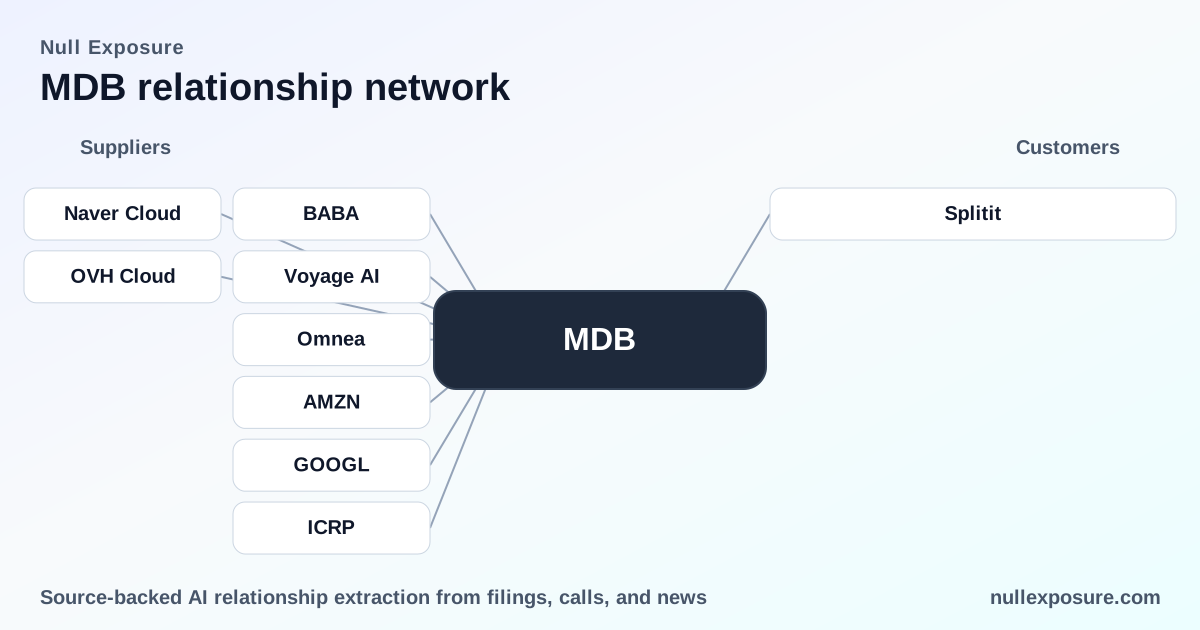
MongoDB (MDB): supplier map and what it means for investors and operators
MongoDB operates a global, general-purpose database platform and monetizes through subscription and usage-based services for its managed cloud product (Atlas), enterprise software licenses and professional services. The company drives revenue growth by expanding cloud partnerships and embedding its database into customers’ application stacks, converting on-premise workloads to managed Atlas subscriptions and upselling value-add features. For a concise view of supplier exposure and third-party integrations that affect operations and go-to-market, see Null Exposure’s research hub: https://nullexposure.com/.
Why the supplier picture matters for valuation and risk
MongoDB’s economics are built on recurring cloud-hosted consumption and strategic OEM/cloud partnerships that accelerate customer adoption globally. Supplier and partner relationships are not peripheral — they are a core channel and operational dependency: cloud vendors enable distribution and billing, specialist AI providers broaden product capability, and investor relations firms move capital markets narratives. Investors and operators must evaluate counterparty concentration, contract posture and integration criticality alongside growth metrics (MongoDB’s TTM revenue ~ $2.46bn and 26.7% quarterly revenue growth year-over-year). For more supplier intelligence, visit https://nullexposure.com/.
What the reporting shows about every supplier relationship
Below are the relationships surfaced in the available reporting, with a concise, plain-English summary and source citation for each item.
Amazon Web Services (AWS)
MongoDB lists AWS as a major cloud partner that helped accelerate a strong quarter; AWS is a primary hosting and distribution channel for Atlas customers. According to a company release reported in Daily Freeman during Q1 FY2022, partnerships with AWS contributed materially to MongoDB’s go-to-market momentum. Source: Daily Freeman (June 2021) — https://www.dailyfreeman.com/2021/06/03/mongodb-inc-announces-first-quarter-fiscal-2022-financial-results/
Google Cloud
Google Cloud is identified alongside AWS as a strategic cloud partner that broadened managed-service reach and supported Atlas adoption during MongoDB’s reported strong quarter. The same Q1 FY2022 report highlighted Google Cloud as a key channel partner. Source: Daily Freeman (June 2021) — https://www.dailyfreeman.com/2021/06/03/mongodb-inc-announces-first-quarter-fiscal-2022-financial-results/
Alibaba
Alibaba is documented as a major cloud partner that expanded MongoDB’s distribution in Asia and contributed to an accelerated quarter. The June 2021 company results cited Alibaba with AWS and Google Cloud as drivers of MongoDB’s strongest quarter to date. Source: Daily Freeman (June 2021) — https://www.dailyfreeman.com/2021/06/03/mongodb-inc-announces-first-quarter-fiscal-2022-financial-results/
OVH Cloud
OVH Cloud is referenced as an OEM cloud partner, deployed to expand managed-service options in Europe and support regional customers who require local cloud infrastructure. The Q1 FY2022 update describes OVH Cloud as part of MongoDB’s OEM cloud expansion. Source: Daily Freeman (June 2021) — https://www.dailyfreeman.com/2021/06/03/mongodb-inc-announces-first-quarter-fiscal-2022-financial-results/
Naver Cloud
Naver Cloud is cited as a Korea-based OEM cloud partner added to broaden managed-service availability in Asia and give enterprise customers another hosting option for Atlas. This relationship was noted in the same Q1 FY2022 release. Source: Daily Freeman (June 2021) — https://www.dailyfreeman.com/2021/06/03/mongodb-inc-announces-first-quarter-fiscal-2022-financial-results/
Voyage AI
MongoDB has integrated Voyage AI models into its core platform, signalling vendor-supplied AI capabilities are being used to enhance product features and competitive positioning in FY2026 commentary. This integration reflects a trend of embedding third-party machine learning models into the product stack. Source: SahmCapital analysis (Jan 21, 2026) — https://www.sahmcapital.com/news/content/mongodb-expands-ai-platform-as-valuation-and-momentum-raise-questions-2026-01-21
Omnea
Omnea cites MongoDB as a key customer within its expanding U.S. enterprise procurement reach, indicating MongoDB’s role as both buyer and reference customer in broader enterprise sourcing networks in FY2026. This relationship frames MongoDB as part of procurement ecosystems that vendors use for enterprise sales momentum. Source: SahmCapital analysis (Jan 31, 2026) — https://www.sahmcapital.com/news/content/mongodb-gains-ai-procurement-exposure-as-omnea-expands-us-enterprise-reach-2026-01-31
ICR (Investor Relations)
ICR served as an investor relations contact across multiple convertible note financings and public communications (documented in PR Newswire releases for FY2018 and FY2020), indicating established IR support for capital markets and debt transactions. These PR Newswire notices list ICR as the contact for MongoDB’s convertible notes offerings. Sources: PR Newswire (FY2020) — https://www.prnewswire.com/news-releases/mongodb-announces-pricing-of-upsized-1-0-billion-convertible-senior-notes-offering-300984868.html; PR Newswire (FY2018) — https://www.prnewswire.com/news-releases/mongodb-announces-pricing-of-upsized-250-million-convertible-senior-notes-offering-300672134.html
Operating model signals and constraints (company-level)
The dataset provided contains no explicit third-party contractual constraints. That absence is a signal in itself: public reporting here focuses on partnership announcements and investor communications rather than detailed vendor contracts. Investors and operators should interpret the supply picture through these company-level characteristics:
- Channel-driven contracting posture: MongoDB relies on cloud partners for distribution and billing; supplier agreements are likely structured as channel/OEM arrangements that prioritize market reach over exclusive supply terms.
- Concentration risk in hosting and distribution: Major cloud providers (AWS, Google Cloud, Alibaba) are core commercial partners; dependency on a handful of hyperscalers increases concentration risk, particularly for billing and regional routing of Atlas traffic.
- Integration criticality: Partnerships with AI vendors like Voyage AI indicate operational reliance on third-party models to extend product capability, making these integrations functionally important for product differentiation.
- Maturity and diversification: The presence of OEM relationships with OVH and Naver Cloud shows geographic diversification for customers that require non-hyperscaler options, reducing single-cloud exposure for certain segments.
- Capital markets support: Repeated use of ICR for investor relations across financings points to an established capital-markets communications strategy and external support for debt/equity issuance.
Investment and operational takeaways
- Growth channel is also an operational dependency. Cloud partnerships accelerate revenue but create counterparty concentration and contractual reliance; monitor changes in cloud pricing, platform terms, and OEM arrangements for margin impact.
- Third-party AI integrations are strategic extensions, not mere add-ons. Integrations such as Voyage AI expand product capability quickly but bring model dependency and procurement complexity that operations teams must manage.
- Regional OEM partnerships reduce single-cloud exposure. OVH and Naver Cloud provide options for compliance and localization, which supports enterprise adoption in regulated markets.
For a deeper supplier risk profile and tailored exposure analysis, visit Null Exposure to commission research or request a supplier-side briefing: https://nullexposure.com/.
Final recommendation for investors and operators
Focus diligence on contract terms with hyperscalers (billing, data egress, service levels), the commercial arrangements that monetize Atlas, and the operational resilience of third-party AI integrations. Monitor public disclosures and partner announcements closely; they drive both growth and counterparty risk. For ongoing supplier intelligence and to understand how these relationships affect valuation and operational continuity, explore Null Exposure’s platform and expert reports at https://nullexposure.com/.