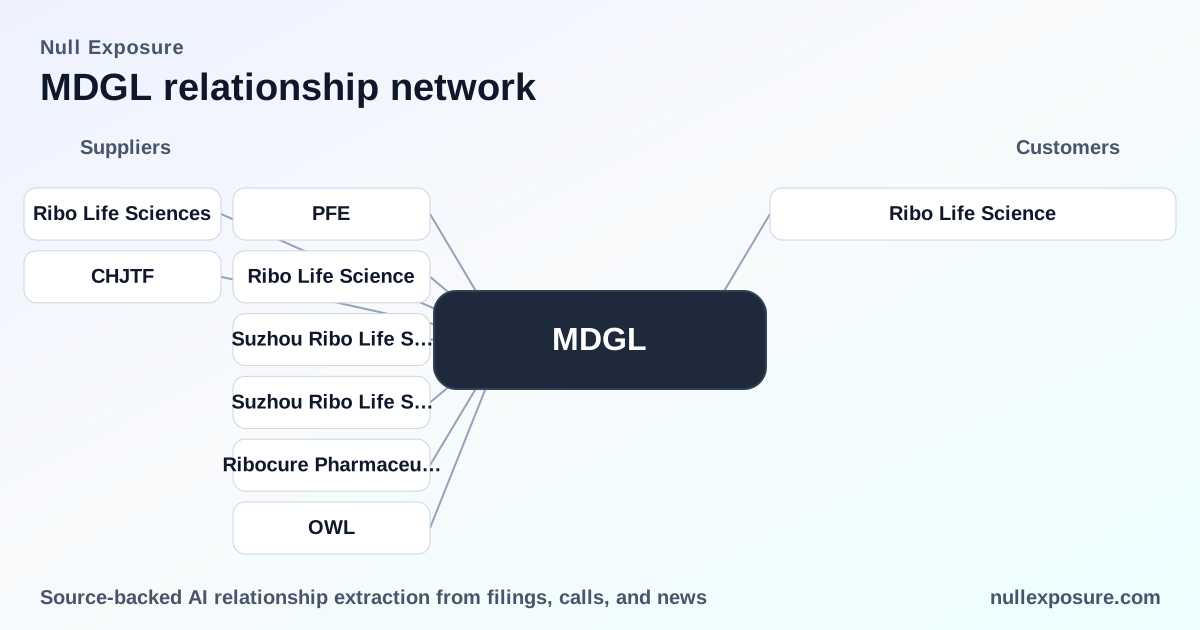
Madrigal Pharmaceuticals (MDGL): supplier relationships that shape commercial scale-up and pipeline breadth
Madrigal Pharmaceuticals is a clinical-stage biopharma that monetizes through licensing, drug development and the commercialization of Rezdiffra (resmetirom) and an expanding MASH (metabolic dysfunction‑associated steatohepatitis) franchise built by licensing and alliance deals. The company runs a virtual manufacturing model—outsourcing API and finished‑product production while retaining development, regulatory and commercial control—and it funds scale with a mix of upfront licensing, capital markets and structured credit. For investors and operators, the critical signals are concentration of outsourced manufacturing, multi-year supply contracts with volume pricing, and a deliberate strategy to top up the pipeline via external R&D partnerships.
Explore broader supplier analytics at https://nullexposure.com/ for comparative supplier risk scoring.
What the recent deal flow says about Madrigal’s operating model
Madrigal’s supplier and partner strategy is transactional and scale-focused: the company licenses novel candidates from Big Pharma and specialty biotech, then outsources manufacturing and distribution rather than building in‑house capacity. That operating posture delivers capital efficiency and faster pipeline expansion, but it also creates concentration and supplier‑operation risk because commercial supply, API sourcing and specialty distribution are outsourced under multi‑year agreements with volume-driven pricing.
- Contract posture: The company uses long-term agreements with automatic renewals and usage‑based pricing for manufacturing — a mix that preserves flexibility while locking in suppliers for core products. Company disclosures cite multi-year supply agreements with renewal mechanics and volume‑linked purchase pricing (UPM, Evonik excerpts in filings).
- Concentration & criticality: Rezdiffra’s supply chain relies on a small set of CMOs and a specialty pharmacy distribution network, making those supplier relationships operationally critical.
- Maturity & financing: Madrigal complements licensing with structured credit to fund pipeline advancement rather than diluting equity; a senior secured facility from Blue Owl is a recent example.
If you need a concise vendor risk profile or to benchmark these relationships across peers, visit https://nullexposure.com/ for supplier mapping and exposure analytics.
Supplier and alliance roll call — what was reported (sources and plain-English takeaways)
Pfizer — exclusive licensing and a series of MASH candidate deals
Madrigal acquired exclusive global rights to ervogastat and has licensed additional MASH candidates from Pfizer, including a deal with a reported $50 million upfront payment that expands Madrigal’s combination‑therapy strategy. (Finviz, March 10, 2026; Pharmaphorum, March 10, 2026 — https://finviz.com/news/309475/mdgl-strengthens-mash-franchise-with-new-genetic-approaches; https://pharmaphorum.com/news/madrigal-builds-mash-44bn-ribo-alliance)
Suzhou Ribo Life Science (Ribo) — siRNA pipeline licensing to broaden genetic modalities
Madrigal signed an exclusive global license with Suzhou Ribo Life Science for six preclinical siRNA programs to augment its MASH franchise and provide combination opportunities with small molecules. (Pharmaphorum and The Pharma Letter, March 10, 2026 — https://pharmaphorum.com/news/madrigal-builds-mash-44bn-ribo-alliance; https://www.thepharmaletter.com/biotech-news/madrigal-expands-its-mash-pipeline-via-ribo-deal)
Ribocure Pharmaceuticals AB — subsidiary included in the Ribo agreement
The licensing agreement explicitly covers Ribocure (a Ribo subsidiary), granting Madrigal an exclusive global license to develop, manufacture and commercialize six siRNA compounds as part of the Ribo deal. (Finviz, PennBizReport, The Pharma Letter, March 10, 2026 — https://finviz.com/news/309475/mdgl-strengthens-mash-franchise-with-new-genetic-approaches; https://pennbizreport.com/news/32168-madrigal-pharmaceuticals-secures-global-licensing-agreement/; https://www.thepharmaletter.com/biotech-news/madrigal-expands-its-mash-pipeline-via-ribo-deal)
Blue Owl Capital — structured senior secured financing to accelerate pipeline
Madrigal entered a senior secured credit facility managed by funds at Blue Owl providing up to $500 million to advance pipeline programs and extend its MASH leadership position. (Yahoo Finance Singapore reporting on Q4 2025 results — https://sg.finance.yahoo.com/news/madrigal-pharmaceuticals-reports-fourth-quarter-120000017.html)
Ribo Life Sciences (management commentary) — strategic siRNA collaboration referenced on earnings call
Management reiterated the strategic importance of working with Ribo Life Sciences to develop siRNA assets during the Q4 2025 earnings call and related transcripts. (InsiderMonkey transcript of Q4 2025 earnings call — https://www.insidermonkey.com/blog/madrigal-pharmaceuticals-inc-nasdaqmdgl-q4-2025-earnings-call-transcript-1699679/)
CSPC Pharma — GLP‑1 asset licensing to diversify oral modality exposure
Madrigal licensed an oral GLP‑1 candidate, MGL‑2086, from CSPC Pharma and is moving toward human testing, further diversifying modality risk across oral and genetic approaches. (Pharmaphorum, March 10, 2026 — https://pharmaphorum.com/news/madrigal-builds-mash-44bn-ribo-alliance)
Operating constraints and supplier risk signals you should track
Company disclosures and contract excerpts surface several cross‑cutting constraints that shape operational exposure:
- Long‑term supply commitments with automatic renewals are in place for key suppliers, signaling stability but also potential lock‑in and renegotiation risk as volumes scale (excerpted contract terms reference expirations in 2029 and 2032 with renewal clauses).
- Usage‑based pricing on manufacturing and API supply introduces variable COGS tied to production volumes, which preserves capital but transfers margin volatility to supplier pricing dynamics.
- Geographic split of supply is explicit: the U.S. commercial supply is covered by a UPM Pharmaceuticals agreement (primary U.S. supplier), while a German‑based manufacturer is contracted to serve Europe and as a secondary U.S. source—this provides redundancy but concentrates risk in a few qualified sites.
- Outsourced manufacturing and distribution is the default model: Madrigal does not own production facilities and relies on CMOs for API, finished product and specialty pharmacy partners for patient delivery—this is operationally efficient but creates critical single‑point dependencies.
- Service provider dependency for trials: clinical execution is outsourced to CROs and specialist service providers, making trial timelines dependent on external capacity and vendor performance.
Each of these signals is a governance and operational priority for management and procurement: contract terms, dual sourcing, inventory strategy and contingency qualification will determine whether outsourcing becomes a competitive advantage or a constraint.
If you are comparing supplier posture across biotechs, see vendor concentration scoring and contract-term extracts at https://nullexposure.com/ to inform diligence.
Investment implications and risk framework
- Upside: License deals with Pfizer and Ribo plus an oral GLP‑1 from CSPC expand Madrigal’s shots‑on‑goal and potential combination regimens—this increases optionality for peak sales and clinical readouts. Blue Owl’s facility reduces immediate capital constraints and accelerates development.
- Downside: The commercial model is heavily dependent on a small set of CMOs and specialty distributors, and the pricing mechanics in supply contracts create margin sensitivity to volume assumptions. Regulatory setbacks or supplier disruptions would have an outsized impact on revenue delivery and gross margins.
- What to watch next: progress on MASH combination trials, confirmation of multi‑site commercial production readiness (UPM/Evonik qualification milestones), and how licensing milestones and royalty economics flow through to cash‑runway and net leverage.
Bottom line and next steps
Madrigal’s recent partnerships represent a clear strategic bet: expand modality breadth through external licensing while outsourcing manufacturing and distribution to scale quickly. That strategy accelerates pipeline growth and preserves capital but concentrates operational risk in a handful of supplier relationships and contract terms. For investors and operators, the actionable focus is supplier diversification, contract transparency, and milestone cadence that de‑risks commercial scale-up.
For a side‑by‑side supplier risk comparison and contract-term benchmarking, visit https://nullexposure.com/ to view supplier exposure dashboards and tailored diligence tools.