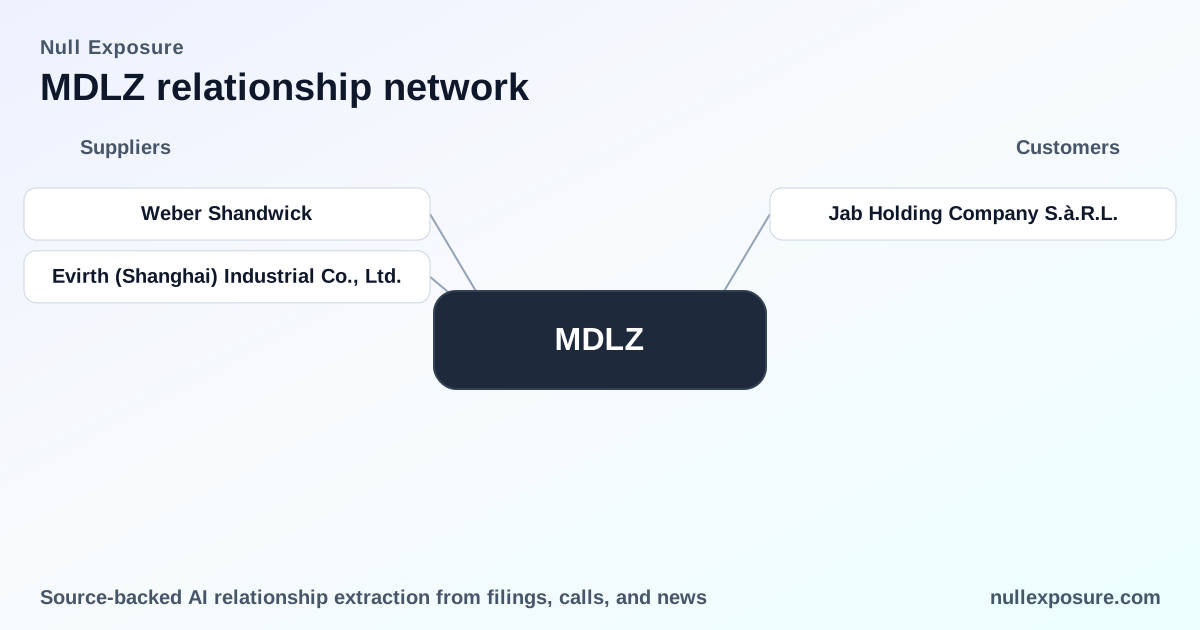
Mondelez (MDLZ) supplier profile: what investors and operators need to know
Mondelez International operates as a global confectionery and snack manufacturer that monetizes through branded packaged goods sales and strategic equity stakes in regional manufacturing partners. The company captures margin via scale in procurement and distribution, leverages brand-led pricing power, and augments growth with targeted acquisitions and majority-stake investments in local suppliers. For investors and procurement operators, Mondelez’s supplier relationships are both operational levers and risk vectors: they reduce manufacturing friction in core markets while concentrating exposure to foreign-currency movements and supplier integration execution.
If you want a consolidated view of Mondelez supplier linkages and commercial signals, explore the full supplier profile on NullExposure: https://nullexposure.com/
How Mondelez uses supplier partnerships to execute strategy
Mondelez combines direct manufacturing with equity investments in local producers and agency/PR relationships to scale new product launches and localize supply chains. This approach produces three operational effects: (1) faster market entry via majority-stake acquisitions in local plants, (2) brand amplification through strategic communications partners when launching co-branded products, and (3) procurement exposure to global ingredient markets and FX. Financially, the company’s FY figures support this model—Revenue TTM $38.5bn and EBITDA $4.99bn, with a market cap around $73.8bn—giving Mondelez the balance-sheet capacity to pursue bolt-on stakes and pay for agency services that accelerate product rollouts.
Explore supplier intelligence tools and supplier-level signals at NullExposure: https://nullexposure.com/
Relationship coverage — what the data shows (two relationships)
Weber Shandwick — PR partner on product launches
Weber Shandwick appears as the media contact for an Oreo co-branded product launch tied to the Marvel/Oreo collaboration, indicating Mondelez leverages established global PR agencies to manage high-profile product introductions and public communications; the press contact listing is shown in the Weber Shandwick press release for the Marvel Oreo product (Weber Shandwick press release, Feb 19, 2026, https://www.sahmcapital.com/news/content/introducing-the-marvel-oreo-stuf-of-doom-cookies-the-culmination-of-marvel-and-the-oreo-brands-iconic-collaboration-2026-02-19).
Evirth (Shanghai) Industrial Co., Ltd. — increased ownership of Chinese manufacturing
Mondelez agreed to acquire an additional majority stake in Evirth (Shanghai) Industrial Co., Ltd., signaling continued consolidation of local manufacturing capacity in China to support regional brands and supply-chain control; this transaction was reported in a Simply Wall St summary referencing the acquisition (Simply Wall St, reported Mar 2026, https://simplywall.st/stocks/us/food-beverage-tobacco/nasdaq-mdlz/mondelez-international/future).
What these supplier relationships imply for investors and operators
- Strategic acquisition of local manufacturers (Evirth): Mondelez’s willingness to increase majority stakes shows a preference for ownership over arms-length supplier contracts where scale and market access justify capital deployment. This reduces vendor risk over the medium term and increases operational control in a strategically critical market (China), while also concentrating integration risk and capital intensity.
- Use of global PR agencies (Weber Shandwick): For brand-driven launches, Mondelez uses established agencies to accelerate consumer awareness and protect brand equity; this highlights a higher cost-to-serve for premium product launches but also enables rapid revenue capture from marketing-backed SKUs.
- Profitability and leverage context: With an EV/EBITDA of 18.11 and forward P/E near 18.0, Mondelez trades on quality and growth expectations; supplier-driven investments are financed from a strong institutional investor base (institutions own ~88.7% of shares), so acquisitions and agency spend are consistent with a capital allocation profile that favors market share and brand investment.
Company-level constraints and operating model signals
The constraint evidence provides a company-level signal rather than a relationship-specific restriction. Mondelez displays characteristics important to supplier risk assessment:
- Contracting posture: The firm structurally operates as a seller of finished goods and controls portions of its upstream supply chain through equity stakes; procurement contracts and ownership balance give Mondelez negotiating leverage, particularly where it owns manufacturing facilities.
- Concentration and criticality: Global sourcing of ingredients introduces concentrated exposure to commodity prices and FX; the company explicitly ties transaction costs to currency movements because ingredients are sourced internationally, elevating the criticality of supplier and commodity risk management.
- Maturity and integration: The mix of PR agency engagements and majority-stake acquisitions indicates a dual approach: mature, outsourced services for consumer-facing activities and deeper ownership where manufacturing scale or regulatory/localization needs require it.
Collectively, these constraints point to a supplier strategy that is control-oriented in manufacturing and partnership-oriented in marketing—a model that reduces certain third-party operational dependencies while increasing capital and integration exposures.
Risk considerations for investors and procurement teams
- Currency and commodity sensitivity: Global ingredient sourcing drives transaction-cost volatility; hedging and supplier diversification are material to margin stability. Mondelez’s profit margin (6.36%) and operating margin (9.53%) provide buffer but are exposed to sudden commodity or FX shocks.
- Execution risk on integrations: Additional majority stakes such as the Evirth transaction increase integration risk—realizing synergies requires systems, regulatory alignment, and cultural integration.
- Reputational and demand risk tied to PR: High-visibility launches managed through agencies create short-term revenue uplifts but increase reputational leverage; missteps in product launches translate quickly into brand and stock reactions.
Actionable takeaways
- Monitor equity investments in regional manufacturers as leading indicators of Mondelez’s capital deployment strategy and margin trajectory; these shifts have immediate operational implications for procurement and supply continuity.
- Track PR and agency engagements around major co-brands to anticipate short-term demand spikes that will pressure manufacturing and logistics.
- Assess FX and commodity hedging disclosures in quarterly filings to quantify how Mondelez is mitigating the supplier-driven transaction cost exposures referenced in company disclosures.
For a deeper supplier-by-supplier view and actionable alerts tailored for corporate diligence or portfolio monitoring, see the full profile at NullExposure: https://nullexposure.com/
Conclusion — how to use this profile
Investors should treat Mondelez’s supplier relationships as both a growth lever and a concentrated operational exposure: ownership of local plants increases control and potential margin upside, while global sourcing and high-profile launches increase sensitivity to FX, commodities, and execution risk. Procurement teams and operators must align integration plans, hedging strategies, and agency timelines to secure margin resilience. For ongoing monitoring of Mondelez’s supplier linkages and to receive relationship-level signals, visit NullExposure and subscribe for alerts: https://nullexposure.com/
Bold takeaway: Mondelez is deploying capital to convert supplier relationships from transactional to strategic ownership while outsourcing high-impact marketing to global agencies—this combination strengthens market access but raises execution and FX risk that investors must price into valuation.