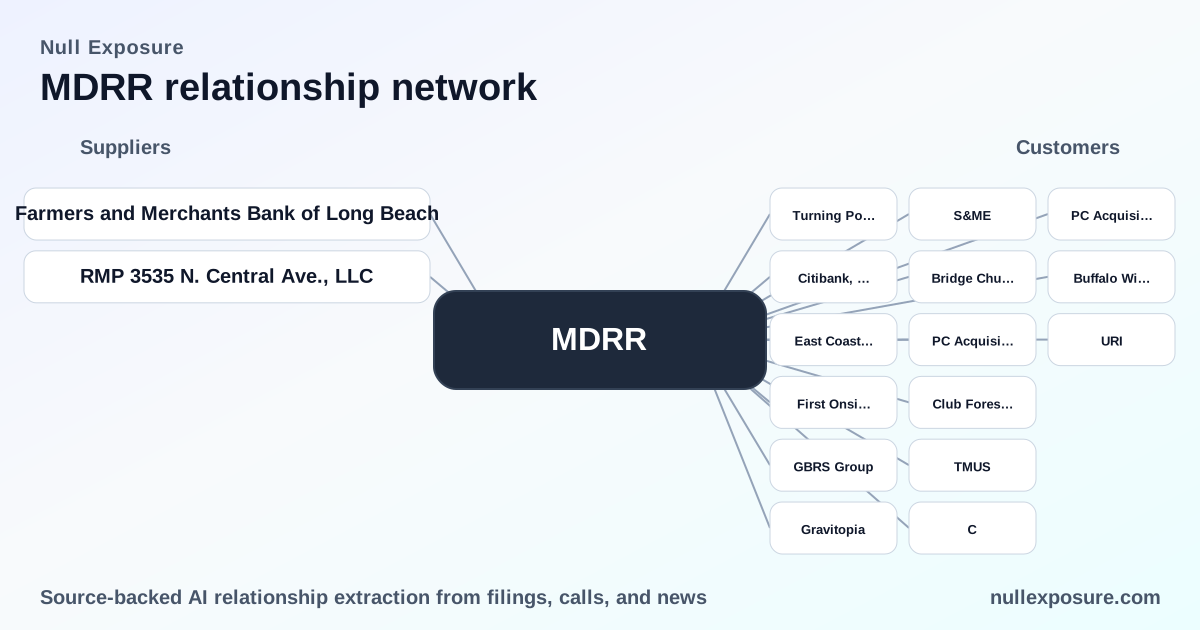
Medalist Diversified REIT (MDRR): Supplier relationships and balance-sheet implications
Medalist Diversified REIT operates as a small-cap, property-investment vehicle that acquires, repositions, and disposes of commercial real estate while outsourcing day-to-day operations to third-party managers. The company monetizes through rental income from its portfolio, opportunistic property sales and capital recycling, and selective use of credit facilities to bridge acquisitions and dispositions. Recent asset sales and the full repayment of a short-term credit line materially change the firm’s liquidity posture and counterparty exposure. For a concise dossier of supplier and counterparty relationships, visit https://nullexposure.com/.
What the company is and how it contracts with vendors
Medalist is a Maryland REIT formed in 2015 that runs a compact portfolio (Revenue TTM ≈ $10.4M; Market Cap ≈ $16.2M). Operationally, the company contracts out property management, which positions third-party managers as critical service providers rather than internal cost centers. That contracting posture reduces in-house operational overhead but increases vendor dependency and requires disciplined vendor governance given the company’s limited scale.
- Concentration signal: Insiders control a majority stake (≈56.8% insider ownership) while institutional ownership is low (≈3.7%), indicating that procurement and supplier decisions are likely influenced by a small group of stakeholders and potentially less subject to diversified institutional oversight.
- Scale and maturity: Small market capitalization and modest revenue base imply that supplier relationships are highly material to operations — single vendor failures or credit shocks can have outsized effects.
- Typical transaction size: Historical property purchases indicate transaction bands in the $10M–$100M range, supporting a mid-market procurement profile rather than pure boutique or enterprise-scale contracting.
Learn more about how we track supplier exposure at https://nullexposure.com/.
Two supplier/partner relationships to know now
Farmers and Merchants Bank of Long Beach — credit facility repaid
Medalist repaid and terminated a $14.7 million credit line with Farmers and Merchants Bank of Long Beach using cash on hand and proceeds from earlier property sales, releasing related guarantees and obligations on December 30, 2025. According to a press release captured by The Globe and Mail and filed for public reporting in early March 2026, this action cleans the balance sheet and reduces short-term leverage, removing a direct banking counterparty exposure associated with that facility. (Source: The Globe and Mail press release reporting on the December 30, 2025 repayment, first seen March 10, 2026.)
RMP 3535 N. Central Ave., LLC — asset sale / acquisition counterparty
Medalist acquired the Citibank property from RMP 3535 N. Central Ave., LLC in a transaction referenced in market summaries, recorded as a May 9 closing in the company’s deal chronology. The reporting summarized by SimplyWall indicates that this counterparty was a seller in a portfolio transaction, signaling the REIT’s ongoing activity in asset purchases as part of its repositioning strategy. (Source: SimplyWall summary referencing the May 9 transaction, first seen March 10, 2026.)
How these relationships affect risk and operational posture
The credit-line repayment to Farmers and Merchants Bank of Long Beach is the most consequential supplier event for investors: it materially reduces short-term counterparty credit risk and removes bank guarantees, improving financial flexibility. The transaction also signals a deliberate capital-recycling strategy where proceeds from property sales are prioritized to de-lever the balance sheet.
The deal with RMP 3535 N. Central Ave., LLC underscores the REIT’s continued reliance on third-party sellers and external real estate counterparties to execute portfolio strategy. That dynamic reinforces the company’s profile as an asset manager that relies on market liquidity and transaction execution capability rather than operational scale.
Supplier constraints and what they imply about the business model
Medalist’s supplier-related constraints, drawn from public disclosures, create a composite view of the company’s procurement and execution model:
- Service-provider contracting posture: The company outsources property management to third-party managers, which concentrates operational delivery with external vendors and elevates the importance of vendor selection and oversight.
- Spend-band signal ($10M–$100M): Historical acquisitions such as the $15.2M Ashley Plaza purchase (August 30, 2019) indicate that individual asset-level transactions commonly sit in the mid-market range, requiring banking relationships, title and closing services, and specialized third-party suppliers.
- Vendor criticality and maturity: Given the company’s small scale, each supplier relationship is highly critical; failures or disruptions at key vendors would be more consequential than at larger peers. Vendor maturity requirements therefore skew toward experienced, well-capitalized counterparties.
- Concentration of decision-makers: High insider ownership suggests procurement and counterparty decisions are concentrated, which accelerates execution but increases governance risk for external stakeholders.
These are company-level signals: they describe how Medalist runs its supplier ecosystem rather than attributing a constraint to a specific counterparty.
Investment implications for operators and research teams
- Balance-sheet improvement is immediate and tangible. The $14.7M credit-line termination materially reduces near-term financing risk and removes bank guarantees that had tied up capital.
- Execution risk remains centered on property transactions and vendor performance. The company’s model continues to rely on selling and buying individual assets in the $10M–$100M band and on third-party managers for occupancy and NOI delivery.
- Governance and counterparty oversight are priority areas. With insiders controlling the company and institutions underweight, independent monitoring of vendor contracts and transaction terms is essential for outside investors.
If you evaluate supplier relationships for portfolio risk, our platform provides structured supplier intelligence and counterparty tracking — start with the Medalist profile at https://nullexposure.com/ to see how these relationships evolve.
Bottom line and next steps
Medalist Diversified REIT has executed a decisive balance-sheet cleanup by eliminating a $14.7M credit facility and continues active portfolio turnover, including the Citibank property acquisition from RMP 3535 N. Central Ave., LLC. For investors, the key takeaway is a shifted risk profile: less short-term bank exposure but sustained reliance on mid-market transaction execution and external property managers. Monitor subsequent disclosures for changes in vendor composition, management contracts, and any new financing arrangements.
For focused counterparty intelligence and supplier relationship monitoring across small-cap REITs, visit https://nullexposure.com/ and review our supplier coverage.