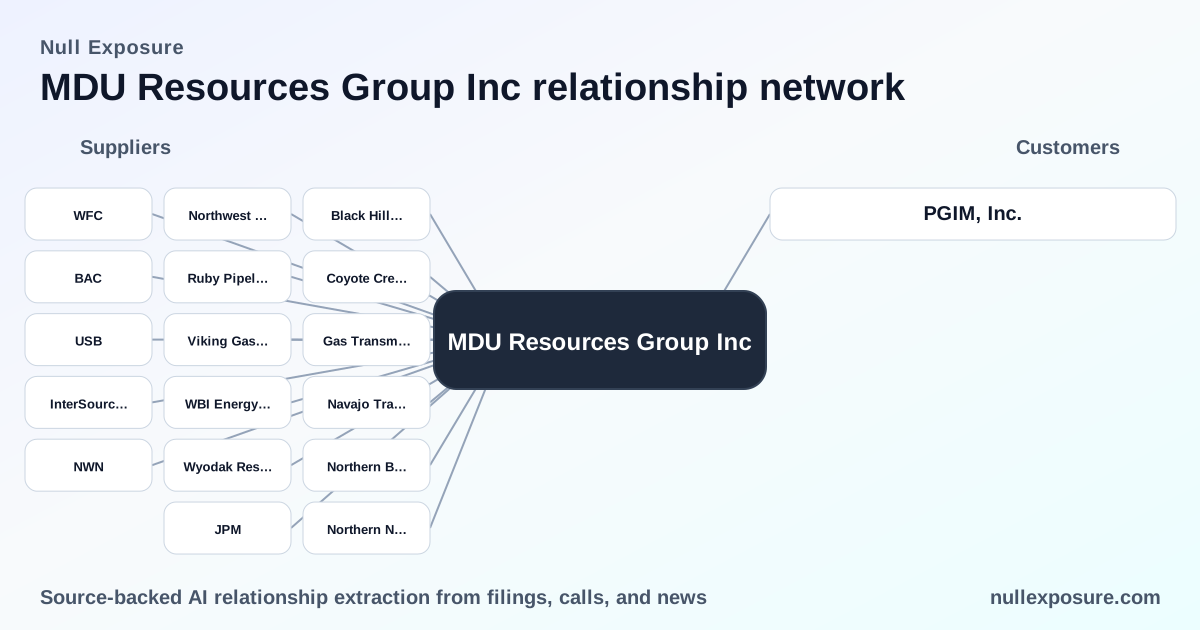
MDU Resources: Supplier Relationships That Anchor a Regulated Utility Investment
MDU Resources Group operates as a vertically integrated utilities and construction-services company, monetizing through regulated utility rate recovery, long-term fuel and transportation contracts, and fee-based construction and materials businesses. Revenue is driven by regulated electricity and gas delivery, recovered fuel costs under customer tariffs, and large committed capital projects supported by multi-year contractor and supplier agreements. For deeper supply-chain exposure and counterparty intelligence, visit https://nullexposure.com/.
What investors need to know up front
MDU’s operating model is built on long-dated procurement and transportation contracts, sizable purchase commitments, and captive insurance structures that convert operational inputs into rate-base or service revenue. Contract terms and counterparties determine fuel price pass-through, outage risk, and capital delivery timelines — all of which affect cash flow stability and regulatory outcomes. Underwriting relationships and bank facilities also shape liquidity and financing flexibility.
Explore a consolidated view of these supplier ties at https://nullexposure.com/ to inform sourcing and counterparty diligence.
Why these supplier relationships matter to valuation
MDU’s supplier posture shows four investment-relevant characteristics:
- Contracting posture: Long-term, fixed or indexed supply deals that stabilize fuel availability and regulatory pass-throughs, reducing merchant exposure.
- Concentration and criticality: A small set of pipeline and coal suppliers are functionally critical to plant operations and fuel transport; disruptions would be operationally significant.
- Maturity: Multi-decade contracts align with asset lives, transferring price and delivery risk into regulated recovery frameworks rather than the spot market.
- Spend scale: Material purchase commitments suggest sizable future cash outflows that are largely recovered through regulated tariffs or project billing.
The counterparties — what the filings and press releases show
Below are the supplier, transport, and financing counterparties disclosed in MDU’s filings and recent news, each with a concise plain-English description and source.
- Black Hills Energy — MDU transports and purchases natural gas under transportation arrangements that include Black Hills Energy as a pathway for delivering market-priced gas to the company. Source: MDU 2024 Form 10‑K (FY2024).
- Gas Transmission Northwest LLC — MDU uses transportation agreements with Gas Transmission Northwest LLC to move purchased natural gas under market-based pricing contracts. Source: MDU 2024 Form 10‑K (FY2024).
- Northern Border Pipeline Company — Northern Border Pipeline Company is a gas transportation counterparty used to deliver MDU’s contracted natural gas to delivery points. Source: MDU 2024 Form 10‑K (FY2024).
- Northern Natural Gas — MDU moves purchased natural gas under transportation agreements with Northern Natural Gas as part of its portfolio of delivery arrangements. Source: MDU 2024 Form 10‑K (FY2024).
- Northwest Pipeline LLC — Northwest Pipeline LLC is listed among the transport counterparties under which MDU runs market-priced supply contracts and pipeline transportation. Source: MDU 2024 Form 10‑K (FY2024).
- Ruby Pipeline LLC — Ruby Pipeline LLC appears as a contracted transporter in MDU’s natural gas supply portfolio, supporting the firm’s gas movements. Source: MDU 2024 Form 10‑K (FY2024).
- Viking Gas Transmission Company — Viking Gas Transmission Company is one of the pipeline partners that carry MDU’s purchased natural gas under transportation agreements. Source: MDU 2024 Form 10‑K (FY2024).
- WBI Energy Transmission — WBI Energy Transmission is included in the list of pipeline transportation agreements that enable delivery of MDU’s gas purchases. Source: MDU 2024 Form 10‑K (FY2024).
- Northwest Natural (NWN) — Northwest Natural is another transportation counterparty noted in the 10‑K as part of MDU’s portfolio used to move market-priced natural gas. Source: MDU 2024 Form 10‑K (FY2024).
- Coyote Creek — Owners of Coyote Station, including Montana‑Dakota, have a coal supply contract with Coyote Creek that runs through December 2040, securing coal feedstock for that plant. Source: MDU 2024 Form 10‑K (FY2024).
- Navajo Transitional Energy Company, LLC — Navajo Transitional Energy Company supplies coal under an agreement that meets Big Stone Station’s fuel requirements through 2026. Source: MDU 2024 Form 10‑K (FY2024).
- Wyodak Resources Development Corp. — Montana‑Dakota maintains a coal supply agreement with Wyodak Resources to supply Wygen III under contracted pricing through June 1, 2060. Source: MDU 2024 Form 10‑K (FY2024).
- J.P. Morgan / JPMorgan Chase Bank — J.P. Morgan is serving as a joint lead bookrunner and is party to forward sale agreements and underwriting activity for MDU’s equity offering and forward-sale transactions per market reports. Source: Zacks report syndicated on Sharewise (December 2025) and TradingView headline (March 2026).
- Wells Fargo Securities / Wells Fargo Bank — Wells Fargo Securities is a joint lead bookrunner on MDU’s share issuance and Wells Fargo Bank is a counterparty to forward sale and hedging arrangements disclosed in market notices. Source: Zacks on Sharewise (December 2025) and TradingView (March 2026).
- BofA Securities / Bank of America — BofA Securities and Bank of America are joint lead bookrunners and forward sale counterparties in recent financing and hedging arrangements. Source: Zacks on Sharewise (December 2025) and TradingView (March 2026).
- U.S. Bank National Association — U.S. Bank is the administrative agent for MDU’s amended Five‑Year Revolving Credit Agreement, which was extended to December 11, 2030, improving near-term liquidity runway. Source: Press release reported by The Globe and Mail (March 2026).
- InterSource Insurance Company — Through Centennial Capital, InterSource operates as a captive insurer underwriting certain MDU subsidiary risks, consolidating insurance expense and risk retention. Source: MarketScreener summary (March 2026).
Constraints and what they imply for MDU’s operating model
The filings and evidence produce clear company-level signals about procurement and financing:
- Long-term contracting is a structural element. MDU’s portfolio includes multi-decade coal and power purchase agreements and financing intended to be refinanced on a long-term basis, which translates to predictable fuel supply and amortized financing risk. This characteristic reduces merchant exposure and supports regulated rate recovery mechanics. (Evidence: 2024 Form 10‑K excerpts including Coyote Creek and Wyodak agreements.)
- MDU operates primarily as a buyer of fuel and transport services. Coal purchased under supply agreements is booked to inventory and recovered via electric fuel and purchased power charges to customers, indicating pass-through economics rather than merchant commodity exposure. (Company-level signal from 10‑K.)
- Supplier maturity and lead-time sensitivity factor into capex delivery. Management states active engagement with manufacturers to mitigate pricing and lead-time pressure for generation and pipeline equipment, signaling operational dependence on specialized suppliers. (Company-level signal from 10‑K.)
- Spend commitments are material. Reported purchase commitments total in the hundreds of millions to over a billion dollars across contracts, indicating significant contracted future cash flow that investors should reconcile with rate-base recovery and working capital. (Company-level signal from disclosed purchase commitments.)
Investment implications and a practical checklist
- Positive: Predictable fuel recovery and long-term supply cadence reduce volatility in regulated earnings; capital projects supported by long vendor lead-times favor stable execution if supplier relationships hold.
- Watch: Counterparty concentration and long tenors create operational risk if a transport line or coal supplier experiences disruption; regulators and contracts will determine ultimate cost recovery.
- Liquidity and financing: Recent amendments to the revolving credit facility and active equity/forward-sale syndication indicate management is proactively managing capital sources to fund acquisitions and working capital.
Actionable steps for investors: validate counterparty credit profiles for critical pipelines and coal suppliers, map contract expiration timelines against plant retirements and rate cases, and monitor financing syndicate activity for dilution or leverage shifts. Learn more about supplier concentration and counterparty risk at https://nullexposure.com/.
Bottom line
MDU’s supplier matrix is deliberately structured to support a regulated cash-flow profile: long-term fuel contracts, broad pipeline transportation coverage, and captive insurance reduce earnings volatility while creating large, contractually committed outflows. For investors and operators, the decisive factors are counterparty resilience, the longevity of supply contracts, and the company’s financing posture. For comprehensive supplier intelligence and to compare MDU’s counterparty risk across peers, visit https://nullexposure.com/.