Mediwound (MDWD) — supplier relationships and what they mean for investors
Mediwound is a specialized wound-care developer that monetizes through product sales, strategic clinical collaborations, and government-supported development programs. Its commercial profile combines direct market activity around enzymatic debridement (NexoBrid) and clinical-stage assets (EscharEx) with co-development and product-supply arrangements that validate clinical programs while keeping fixed-cost exposure contained. For active diligence, the supplier map is less about raw revenue share and more about market validation, partner risk-sharing, and access to complementary wound-care inputs.
Explore further on the NullExposure homepage: https://nullexposure.com/
Why the supplier list reads like strategic validation, not commodity buying
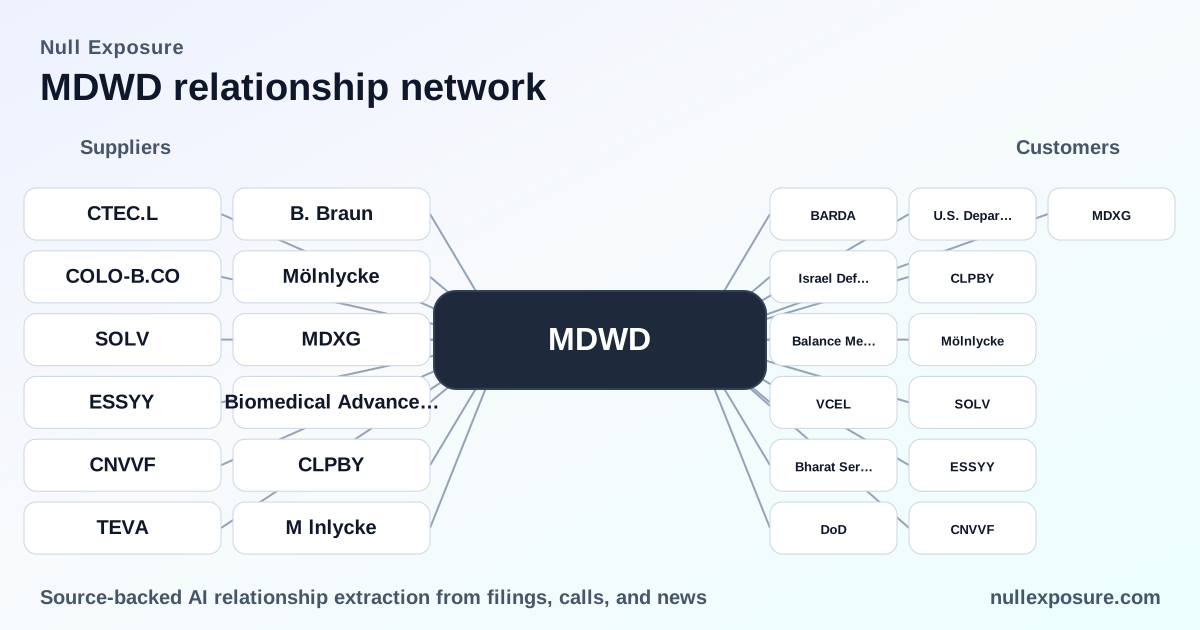
Mediwound’s supplier footprint in the latest disclosures is dominated by large wound-care OEMs and a federal development partner, indicating a deliberate strategy of clinical co-sponsorship and in-kind product provision rather than simple procurement. The roster—Coloplast, ConvaTec, Essity, Mölnlycke, Solventum, MiMedx, B. Braun—are established manufacturers whose participation signals clinical endorsement and logistical support for multi-arm trials. Separately, BARDA’s federal funding for NexoBrid underscores a different axis of value: non-dilutive financing and defense/trauma market relevance.
- Business model signal: Mediwound uses collaborators to de-risk clinical development and to ensure trial standard-of-care comparators and logistics are handled by incumbents, preserving cash while gaining distribution credibility.
- Commercial posture: Collaborative and partnership-driven; contracting is oriented to research collaborations and supply agreements rather than high-volume strategic sourcing.
Read the company context and supplier network at https://nullexposure.com/.
Relationship-by-relationship: who does what (concise investor view)
B. Braun — B. Braun joined the EscharEx clinical development program and will participate in the planned Phase II diabetic foot ulcer study; the company will supply its antimicrobial wound cleanser (Prontosan) to be used during dressing changes in both trial arms. Source: MDWD Q4 2025 earnings call and an earnings transcript republished on InsiderMonkey (Q4 2025 / published March 2026).
Mölnlycke — Mediwound lists Mölnlycke among existing collaborators supplying products into its clinical programs, signaling the use of Mölnlycke dressings or consumables as part of trial protocols. Source: MDWD Q4 2025 earnings call transcript (Q4 2025).
MiMedx — MiMedx is named as an existing collaborator supplying wound-care products into Mediwound’s clinical work, reinforcing the practice of sourcing established wound-matrix and dressing solutions from third-party specialists. Source: MDWD Q4 2025 earnings call and the Q4 2025 transcript on InsiderMonkey (FY2026 references).
Coloplast — Coloplast, referenced through its acquisition of Kerecis, is listed among collaborators providing product inputs for Mediwound trials, which indicates use of biological or engineered dressings within study arms. Source: InsiderMonkey transcript of the Q4 2025 earnings call (published March 2026).
Solventum — Solventum is on the collaborator list for Mediwound’s clinical programs and is supplying wound-care materials for trial comparators and standard-of-care procedures. Source: MDWD Q4 2025 earnings call and the related earnings transcript on InsiderMonkey (Q4 2025 / FY2026 context).
Essity — Essity appears as another established OEM providing dressings or ancillary wound-care products into Mediwound’s clinical collaborations, contributing to the standardized care processes used across trial sites. Source: MDWD Q4 2025 earnings call and the March 2026 earnings transcript (InsiderMonkey).
ConvaTec — ConvaTec is included among the roster of commercial collaborators supplying products to Mediwound’s clinical programs, helping to populate both arms of comparative studies with market-standard dressings. Source: MDWD Q4 2025 earnings call (Q4 2025) and the InsiderMonkey transcript (FY2026).
MiMedx (again referenced in media) — Media coverage repeats MiMedx’s role as a collaborator supplying product for clinical arms, confirming consistency across public messaging. Source: InsiderMonkey Q4 2025 earnings call transcript (published March 10, 2026).
BARDA — The Biomedical Advanced Research and Development Authority provided federal funds that supported NexoBrid development under contract HHSO100201500035C, reflecting non-dilutive government support tied to trauma and burn-care readiness. Source: GlobeNewswire press release on NexoBrid clinical data (Dec 10, 2025).
TEVA — Mediwound’s corporate updates note a repayment of liabilities in respect of TEVA during FY2025, indicating a past financing or liability relationship that was settled in that reporting period. Source: GlobeNewswire corporate update / third-quarter 2025 financial results (Nov 20, 2025).
What this network means for investors — practical implications
- Validation over volume: The participation of large wound-care manufacturers is a strategic signal of clinical validation rather than immediate commercial revenue; these partners supply complementary products into trials, which reduces Mediwound’s run-rate spend and accelerates enrollment logistics.
- Diversified supplier set reduces single-vendor concentration risk. The list spans multiple major vendors, lowering counterparty concentration on the supplier side.
- Government backing de-risks development cash flow. BARDA funding for NexoBrid is material for non-dilutive capital and elevated relevance in trauma markets.
- Operational risk centers on trial timelines and regulatory milestones, not raw supply availability. Partners provide standard-of-care consumables; the critical path is regulatory and clinical efficacy.
Dive deeper into partner dynamics on the NullExposure homepage: https://nullexposure.com/
Constraints and company-level signals
The collected records do not disclose explicit contractual constraints (no supplier exclusivity clauses or purchase commitments were provided). Presenting that as a company-level signal:
- Contracting posture: Collaborative and research-focused — Mediwound structures relationships as co-development and supply-for-trial arrangements rather than long-term exclusive procurement contracts.
- Concentration: Supplier base is broad across major OEMs, indicating low single-supplier dependency.
- Criticality: For commercial rollout, Mediwound’s proprietary products (NexoBrid/EscharEx) remain critical; partner-supplied dressings are complementary inputs used to standardize trial arms.
- Maturity: Partners are mature global wound-care companies, which increases reliability of trial execution and supply logistics.
Bottom line and action points for investors
Mediwound’s supplier relationships are strategic validation vehicles rather than traditional procurement exposures. The company leverages large OEMs to underwrite trial logistics and BARDA funding to shore up development capital. Together these dynamics increase clinical credibility while containing capital intensity—but they do not eliminate the core regulatory and commercial execution risk tied to clinical outcomes.
For further due diligence and a deeper read on partner exposures, visit NullExposure: https://nullexposure.com/
If you want a tailored supplier-risk memo or a slide-ready slide deck summarizing Mediwound’s partner exposures and potential scenario outcomes, start at https://nullexposure.com/ and we’ll prioritize MDWD analysis in the next update.