MEG supplier relationships: what the Chromafora licensing deal means for investors
Montrose Environmental Group (MEG) operates as an environmental services firm that monetizes through a mix of remediation and treatment contracts, ancillary technology licensing via subsidiaries, and asset-backed service delivery supported by external financing. Revenue is generated from long-duration service contracts and selectively licenced proprietary technology, while capital needs are addressed through leases and bank-arranged credit facilities. This profile produces predictable contract cashflows but also concentrative exposure to project delivery, regulatory regimes, and leverage structures. For a deeper look at related disclosures and relationship mapping, visit https://nullexposure.com/.
The headline: Chromafora licenses technology from MEG’s ECT2 to scale PFAS work in Europe
Chromafora has completed a transaction to acquire Montrose’s Denmark business and, according to reporting, entered a licensing agreement with ECT2, a Montrose subsidiary, for proprietary technology to support scaling and growth across Europe. This positions MEG (via ECT2) as a technology licensor in addition to its service-provider role and creates a channel to monetize intellectual property beyond direct project execution. (Smart Water Magazine, March 10, 2026.)
All supplier relationships uncovered in our review
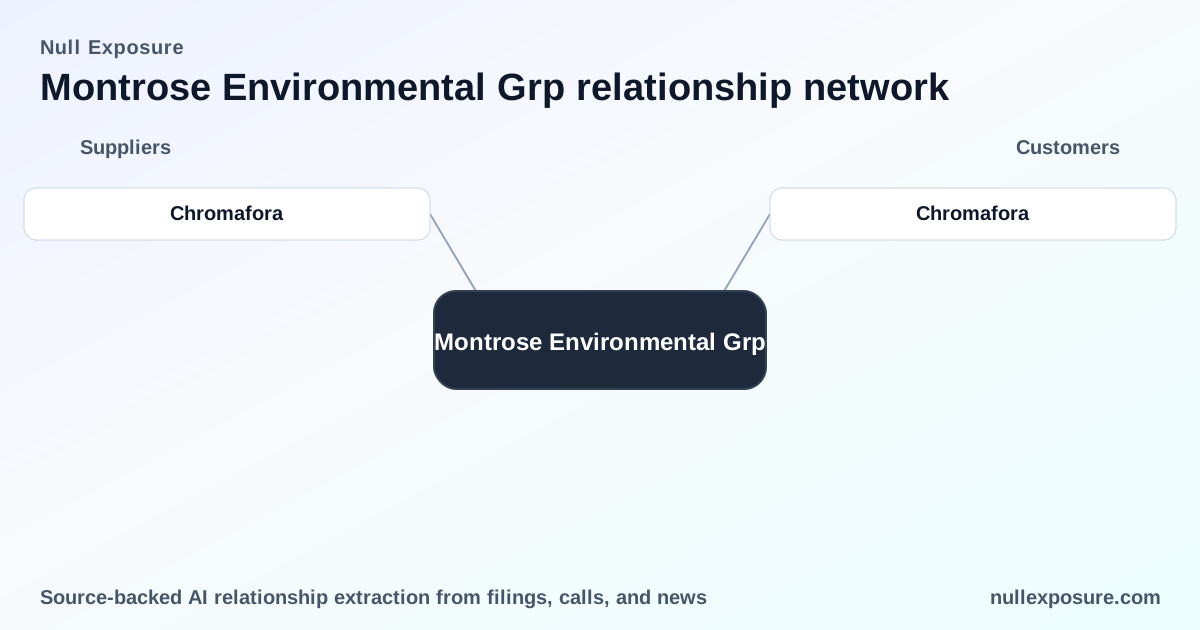
- Chromafora — ECT2 licensing agreement and Denmark acquisition: Smart Water Magazine reported that ECT2, a Montrose subsidiary, entered into a licensing agreement with Chromafora to support European expansion of PFAS solutions, following Chromafora’s acquisition of Montrose Environmental Group Denmark (March 10, 2026).
Source: Smart Water Magazine, news report dated 2026-03-10.
This is the sole third-party supplier/partner relationship captured in the available results; it is material from a strategic standpoint because it converts a segment of MEG’s operational capability into a licensable technology revenue stream.
Why the Chromafora deal matters to investors
- Business-model extension: Licensing proprietary treatment technology to Chromafora signals a move from pure service delivery to licensing, creating higher-margin, recurring revenue potential if the technology scales across Europe. Smart Water Magazine frames the agreement as deliberately intended to support scaling and growth in the region (March 2026).
- Geographic de-risking and capital-light expansion: By licensing technology to an acquirer of the Denmark assets, MEG can extract value without retaining all the operational capex and geographic operational risk tied to local build-outs.
- Regulatory and commercial upside: PFAS remediation is a high-demand, regulated niche; being a licensor of proprietary solutions positions MEG to capture price and adoption premiums where regulatory drivers accelerate demand.
Constraints and what they signal about MEG’s operating model
The disclosures in the review surface two company-level constraint signals that shape the operating and financial profile investors must underwrite.
- Long-term contracting posture and capital intensity: The company states it maintains finance leases for vehicles and equipment and operating leases for real estate and office equipment, with lease terms generally between one and 15 years and occasional renewals. This indicates a deliberate use of long-lived leases to support project execution capacity, which creates capital commitments and fixed-cost leverage across the business. Investors should view MEG as asset-backed and contractually committed, with predictable depreciation of service capacity over multi-year horizons (company lease disclosure excerpt).
- Service-provider orientation with bank financing and audited reporting: Filings reference a Credit Agreement (dated April 27, 2021) involving Montrose entities, Bank of the West as Administrative Agent, and other arrangers, and consolidate audited financial statements prepared by Deloitte & Touche LLP. This combination signals a mature corporate financing posture: MEG operates as a service provider under bank-supervised credit facilities and transparent external audit processes. Expect covenant governance, attention from lenders on liquidity, and reliance on stable contract cashflows to support leverage.
Neither constraint excerpt names a specific third-party supplier; treat these as company-level structural characteristics that affect all supplier relationships and the firm’s ability to execute licensing and service contracts.
Implications for partner concentration, criticality, and contract maturity
- Contracting posture: Long-term leases and multi-year contracts reduce revenue volatility but raise fixed-cost commitments, increasing the importance of utilization rates and project win rates to cover lease-related cash outflows.
- Counterparty criticality: Licensing a technology to Chromafora offloads operational execution risk and can accelerate scale, but it also creates a dependency on the licensee for downstream commercialization in Europe; this is a classic trade-off between capital-light growth and partner concentration.
- Maturity and governance: The existence of a formal credit facility and external audit suggests sophisticated governance and an expectation of steady cash generation; lenders will monitor covenant compliance as licensing revenues scale alongside traditional service revenues.
Risk and opportunity checklist for investors
- Upside: Licensing revenue offers margin expansion and geographic reach without commensurate capex, and PFAS remediation demand is supported by regulatory pressure in Europe.
- Risk: Concentrating European rollout in a single licensee creates commercial execution risk; success depends on Chromafora’s integration of the technology and local market execution.
- Balance sheet sensitivity: Long-term lease obligations and bank covenants amplify exposure to project underperformance; monitor lease maturities and covenant thresholds disclosed in filings (credit agreement and audit notes).
For active diligence, review the company’s credit agreement language and the lease note disclosures to quantify covenant headroom and fixed-cost run-rate sensitivity.
Visit https://nullexposure.com/ for a consolidated view of MEG disclosures and linked source documents that support these points.
Recommended investor actions
- Monitor adoption metrics from Chromafora and follow-up press or filings confirming licensing revenues, milestone receipts, or royalty structures tied to the ECT2 technology rollout.
- Track upcoming lease maturities and bank covenant tests in the next two reporting cycles to assess refinancing risk and leverage trajectory.
- Validate that licensing arrangements are accompanied by appropriate IP protection and enforcement clauses; licensing is valuable only if exclusivity and enforcement are credible.
For a centralized, investor-ready aggregation of MEG supplier relationships and disclosure excerpts, see https://nullexposure.com/.
Bottom line
The Chromafora–ECT2 licensing arrangement converts MEG’s remediation technology into a monetizable, capital-light distribution channel in Europe, while the company’s long-term lease posture and bank credit arrangements reflect a mature, leveraged service provider profile. Investors should weigh the recurring-margin potential from licensing against the balance-sheet commitments and partner concentration introduced by this strategy.