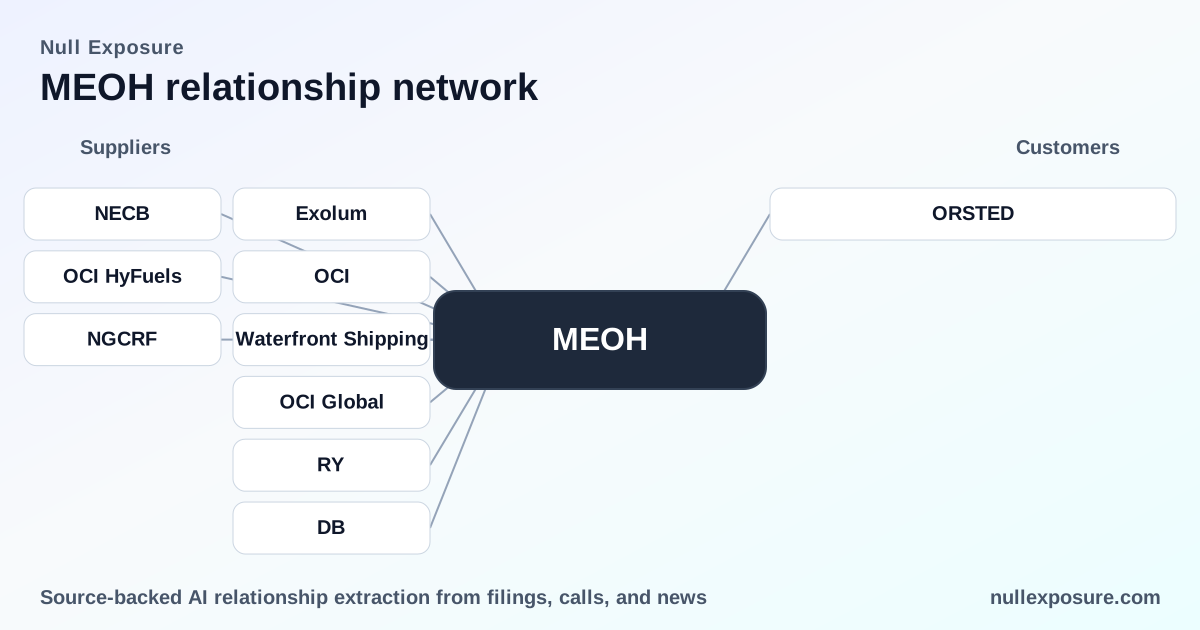
Methanex (MEOH): supplier relationships that shape margins and market access
Methanex produces and sells methanol globally, monetizing through a mix of merchant sales, long-term offtakes and asset-backed logistics — including ownership and long-term arrangements for shipping and terminals. The company’s profitability depends on feedstock economics, shipping and terminal access, and the pace of inorganic expansion, with recent transactions and partner agreements positioned to expand U.S. and low‑carbon supply while adding near‑term integration costs.
Learn more about supplier intelligence and relationship risk at https://nullexposure.com/.
How Methanex runs the business and where supplier relationships matter
Methanex operates large, geographically distributed production assets and matches production to global demand through spot and contract sales. Key monetization levers are feedstock procurement, freight/terminal control, and the ability to scale through M&A. The company has material scale — roughly $3.59B revenue TTM and $811M EBITDA — but thin net margins relative to gross profit, which makes supplier and logistics efficiencies a direct driver of free cash flow. Shipping exposure and port arrangements reduce volatility in delivered cost and market access; conversely, acquisitions and financing reshape capital structure and operational complexity.
- Contracting posture: Methanex combines owned assets (dedicated fleet, terminals) with third‑party contracts to limit pure spot exposure while preserving commercial flexibility.
- Concentration and criticality: Production and supply hubs are critical infrastructure; port and shipping partners are operationally essential.
- Maturity and scale: Steady revenue and institutional ownership (~70%) point to an established cash‑flow business that expands via M&A and integration of acquired assets.
Discover how supplier mapping informs investment decisions: https://nullexposure.com/.
Who Methanex works with and what each relationship means
Exolum — bunkering and fuel infrastructure in the UK
Methanex partnered with Exolum to provide storage and fueling infrastructure for the UK’s first biomethanol bunkering service at Immingham, enabling marine uptake of low‑carbon methanol and anchoring terminal access in a growing region. This was reported in a Finviz news item in March 2026.
OCI Global — major asset acquisition that expands footprint
Methanex agreed to acquire OCI Global’s international methanol business for US$2.05 billion, a transformative deal that increases U.S. and European production exposure and adds scale to global distribution. Multiple press reports covering the September 2024 announcement and subsequent filings document the transaction and its strategic intent.
OCI HyFuels — transfer of low‑carbon methanol assets
As part of the OCI transaction, OCI HyFuels’ low‑carbon methanol operations are included in the asset transfer, positioning Methanex to capture emerging demand for lower‑carbon feedstocks and products. The Globe and Mail covered the asset transfer language during the transaction reporting.
Waterfront Shipping — dedicated fleet and freight risk management
Methanex leverages Waterfront Shipping operations to limit direct spot exposure to freight while maintaining competitive logistics positioning; company commentary highlighted the fleet as a buffer while shipping rates doubled on certain routes. This detail comes from the Q4 2025 earnings call transcript published by The Globe and Mail.
Royal Bank of Canada (RBC) — committed financing for the OCI acquisition
RBC provided a fully committed debt financing package to support the OCI transaction, supplying necessary acquisition capital and shaping leverage and covenant terms on closing. Latham/WilmerHale and deal reporting documented RBC’s role during the transaction coverage in FY2024.
RBC Capital Markets — financial adviser on the OCI deal
RBC Capital Markets, together with Deutsche Bank, served as financial adviser to Methanex on the OCI Global acquisition, executing the sell‑side and buy‑side financing and structuring workstreams reported at the time of the transaction.
Deutsche Bank — deal adviser on the OCI acquisition
Deutsche Bank acted as financial adviser alongside RBC Capital Markets on the OCI purchase, contributing to valuation, financing syndication and integration planning as described in press coverage around the transaction.
NEC — port arrangements and fee contracts
Methanex confirmed the existence of a contract with NEC for port fees or port arrangements, indicating formalized terminal access rather than ad‑hoc port usage, which supports consistent export and import flows. This was referenced in a Q3 2025 earnings call transcript reported by InsiderMonkey.
NGC — gas supply discussions
Methanex reported active discussions with NGC regarding gas, underscoring the importance of feedstock procurement conversations in regions where natural gas sourcing determines production economics. This was disclosed during an earnings call excerpt captured by InsiderMonkey in FY2025.
What these relationships collectively signal for operators and investors
The relationship map shows an operational model focused on vertical control of logistics (shipping, terminals) and strategic inorganic growth. The OCI Global acquisition increases scale and complexity: targeted integration synergies of roughly $30M by end‑2026 were disclosed in Q4 2025 commentary, but the transaction also required committed financing and near‑term transition costs. Shipping and port contracts reduce commodity shipping exposure but retain counterparty and operational concentration risk, especially when spot freight spikes on key routes.
- Risk profile: Operational criticality of shipping and terminal partners increases systemic exposure to transport disruptions; feedstock negotiations (e.g., with NGC) directly alter unit economics.
- Capital posture: Use of committed debt facilities and adviser engagement for acquisitions changes leverage dynamics and raises integration execution risk.
- Growth vector: Inclusion of low‑carbon assets through OCI HyFuels and the Exolum bunkering partnership position Methanex to capture maritime and industrial decarbonization demand.
If you are evaluating supplier counterparties or underwriting exposure to Methanex’s supply chain, a deep read of port agreements, dedicated fleet charters, and post‑acquisition integration milestones is essential. For bespoke supplier risk mapping and exposure analysis visit https://nullexposure.com/.
Investment implications and recommended next steps
- Monitor integration metrics: Track the $30M synergy target and transitionary costs that management flagged; missed synergy or higher integration costs compress cash flow.
- Validate logistics resilience: Confirm contractual terms for Waterfront Shipping, Exolum terminal access, and NEC port arrangements to understand service continuity and termination risk.
- Assess feedstock contracts: Outcomes of gas discussions with suppliers such as NGC determine margin sensitivity to commodity cycles.
Final action: investors and supply chain operators should request contract maturity schedules, counterparty collateral terms, and post‑close financing covenants when underwriting Methanex exposure.
For a tailored supplier‑risk briefing or to map counterparty concentration across your portfolio, start here: https://nullexposure.com/.