Mercer International (MERC): Supplier relationships that reshape a pulp company into a broader forest-products platform
Mercer International sells Northern Bleached Softwood Kraft (NBSK) pulp worldwide and increasingly monetizes adjacent forest-product assets—most notably mass timber—through acquisitions and pilot industrial projects. The company generates cash primarily from pulp sales while pursuing vertical and decarbonization initiatives that reweight its revenue mix and capital cycle. Investors should value Mercer as a pulp producer with growing strategic exposure to mass-timber manufacturing and decarbonization technology trials, a profile that affects capital allocation, supplier contracting, and regulatory exposure. For a focused investor dashboard and deeper relationship mapping, visit https://nullexposure.com/.
What the supplier and partner signals mean for capital markets
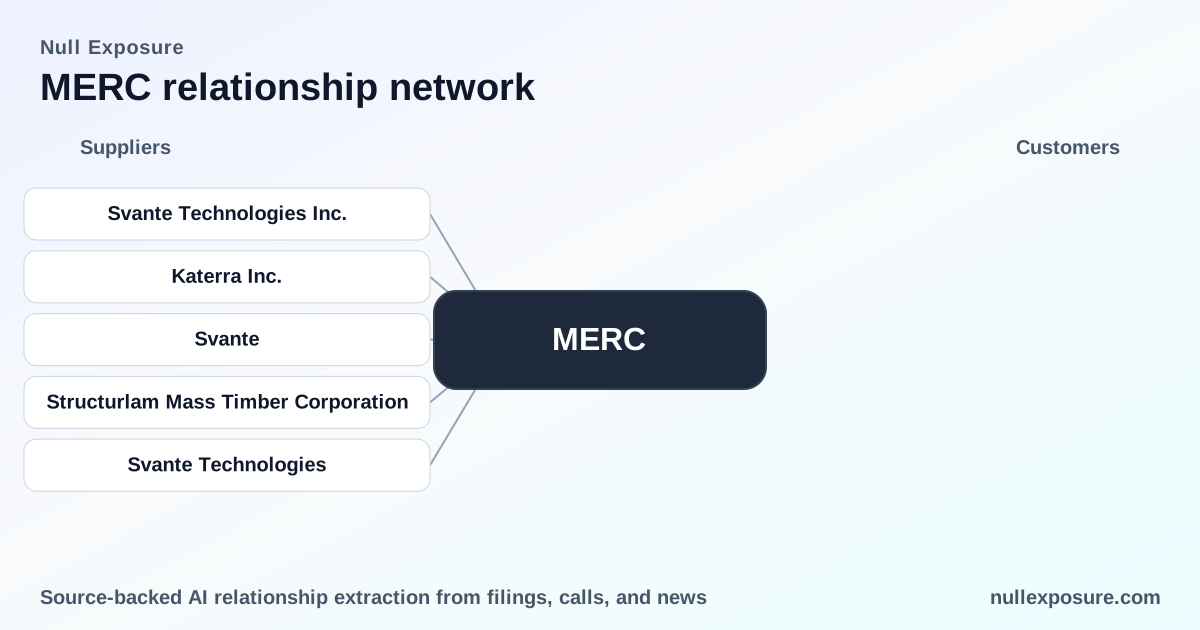
Mercer’s recent public mentions highlight two strategic threads: decarbonization pilots and asset repurposing through acquisitions. The company is running a carbon-capture demonstration at its Peace River mill with Svante Technologies, and it has absorbed mass-timber manufacturing assets originally owned by Katerra and Structurlam. These moves change the supplier and service relationships Mercer relies on, and they reshape operating risk in three ways:
- Contracting posture: Mercer’s raw-material sourcing and service relationships are characterized by short-term contracts and open-market purchases, which gives procurement flexibility but increases exposure to spot-price swings and logistics disruption.
- Geographic sourcing: The company operates with dual sourcing footprints—North America and EMEA—creating both diversification and regional operational complexity.
- Capital and spend profile: Mercer carries meaningful purchase obligations for fiber and third-party services; disclosed commitments exceed typical small-cap peer levels and indicate a >$100m spend band that drives supplier negotiations and cash-flow timing.
These are company-level operating signals drawn from Mercer’s disclosures and industry reporting rather than single-supplier quirks. For an investor-grade relationship map and supplier risk scoring, see more at https://nullexposure.com/.
Who Mercer is working with (and why each relationship matters)
Svante Technologies Inc.
Mercer has launched a six-month carbon-capture demonstration unit to test Svante’s solid-sorbent technology on biogenic CO₂ from its Peace River mill recovery boiler flue gas, positioning Mercer to lower mill emissions and gather operational data for scaling capture technology. According to Lesprom and contemporaneous press coverage, the pilot began in late 2025/early 2026 and is structured as a joint development demonstration. (Lesprom / March 2026; QuiverQuant / March 2026)
Katerra Inc. (facility legacy)
Mercer acquired a large Spokane Valley facility originally owned by Katerra (purchased in 2021 for $50 million) and is investing in upgrades and new mass-timber operations at that site, converting a distressed asset into an operating timber-production business. Local reporting documents the acquisition and subsequent investment plans, signaling Mercer’s intent to reuse existing industrial footprints for vertical expansion. (Spokane Journal / reporting on Mercer’s Spokane investments, 2022–2026)
Structurlam Mass Timber Corporation
Mercer completed the acquisition of substantially all assets of Structurlam Mass Timber Corporation, adding engineered-mass timber production capability and expanding its product set beyond pulp into higher-value wood products. The company announced the deal completion in a corporate release covered by The Globe and Mail in 2023. (The Globe and Mail / press release, 2023)
Strategic implications: procurement, operational risk, and upside
The Svante pilot is a strategic defensive investment against tightening emissions regulation and customer decarbonization demands; successful scale-up would reduce regulatory risk and create a pathway to sell lower-carbon pulp or capture credits. The Structurlam and Katerra-derived assets transform Mercer from a pure pulp merchant into a vertically integrated forest-products operator with higher-margin, capital-intensive manufacturing exposure.
Operationally, Mercer’s supplier posture—rooted in short-term fiber purchases, reliance on public forest agencies and regional sawmills, and the need for third-party transportation—creates volatile input-cost exposure and logistics criticality. Mercer discloses purchase obligations for fiber and services that place it in a higher spend band and require disciplined working-capital management. High insider ownership (over 60%) and modest market capitalization concentrate governance and execution risk into a smaller shareholder base.
How these relationships change the risk/reward calculus
- Revenue diversification: Mass-timber assets increase optionality into structural wood markets that trade on different demand cycles than pulp. That reduces pure-pulp cyclicality but increases capital intensity and execution risk.
- Regulatory and ESG exposure: The Svante pilot is a clear line item for environmental transition investors; successful implementation enhances access to customers prioritizing low-carbon inputs.
- Supplier and logistics concentration: Short-term contracts and regional sourcing lower fixed supply risk but increase price volatility and reliance on third-party transport as a service provider—an operational vulnerability during capacity constraints or fuel-price shocks.
For investors seeking a quantified supplier-risk view or an exposure heatmap across Mercer’s mills and timber assets, our platform consolidates these relationship signals: https://nullexposure.com/.
Actionable takeaways for investors and operators
- If you are an investor seeking upside from strategic repositioning, Mercer provides a hybrid exposure: cyclical pulp revenues with emerging higher-margin mass-timber assets and a decarbonization option via the Svante pilot. Monitor pilot operational metrics, capital spend for timber upgrades, and pulp-price realization.
- If you are an operator or counterparty, expect Mercer to contract for short-duration supply terms and to rely on regional partners for logistics—pricing and delivery flexibility will be decisive in commercial negotiations.
- If you are a risk manager, focus on fiber spend commitments and third-party transportation continuity plans: these are the most immediate levers to protect margins under stress.
For due-diligence support and ongoing supplier monitoring of Mercer and peer exposures, visit https://nullexposure.com/.
Final assessment
Mercer is executing a deliberate strategic pivot from a single-product pulp merchant toward a broader forest-products platform with active decarbonization trials. The business model now balances commodity cyclicality with industrial transformation risk—investors should price both the near-term cash-flow profile of pulp and the longer-term capital needs and execution risk inherent in mass-timber production and carbon-capture scale-up. For a tailored supplier-risk score and ongoing alerts on Mercer relationships, see our coverage at https://nullexposure.com/.