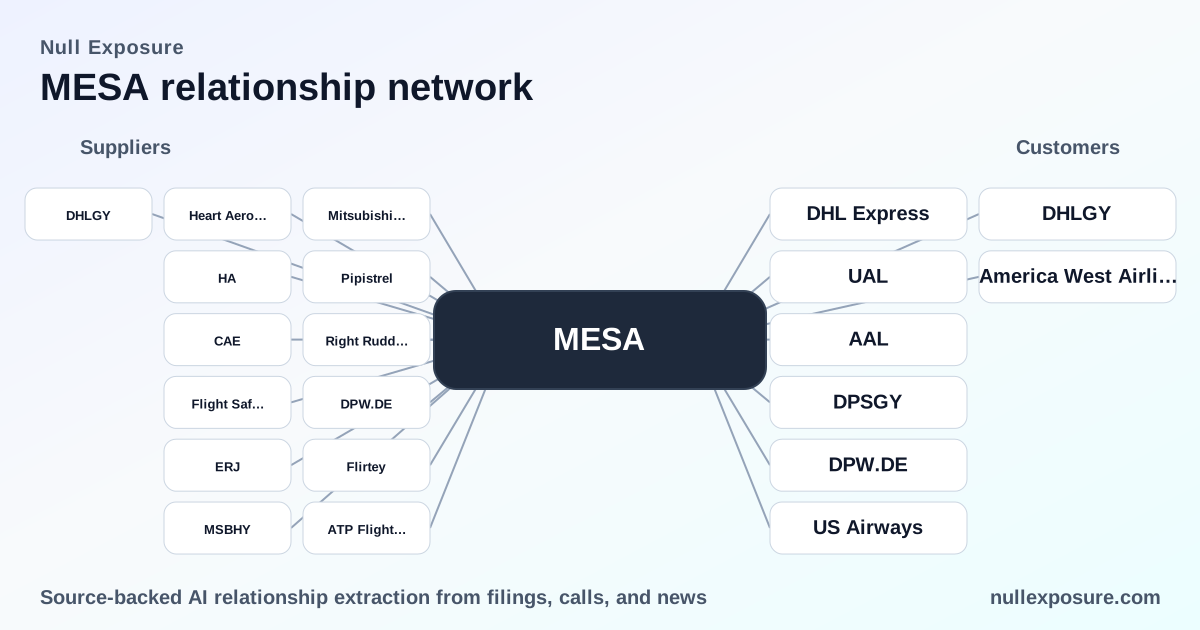
Mesa Air Group (MESA): Supplier Relationships and Strategic Signals for Investors
Mesa Air Group operates regional airline Mesa Airlines and monetizes through capacity purchase agreements (CPAs) with major carriers, selling flight capacity rather than ticket revenue directly; ancillary revenue lines include ad hoc cargo charters and nascent delivery services. The company’s supplier relationships reflect a hybrid strategy: traditional OEM and training vendors for operational continuity, and selective strategic bets in electrification and unmanned delivery to diversify future revenue vectors. For an investor or operator assessing counterparty risk, these relationships map directly to fleet flexibility, pilot pipeline stability, and technology exposure. Learn more about supplier analytics at https://nullexposure.com/.
How Mesa makes money and why suppliers matter
Mesa’s revenue model is predominantly fee-for-service under CPAs with American and United, meaning operational performance and fleet availability are the primary drivers of cash flow rather than direct ticket yield. The company has a small market capitalization (about $58.6 million) and reported negative EPS (-64.2) with trailing revenue of roughly $406 million, which positions supplier contracts and capital commitments as high-leverage items for credit and operational risk. Supplier commitments therefore translate into critical operational dependencies—from pilot training to aircraft orders, each relationship is a piece of Mesa’s ability to meet CPA performance metrics.
Explore supplier exposures and counterparties at https://nullexposure.com/.
Supplier list: what each relationship means in plain English
Below are every counterpart referenced in the provided results, with a concise investor-oriented summary and source for verification.
Mitsubishi Aircraft Corporation / Mitsubishi
Mesa entered into formal negotiations under an MOU with Mitsubishi Aircraft Corporation for the SpaceJet M100, reflecting a plan to modernize regional capacity with approximately 100 aircraft discussed in the September 2019 MOU; other references put the order exposure between 50 and 100 units in various press pieces. Source: Mitsubishi press release and aviation outlets (September 2019; follow-ups through 2020).
Pipistrel
Mesa purchased 29 Pipistrel Alpha Trainer 2 aircraft to staff its Mesa Pilot Development program, creating an in-house pathway to the 1,500-hour ATP requirement and reducing reliance on external time-building arrangements. Source: flyingmag.com and AINonline reporting on the 2022 purchase order (FY2022).
Right Rudder Aviation
Right Rudder Aviation was contracted to operate and distribute Pipistrel trainers for Mesa’s cadet program, establishing an outsourced operator relationship to scale pilot training operations without absorbing full flight school risk. Source: flyingmag.com coverage of the MPD program (FY2022).
DHL
Mesa leased Boeing 737 freighters from DHL and began cargo operations in 2020, illustrating a short-term pivot into cargo capacity under a crewing/maintenance arrangement, with later reporting indicating Mesa stopped 737F operations for DHL by 2024. This represents both revenue diversification and the transient nature of ad hoc cargo contracts. Source: FreightWaves, AirlineGeeks (FY2020) and AirCargoNews (FY2024).
Flirtey
Mesa partnered with Flirtey to launch commercial drone delivery using Flirtey’s Eagle drone and autonomous software, positioning Mesa as an operator of last-mile drone delivery rather than a hardware developer, which adds a technology services leg to its operations. Source: UASWeekly reporting on the 2021 agreement (FY2021).
Heart Aerospace
Mesa participated in Heart Aerospace’s Series A and jointly placed purchase orders with United for the ES-19 electric 19-seater (200 combined orders with options for 100), signaling an early-stage strategic investment into electric regional aircraft aimed at long-term fleet decarbonization and cost reduction. Source: Heart Aerospace/Cision and industry reporting (FY2021).
Hawaiian Airlines (Go! interisland context)
Historical coverage of Go!—the carrier that previously operated under Mesa airline branding—shows Mesa’s experience in inter-island operations and legacy operational transitions; a 2014 report on Go! ceasing Hawaii operations underscores the company’s historical operational volatility in niche markets. Source: Honolulu Star-Advertiser (March 2014).
ATP Flight School
Mesa implemented a tuition reimbursement program with ATP Flight School to recruit pilots who commit to fly for the airline, reflecting a contractual approach to securing pilot labor through sponsorship and retention incentives. Source: AVweb reporting on the program launch (FY2015).
CAE
Mesa routes pilots to CAE for simulator training and type ratings, reflecting reliance on established global training providers for regulatory-compliant simulator qualification. Source: AirlineGeeks feature on Mesa’s training pipeline (FY2018).
Flight Safety
Alongside CAE, Flight Safety is used for simulator-based training and type ratings, indicating dual-supplier training relationships that preserve scheduling flexibility and capacity for simulator slots. Source: AirlineGeeks (FY2018).
Embraer
Industry commentary highlights Mesa’s operational experience with Embraer aircraft (notably E175-type operations via CPAs), signaling continued platform familiarity that underpins fleet assignment and CPA negotiations. Source: SimpleFlying reporting on Embraer ties (FY2019).
What the supplier map implies about Mesa’s operating constraints
No explicit constraint excerpts were provided in the dataset, so the following are company-level operational signals derived from the supplier list and financial profile:
- Contracting posture: Mesa operates primarily under CPAs with major carriers, making supplier performance (aircraft delivery, maintenance, pilot training) contractually critical; supplier failures would directly impact CPA payments and performance penalties.
- Concentration risk: Mesa’s reliance on a small number of major partners and a narrow fleet mix concentrates counterparty and operational risk; supplier relationships that affect fleet availability (OEMs and lessors) are high-impact.
- Criticality of suppliers: Training partners (CAE, Flight Safety, ATP) and OEM commitments (Mitsubishi, Heart Aerospace, Embraer orders) are mission-critical because flight crews and airframes are non-substitutable in the short run.
- Maturity and optionality: Partnerships in early-stage technologies (Heart Aerospace, Flirtey) are strategic options rather than immediate cash drivers; they deliver long-term optionality but not near-term revenue relief.
- Balance-sheet sensitivity: With modest market capitalization (~$58.6M), negative EPS and thin margins, capital-intensive supplier commitments create elevated execution risk during demand downturns, making conditional orders and partnerships preferable to firm, capital-draining purchases.
Investment takeaways and recommended next steps
- Short-term operational resilience is driven by training & maintenance suppliers; failures here would immediately harm CPA revenues.
- Long-term upside resides in strategic bets on electric aircraft and drone operations, but those are early-stage and not substitutes for core CPA performance.
- Financial leverage and small market capitalization make Mesa sensitive to supplier financing terms and schedule risk.
For investors and operators who need granular supplier exposure and counterparty scoring, review Mesa’s supplier roster and contract terms at https://nullexposure.com/. If you require a custom supplier risk brief or portfolio-level counterparty mapping, start here: https://nullexposure.com/.
Concluding, Mesa’s supplier network reflects a pragmatic mix of tactical operational suppliers and strategic, optional technology partners; the principal investor question is whether Mesa can preserve its core CPA performance while selectively scaling riskier, longer-term bets without overextending limited capital.