Mesoblast (MESO): supplier relationships that drive clinical supply and commercial access
Mesoblast develops and commercializes allogeneic cellular therapies and monetizes through product sales, licensing partnerships, and third‑party manufacturing and distribution arrangements that move clinical assets into commercial channels. The company outsources critical manufacturing and leans on specialty pharmacy partners for distribution, meaning supplier arrangements are operationally central to revenue realization and payer access. For investors evaluating MESO as a supplier-dependent bio-asset, the core question is whether these external relationships are durable, concentrated, and capable of supporting scale-up into commercial markets.
Learn more about supplier risk and relationship intelligence at https://nullexposure.com/
Why supplier relationships matter to MESO's business model
Mesoblast’s model converts cell therapy R&D into revenue by outsourcing production and partnering for channel execution, rather than building fully integrated manufacturing and distribution in-house. That setup reduces fixed capex but creates operational dependence on a small number of external partners for regulatory-compliant manufacturing, lot release, and patient access. Company financials underline the strategic trade-offs: Market capitalization of ~$1.94bn against TTM revenue of $17.2m and negative EBITDA signals the market is pricing future commercial ramp potential rather than current cashflow, so supplier execution is a valuation lever.
At the company level, the public record in this review contains no explicit contract clauses or performance covenants disclosed as constraints, which itself is a signal: there are no publicly highlighted, standardized constraints attached to supplier relationships in this source set, so investors should assume contractual detail will be material in diligence.
What the public record shows about MESO’s supplier relationships
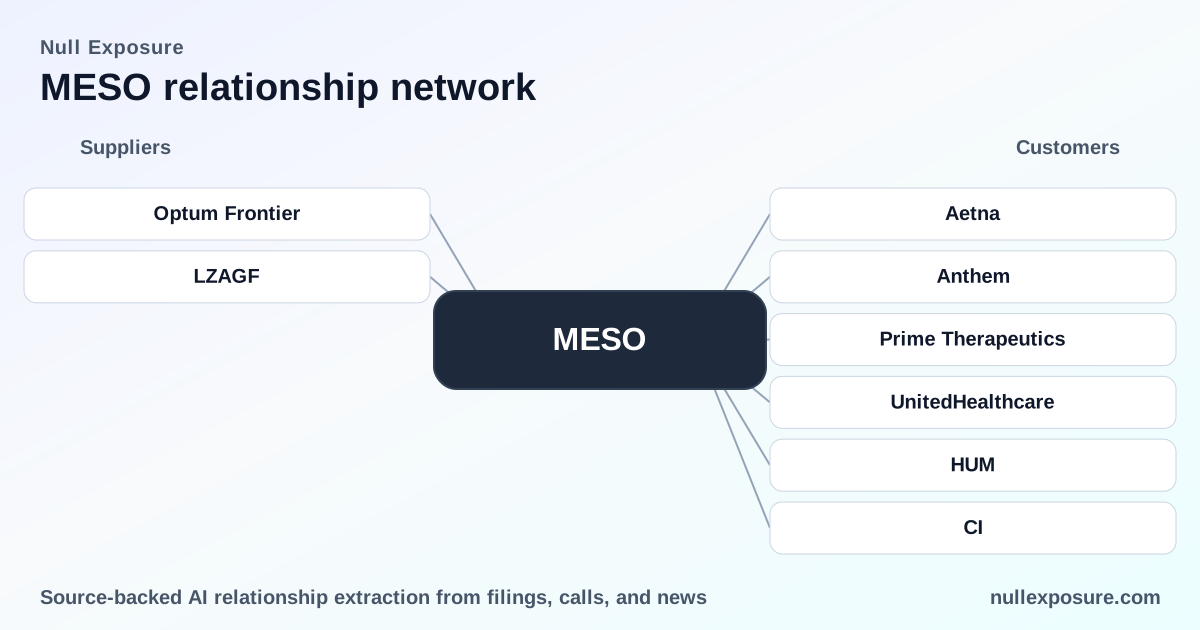
The available reports identify two material supplier relationships in the FY2026 commentary: a specialty pharmacy partner used to shift hospital billing exposure, and a contract manufacturer responsible for clinical and potentially commercial production.
Optum Frontier — specialty pharmacy arrangement
Thirteen hospitals elected to route product through Optum Frontier, which substantially reduces hospital financial responsibility for the product, transferring billing and fulfillment functions to the specialty pharmacy partner. This deployment is described in MESO’s FY2026 earnings commentary captured on InsiderMonkey (March 2026). (Source: InsiderMonkey FY2026 earnings call transcript, March 2026 — https://www.insidermonkey.com/blog/mesoblast-limited-nasdaqmeso-q2-2026-earnings-call-transcript-1706199/)
Lonza — contract manufacturing provider
Mesoblast reported that rexlemestrocel‑L and the associated Phase III trial material were produced at Lonza’s facility, the same site previously approved for Ryoncil, establishing continuity with an approved manufacturing location. This indicates reliance on an established CDMO for both clinical and regulated production, as referenced in FY2026 earnings commentary. (Source: InsiderMonkey FY2026 earnings call transcript, March 2026 — https://www.insidermonkey.com/blog/mesoblast-limited-nasdaqmeso-q2-2026-earnings-call-transcript-1706199/)
What these relationships imply for investors — operational and valuation consequences
- Concentration risk is elevated. The public mentions focus on two partners only, implying operational concentration that amplifies single‑counterparty disruption risk. That concentration has direct valuation consequences given the company’s limited revenue base.
- Execution risk converts to commercial risk. If Lonza’s capacity, quality approvals, or timelines slip, product launch cadence and revenue recognition shift, stressing an already loss-making P&L.
- Distribution strategy reduces payer friction. The Optum Frontier arrangement transfers financial administration and access friction away from hospitals, which accelerates adoption pathways and reduces receivables stress for providers — a positive for uptake and gross‑to‑net conversion.
- Market expectations are high. With a Price/Sales of ~29.7 and an analyst target price materially above spot ($35 target), the market requires seamless supplier execution to justify valuation; supplier missteps are therefore binary for near-term returns.
Explore supplier-level monitoring tools and relationship scoring at https://nullexposure.com/ to prioritize due diligence and counterparty risk assessment.
Company-level operating posture and business-model characteristics
Because no contractual constraints are explicitly published in the sources reviewed, treat the following as company-level signals rather than partner-specific disclosures:
- Contracting posture: Outsourced and strategic. Mesoblast runs a lean internal manufacturing footprint, contracting out to established service providers.
- Concentration: High. Public commentary references only a handful of providers, which implies potential supplier concentration risk if additional partners are not engaged.
- Criticality: Essential. Manufacturing and specialty pharmacy partners are mission-critical — failures disrupt approvals, launches, and cash flow.
- Maturity: Mixed. Partnerships with recognized industry players indicate a mature outsourcing approach, but the company’s limited revenue and negative operating margins show commercial maturity is still developing.
These signals require investors to prioritize supplier contractual terms, capacity commitments, quality history, and contingency plans in diligence.
Valuation context and practical red flags to watch
Financial context sharpens supplier risk: negative EBITDA, $17.2m in trailing revenues against a $1.94bn market cap, and high Price-to-Sales mean market value rests on successful commercial execution. Key red flags for operators and investors include:
- Lack of disclosed long‑term manufacturing capacity commitments from CDMOs.
- No publicly available transition or dual‑sourcing plans to mitigate single‑facility risk.
- Concentration of commercial distribution through few specialty pharmacy channels without transparent service-level agreements.
Address these issues in diligence calls and contract reviews; investors should insist on evidence of capacity guarantees, quality metrics, and contingency capacity.
Bottom line and next steps for due diligence
Mesoblast’s supplier relationships are central to its ability to convert clinical assets into commercial revenue. The Lonza manufacturing link signals access to experienced CDMO capacity, while the Optum Frontier specialty pharmacy arrangement improves hospital uptake economics. However, concentration and execution risk are primary valuation levers given weak current revenue and negative cashflow.
For investors and operators, prioritize:
- Confirming contractual capacity and quality commitments with manufacturers.
- Validating specialty pharmacy reimbursement workflows and patient access metrics.
- Stress-testing commercial scenarios against supplier disruption.
For a focused view on supplier exposure and next‑step due diligence tools, visit https://nullexposure.com/ — the right intelligence shortens your path from hypothesis to investment decision.