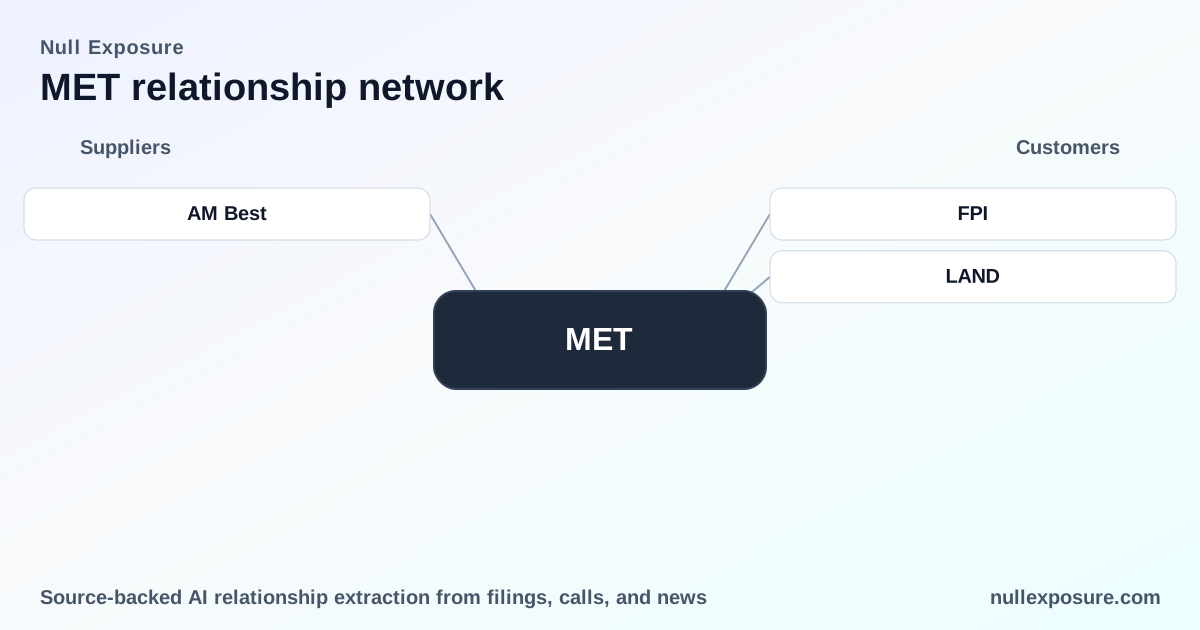
MetLife (MET) — supplier relationship briefing and implications for investors
MetLife is a balance-sheet centric insurance holding company that monetizes through insurance premiums, annuity deposits, investment income, and employee-benefit program fees, while managing a large fixed-income portfolio to support long-duration liabilities. The company funds operations and regulatory capital with a mix of long-term subordinated debt and shorter-term borrowings, and leverages third‑party investment managers for separate accounts that service institutional and group business. For an executive summary of supplier and capital-market signals, visit https://nullexposure.com/.
One-line investment thesis up front
MetLife’s scale and diversified revenue base underpin a stable cash flow profile, but credit-market activity—subordinated debt issuance and ratings—are leading indicators of funding cost and capital buffer dynamics that will drive near‑term returns and dividend sustainability.
What the AM Best signal actually means for an investor
AM Best assigned a Long‑Term Issue Credit Rating of “bbb+” to MetLife’s newly issued $1.0 billion subordinated debentures due March 15, 2056, coupon 5.85%. This is a standard market step when an insurer raises subordinated capital: it locks in long-dated funding at a fixed spread, preserves regulatory capital treatment, and gives the market a transparent reference point for MetLife’s subordinated credit cost (AM Best report, March 10, 2026; https://aijourn.com/am-best-assigns-issue-credit-rating-to-metlife-inc-s-new-subordinated-debentures/).
Operationally, subordinated debt issuance affects solvency ratios and replaces equity-like buffers at a lower blended cost than equity; for an insurer, that drives ROE leverage while adding interest expense. MetLife’s financials—USD 77.1 billion revenue TTM, market capitalization roughly USD 45.6 billion—show the company runs significant insurance spread business supported by investments, so capital-market moves like this materially influence capital allocation and shareholder returns.
Visit https://nullexposure.com/ for additional capital-markets and supplier intelligence on insurers.
Supplier relationship: AM Best (complete list coverage)
AM Best — A rating agency provided the public credit opinion and assigned the subordinated debentures a “bbb+” long‑term issue rating for the $1 billion, 5.85% notes due 2056 issued by MetLife, Inc.; the report was published March 10, 2026. Source: AM Best news report (March 10, 2026), https://aijourn.com/am-best-assigns-issue-credit-rating-to-metlife-inc-s-new-subordinated-debentures/.
Constraints and company-level operating signals investors should treat as facts
The filings and excerpts reviewed supply several company-level signals about MetLife’s operating model and vendor posture:
-
Contracting posture — mixed maturities. MetLife carries both long‑term debt (senior notes maturing across 2025–2059) and short‑term borrowings (short-term debt ~$465 million at December 31, 2024), indicating active management of both immediate liquidity and multi‑decade liability matching; this is a strategic funding mix rather than a short-term liquidity squeeze. Source: MetLife annual filing (Dec 31, 2024).
-
Counterparty composition — government exposure. The firm reports sizeable fixed‑income holdings in sovereign and agency securities of Japan, South Korea, and Mexico that represent investments greater than 10% of equity in aggregate; this demonstrates meaningful sovereign concentration within the investment book, which insulates credit risk but exposes the balance sheet to regional macro moves (MetLife annual report, Dec 31, 2024).
-
Geographic concentration signals — APAC and LATAM matter. The same investment excerpts show material exposure to APAC (Japan, South Korea) and LATAM (Mexico), so asset‑liability sensitivity will reflect those regional rate and currency dynamics rather than being U.S.-only.
-
Service-provider reliance — delegated asset management. MetLife uses third‑party investment managers as sub‑advisors for separate accounts, where managers have portfolio discretion under investment management agreements; this structure reduces internal trading overhead but increases operational and counterparty concentration risk tied to external managers’ performance and governance (MetLife filing disclosures).
Each of these constraints is presented as a company-level characteristic and not attributed to any single supplier unless the underlying text explicitly names that supplier.
Investment implications — what to watch in the next 12–24 months
-
Funding and spread management. The subordinated issuance priced at 5.85% signals the current secondary market cost of long‑dated subordinated credit for MetLife; investors should track incremental issuance, maturities (2025–2059), and the company’s appetite for refinancing because these drive the cost of capital and leverage trajectory.
-
Capital adequacy vs. shareholder returns. Additional subordinated instruments support regulatory capital but add fixed cash interest obligations; monitor capital ratios and dividend coverage metrics (MetLife delivered EPS of $4.71 and dividend per share ~$2.248 TTM).
-
Asset concentration and regional risk. Large sovereign holdings in Japan, South Korea, and Mexico reduce default risk but increase sensitivity to regional yields and FX; scenario‑test the investment portfolio under rising-rate and currency‑shock scenarios.
-
Operational vendor risk. The delegated separate‑account structure improves scalability, but governance of external managers and concentration among providers is a potential single point of failure for asset performance; investors should review disclosures on manager diversification and replacement provisions in investment‑management agreements.
-
Rating dynamics as a leading indicator. Agency actions—here, AM Best’s issuance rating—are actionable signals that alter funding spreads and re‑price subordinated and senior instruments; follow subsequent agency commentary and comparable peer issuance for relative valuation.
Practical next steps for investors evaluating MET supplier exposure
- Check upcoming debt maturities and planned issuances in MetLife’s quarterly filings to map refinancing timelines against market rate expectations.
- Review the company’s schedule of separate-account managers and concentration disclosures to understand who controls asset decisions and how much of the book is externalized.
- Run sensitivity analysis on sovereign exposure to gauge capital and earnings impacts under adverse APAC/LATAM rate moves.
For deeper supplier and counterparty intelligence on MetLife and its capital-market counterparties, see our coverage hub at https://nullexposure.com/.
Conclusion — MetLife is executing a conventional insurer playbook: diversified premium flows, investment income, and judicious use of subordinated capital to optimize return on equity. The AM Best rating and the recorded mix of long- and short-term debt are direct levers that will determine funding cost and capital flexibility. Track issuance activity, sovereign exposure, and manager concentration as the three primary variables that will move relative valuation and credit spreads over the next 12 months. For continuing coverage and supplier mapping, start at https://nullexposure.com/.