MetLife (MET-P-A) — supplier relationships that shape distribution, experience and property investments
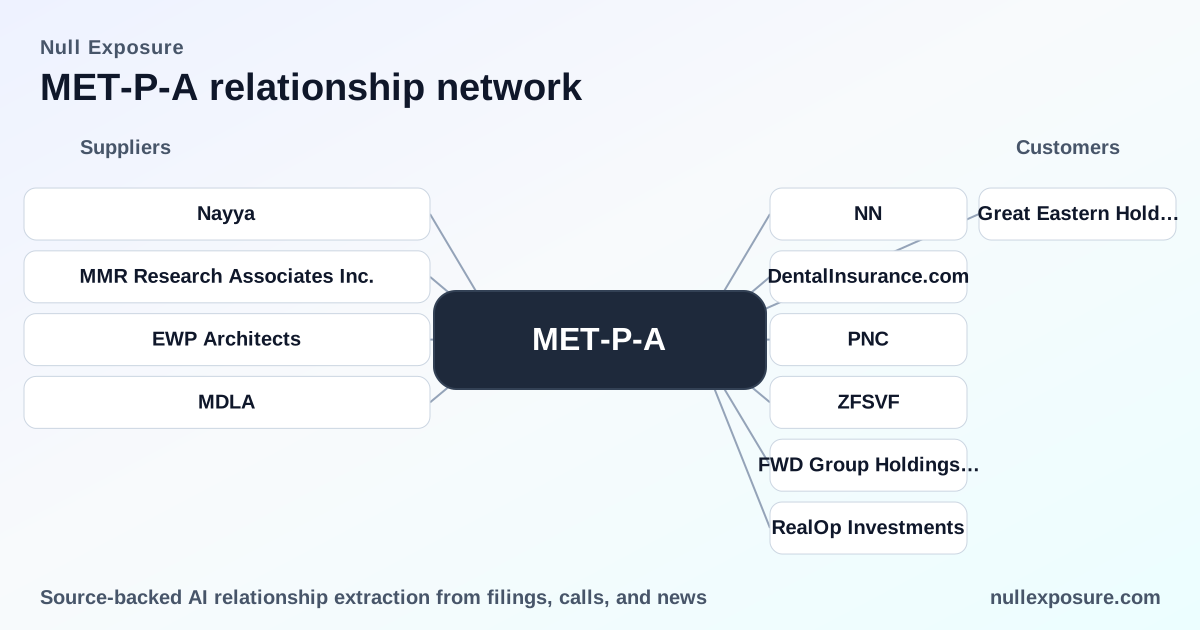
MetLife operates as a global insurance holding company that monetizes through risk-bearing insurance products, annuities and employee benefits distribution, plus corporate asset management and balance-sheet optimization. For investors evaluating supplier posture, the recent supplier relationships underscore a dual focus on distribution partnerships for large-employer benefits and operational investments in employee experience and real estate that influence cost structure, customer retention, and brand positioning. Learn more at https://nullexposure.com/.
How these supplier ties translate into revenue and strategic advantage
MetLife’s commercial economics depend on scale and distribution. Exclusive or preferred relationships for benefits decision tools accelerate policy placement and retention among large-employer groups; investments in workplace design and employee-feedback systems reduce frictional costs and support productivity. Supplier choices therefore map directly to distribution velocity, client retention, and operating leverage, rather than to one-off cost items.
Operational constraints and what they signal for investors
MetLife’s supplier footprint implies several company-level operating characteristics investors should treat as structural signals:
- Contracting posture — strategic and occasionally exclusive: MetLife is willing to take exclusivity positions with platform partners when those partners materially expand its access to target clients (large employers). This is consistent with a distribution-led contracting posture that values control of benefits channels.
- Concentration — diversified but targeted: Supplier relationships span technology, research, experience design and real estate services, indicating functional diversification rather than single-vendor concentration.
- Criticality — customer-facing and brand-critical: Several suppliers support customer and employee journeys (benefits decision tools, leave navigation, feedback loops), which are critical for retention and reputation; disruptions would have outsized service and sales implications.
- Maturity — mix of established and platform-stage partners: The roster includes both established professional service firms and newer digital platforms, implying a hybrid approach to innovation adoption and vendor lifecycle risk.
These constraints are company-level signals and should guide diligence on contract terms, SLAs, exclusivity lengths, and supplier financial stability.
Supplier relationships investors should watch
Nayya — exclusive channel for digital benefits decision support
MetLife established a strategic relationship with Nayya under which MetLife will be the exclusive carrier to offer Nayya’s benefits decision support to U.S. employers with more than 1,000 employees going forward. This is a clear distribution play to win larger employer groups by embedding decision tools into the benefits sales cycle (reported March 2026). (Source: 401k Specialist magazine, March 2026)
MMR Research Associates Inc. — commissioned survey research supporting pension risk messaging
MetLife commissioned MMR Research Associates Inc. to conduct an online survey used in its pension-risk-transfer positioning, underlining the company’s continued reliance on external research to refine sales narratives and market timing for pension-risk opportunities (FY2023 referenced in reporting, observed March 2026). (Source: PlanSponsor coverage, March 2026)
EWP Architects — real estate and lobby renovation for corporate presence
MetLife engaged EWP Architects to design and oversee renovations aimed at enlarging the lobby and revamping arrival experience, signaling capital investment in corporate real estate and physical brand presentation consistent with high-touch client and talent strategies (project reporting on renovations, FY2024 context). (Source: Chicago Urbanize, March 2026)
Medallia — embedding employee feedback into leave-management tooling
MetLife integrated Medallia surveys into its MyLeaveNavigator product to gather ongoing employee input, showing a systematic use of customer-experience technology to improve internal leave processes and reduce administrative friction (reported as part of MyLeaveNavigator launch, FY2025). (Source: II Reporter, March 2026)
What these relationships mean for revenue quality and operating risk
- Distribution acceleration via Nayya is revenue-accretive. Exclusive access to a decision-support platform for large employers creates a narrower path to competitors for that channel; this increases the marginal return on sales and underwriting efforts directed at large-group business. This is a high-impact supplier tie that elevates the importance of contract terms and performance guarantees.
- Research-driven marketing is low-cost but strategic. Commissioning MMR Research demonstrates an analytical approach to market timing and messaging for pension-risk transfers, which helps optimize product pricing and transactional volumes without large capital outlay.
- Physical and experience investments are long-cycle and brand-focused. Work with EWP Architects signals ongoing capital allocation to real estate and client-facing spaces; these investments affect depreciation schedules and occupancy economics over multiple years.
- Employee-experience tooling reduces operational drag. Medallia integration into leave workflows targets lower administrative costs and faster return-to-work cycles, improving productivity and reducing hidden claims or legal friction.
Each supplier relationship therefore connects to a distinct value driver: distribution growth (Nayya), targeted sales effectiveness (MMR), brand and property economics (EWP), and operational efficiency (Medallia).
Explore deeper supplier analytics and model implications at https://nullexposure.com/ if you want a structured view of how vendor choices alter cash-flow sensitivity.
Risk considerations for investors
- Contractual concentration risk with platform exclusivity: Exclusivity accelerates customer acquisition but concentrates execution risk in the partner’s platform reliability and commercial stability.
- Execution risk on real-estate projects: Renovation programs carry schedule and cost overruns that can temporarily impair operating cash flow or distract management.
- Reputational and operational risk from customer-experience systems: Poor integration or privacy incidents tied to employee- or customer-data platforms would have outsized reputational impact for an insurer.
Mitigants include multiyear contracts with robust SLAs, staged capital deployment on property work, and rigorous vendor governance for technology partners.
Bottom line — what investors and operators should do next
MetLife is actively aligning supplier investments with two priorities: accelerating benefits distribution to large employers and improving customer/employee experience through targeted tools and facilities. For investors, the decisive variables are contract terms, vendor performance metrics, and capital allocation discipline behind real-estate projects. For operators, prioritize vendor governance, data-security assurances, and integration roadmaps that ensure these suppliers deliver measurable sales lift or cost reduction.
For detailed vendor-level diligence and actionable scenario modeling, visit https://nullexposure.com/ for our full suite of supplier analytics and investor-facing briefings.
Key takeaway: these supplier relationships are strategic levers — not incidental purchases — and require active monitoring from both investors and MetLife management to convert supplier engagement into durable economic value.