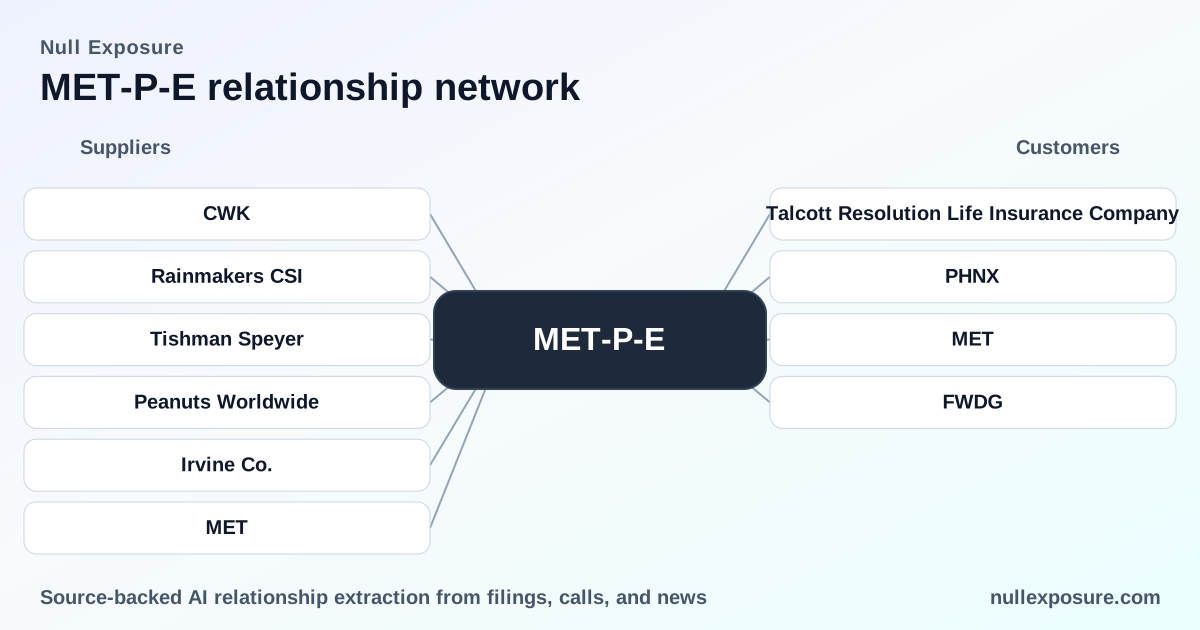
MET‑P‑E supplier landscape: what investors should know
MetLife is a global insurance and asset-management conglomerate that monetizes through insurance premiums, investment income, and fees from institutional asset management. Its supplier relationships — visible in recent press and transaction reporting — cluster around real estate execution, market research, and brand/licensing partners that support product distribution and corporate presence. These vendor links influence cost structure (notably real estate), go‑to‑market effectiveness for new product lines (pet insurance and employee benefits), and the operations of MetLife Investment Management as a capital allocator. For a concise vendor-risk briefing and deeper supplier analytics, visit https://nullexposure.com/.
Executive takeaway: supplier themes that move value
Investors should focus on three practical supplier themes evident in the reporting: real estate and brokerage services for corporate footprint and investment assets, third‑party research that underpins employee‑benefit products and thought leadership, and brand/licensing partners deployed to scale new retail offerings. These relationships are operationally material in different ways — leases affect SG&A over long horizons; research vendors influence product design and client communications; licensing partners drive consumer awareness for niche products. Learn more on the firm’s supplier mapping at https://nullexposure.com/.
What the reported relationships are, and why they matter
Below I summarize each reported supplier link from the available coverage and cite the original reporting for validation.
-
Cushman & Wakefield — The brokerage firm represented MetLife in lease negotiations for a 400,000 sq ft office lease extension at 200 Park Avenue, indicating MetLife engages major commercial brokers to manage its corporate real estate footprint. Source: ReBusinessOnline (FY2024) — https://rebusinessonline.com/metlife-signs-400000-sf-office-lease-extension-at-200-park-avenue-in-manhattan/.
-
Rainmakers CSI — Rainmakers CSI conducted two distinct studies used by MetLife for an employee well‑being study (the MetLife study was carried out in November 2022), showing MetLife contracts specialized research firms to produce proprietary survey-based insights for benefit-product positioning. Source: PlanSponsor reporting referencing the MetLife study (FY2023) — https://www.plansponsor.com/employers-grossly-overestimate-employee-well-being-annual-study-shows/.
-
Tishman Speyer — The real estate investment manager (and building operator in partnership with Irvine Co.) represented the landlord on an internal basis for MetLife’s lease at 200 Park Avenue, signaling landlord and operator coordination on major tenancy agreements that affect MetLife’s occupancy terms. Source: ReBusinessOnline (FY2024) — https://rebusinessonline.com/metlife-signs-400000-sf-office-lease-extension-at-200-park-avenue-in-manhattan/.
-
Peanuts Worldwide (reported via ANB Media) — Peanuts Worldwide partnered with MetLife to relaunch Snoopy as the face of MetLife Pet Insurance in the U.S., a marketing and licensing play designed to accelerate consumer adoption of a newer insurance vertical. Source: ANB Media / industry press (FY2023) — https://www.anbmedia.com/news/2023/01/metlife-pet-insurance-has-a-new-top-dog-snoopy/.
-
Irvine Co. — Irvine Co. identified as a co‑owner of the 200 Park Avenue building alongside Tishman Speyer, demonstrating MetLife’s landlords include institutional real estate owners with whom long-term lease economics are negotiated. Source: ReBusinessOnline (FY2024) — https://rebusinessonline.com/metlife-signs-400000-sf-office-lease-extension-at-200-park-avenue-in-manhattan/.
-
JLL — JLL acted as the broker representing a seller in a transaction where a property was sold by a MetLife Investment Management‑advised client, underscoring the intersection of MetLife’s asset management activity with global brokerage networks used to execute disposition strategies. Source: JLL newsroom (FY2023) — https://www.jll.com/en-us/newsroom/high-performing-miami-shopping-center-trades.
-
Peanuts Worldwide (reported via CarrierManagement) — CarrierManagement reiterated the Peanuts‑MetLife partnership communications around pet insurance awareness, reflecting multiple media outlets carrying the same licensing announcement and the broader marketing coordination. Source: CarrierManagement (FY2023) — https://www.carriermanagement.com/news/2023/01/17/244321.htm.
What these links reveal about MetLife’s operating model
These supplier ties form a coherent operational profile:
-
Contracting posture: Real estate arrangements (long-term leases and landlord negotiations) reveal a conservative occupancy strategy that prioritizes negotiated extensions with institutional landlords and large brokerhouses. Marketing/licensing partnerships such as with Peanuts Worldwide indicate tactical, partnership-driven campaigns rather than in-house brand deployment.
-
Concentration and counterparty profile: The vendors cited are market leaders (Cushman & Wakefield, JLL, Tishman Speyer, Irvine Co.) and specialist firms (Rainmakers CSI, Peanuts Worldwide). That profile reduces execution risk from working with inexperienced vendors but concentrates exposure to participants that service many large clients — a factor when considering bargaining dynamics and fee schedules.
-
Criticality: Real estate and investment‑management brokerage relationships are operationally critical (affecting occupancy costs and investment execution), while research and licensing partners are commercially critical for product traction and marketing ROI.
-
Maturity: The mix contains both mature, long‑tenor arrangements (leases and institutional asset trades) and shorter, campaign‑length commercial contracts (marketing/licensing and research studies), indicating a hybrid supplier maturity profile.
No supplier constraints were logged in the available coverage; the absence of explicit contract constraints in the reporting is itself a company‑level signal that no public supplier disputes or material vendor caveats were captured in these sources.
Investor implications and risk checklist
-
Real estate costs and SG&A volatility: The 200 Park Avenue lease extension and landlord/broker engagements underscore a sizable corporate footprint that will influence expense trends; monitor lease maturities and landlord relationships for future renegotiation risk.
-
Distribution and product growth via licensing: The Peanuts tie is a deliberately public brand strategy to increase consumer awareness of pet insurance, a lower‑margin growth channel where marketing ROI is pivotal.
-
Asset management execution: Broker relationships feeding MetLife Investment Management transactions matter for fee income and capital deployment efficiency; any shifts in third‑party brokerage access could influence transaction timing and realized returns.
For more supplier-level diligence and an investor-ready vendor risk matrix, visit https://nullexposure.com/.
Final verdict and recommended actions
MetLife’s supplier set reflected in recent reporting is strategically aligned to sustain corporate operations and expand consumer product distribution: major brokers and landlords for real estate stability, specialized research to inform products, and well‑known licensing partners for customer acquisition. Monitor upcoming filings and press for any shifts in lease strategy or large marketing commitments that would alter SG&A and growth investments.
If you’re conducting supplier due diligence or integrating vendor risk into valuation models, start with a focused review of lease maturities at major corporate addresses, marketing spend tied to licensing campaigns, and transaction pipelines in MetLife Investment Management. For subscription access to structured supplier intelligence and continuous monitoring, see how NullExposure packages vendor risk for institutional investors at https://nullexposure.com/.