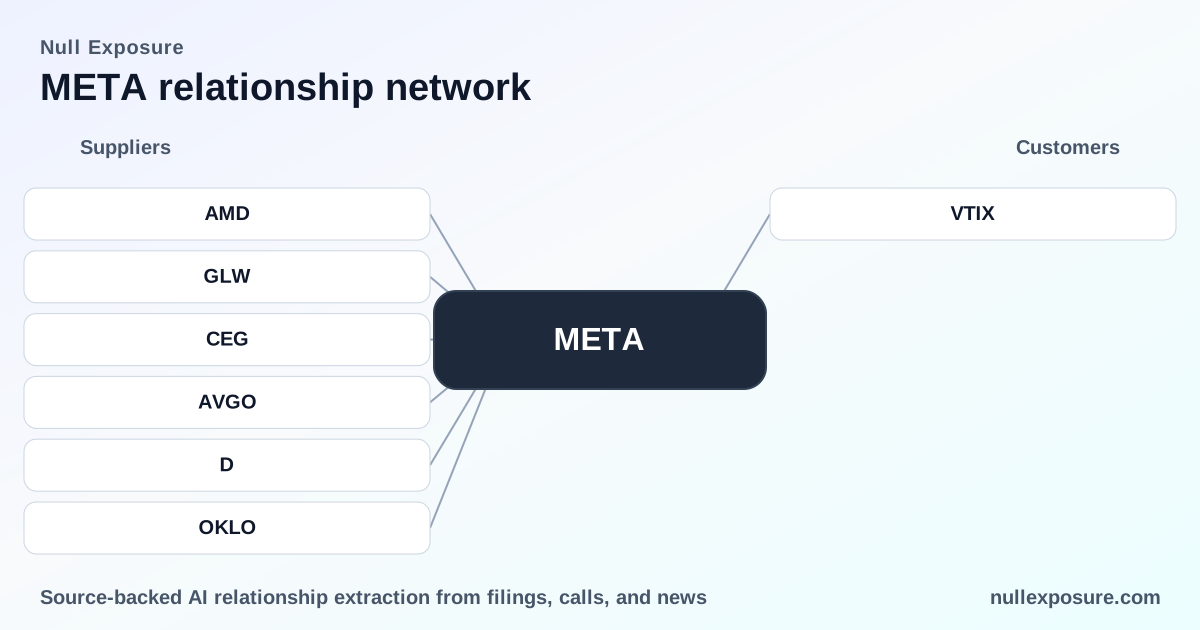
META’s supplier map: infrastructure bets, AI compute partners, and what they mean for investors
Meta Platforms operates a highly capitalized, vertically integrated internet and AI business that monetizes primarily through advertising across its social platforms and increasingly through investments in AI, cloud infrastructure, and Reality Labs hardware. The company scales by owning core data-center architecture while contracting large, multi-year relationships for compute, fiber, and energy, converting infrastructure commitments into performance advantages for AI workloads and ad delivery. For investor diligence on supplier exposure, this note synthesizes every public supplier relationship surfaced in recent coverage and maps the operating constraints that drive Meta’s procurement posture. For a deeper supplier-risk view, visit https://nullexposure.com/.
Key commercial stance in one paragraph
Meta combines internal engineering with selective external sourcing: it designs and builds its own data centers but relies on long-term, material third-party contracts for AI compute, fiber, and energy. That mix produces both operational control and supplier concentration risk—an important trade-off for investors focused on capital intensity, gross-margin durability, and geopolitical sourcing of critical components.
- Market scale: market capitalization roughly $1.587 trillion and trailing revenue of ~$201 billion (TTM), which underwrites multi-year capital commitments and large vendor deals.
- Profitability headroom: strong operating margins and return-on-equity make strategic infrastructure spending affordable relative to peers.
Explore supplier coverage and signals at https://nullexposure.com/.
What the public record lists — supplier relationships you should know
Below I cover every relationship captured in the available results, one by one, with a concise plain-English summary and source note.
Advanced Micro Devices (AMD)
Meta signed a multi-year, gigawatt-scale AI compute arrangement with AMD that is reported as a 6‑gigawatt deployment of Instinct GPUs and EPYC CPUs; coverage frames the deal as transformational for AMD and validates AMD’s position in hyperscaler AI infrastructure. According to multiple news reports in March 2026, the engagement has been described in press coverage as a multi-year, large-scale commitment (FinViz, MarketBeat, InsiderMonkey, March 2026).
Corning Inc.
Corning announced a $6 billion contract to supply fiber to Meta’s data centers, an order that drove a meaningful re-rating of Corning’s share performance in late January 2026. This is a clear supply-chain win tied to data-center buildouts and networking capacity (FinViz, January 2026).
Constellation Energy
Public reporting references past agreements where Constellation Energy reached arrangements with Meta to keep a nuclear reactor in Illinois operating for another 20 years, positioning Constellation as an energy supplier for Meta’s long-term power needs. This underscores Meta’s reliance on stable, long-duration energy contracts for data-center operations (Tikr blog, March 2026).
Broadcom Inc.
Broadcom is publicly listed among custom silicon and infrastructure partners, with coverage naming Meta as a client for high‑volume, custom networking and silicon components. Broadcom’s confirmations and executive commentary place Meta alongside other hyperscalers as a strategic customer for bespoke silicon solutions (FinancialContent, Yahoo Finance Singapore, March 2026).
Dominion Energy
Dominion’s capital plan and growth pivot highlight utility-scale infrastructure investment serving large data-center customers including Meta, framing Dominion as an important regional power partner in markets where Meta expands its facilities. The utility’s expansion plans explicitly reference serving data-center demand from Meta and others (Tikr blog, March 2026).
Oklo
Oklo reported a partnership with Meta in which Meta provided funding for development of a nuclear reactor in Ohio that is intended to generate at least 1.2 GW of power for Meta’s operations. This transaction signals Meta’s use of strategic, innovative off-site power investments to secure capacity (The Globe and Mail, January 2026).
Operating constraints and what they signal for investors
Company-level disclosures and the relationship evidence together reveal a consistent operating model:
-
Contracting posture — long-term commitments. Meta routinely signs multi-year agreements spanning three to 25 years for energy and infrastructure capacity; these contracts reduce short-term procurement risk but lock the company into long-duration obligations that affect capital planning. Company disclosures as of December 31, 2025, describe multi-year clean and renewable energy agreements with no fixed-volume commitments.
-
Materiality and criticality. Infrastructure and supplier relationships are material to Meta’s operations: the firm both builds and sources key technical infrastructure, and a substantial portion of those systems is provided by third parties, making supplier continuity critical to performance and cost structure.
-
Service-provider relationships dominate. Public language classifies many suppliers as third‑party service providers, from compute and networking vendors to energy and security consultants; this creates concentrated vendor dependencies for specialized inputs (security assessments and benchmarking are explicitly third‑party).
-
Infrastructure segment concentration and maturity. Meta disclosed roughly $131.05 billion of contractual commitments tied primarily to cloud capacity, servers, network infrastructure, data centers, and hardware, with $30.63 billion due in 2026—evidence of both scale and near-term capital intensity.
These are company-level signals drawn from Meta’s own disclosures and recent reporting; they explain why the firm negotiates large, long‑dated deals with a small set of strategic suppliers.
Investment implications — upside drivers and risk vectors
-
Upside: Securing gigawatt-scale compute (AMD) and high-volume networking (Corning, Broadcom) improves Meta’s AI cost-per-inference and time-to-market advantages, reinforcing advertising relevance and new product monetization in AI and Reality Labs.
-
Risk: Supplier concentration and long-duration contracts increase operational leverage—supply disruption, price shifts, or vendor-specific technical issues would have outsized impact on delivery timelines and unit economics. Energy and power arrangements, including nuclear partnerships, reduce grid exposure but create counterparty and regulatory complexity.
-
Valuation context: Meta’s strong margins and free-cash generation support continued investment, but investor returns will depend on execution in AI economics and prudent management of large contractual obligations.
For a service-level supplier risk breakdown and to monitor new disclosures as they occur, go to https://nullexposure.com/.
Bottom line and next steps for investors
Meta’s supplier footprint is strategic: large, long-term contracts with a small set of critical providers are deliberate and integral to its AI and data-center strategy. That model enhances performance at scale while introducing vendor concentration and contract-duration risk—factors investors should build into scenario analyses when valuing future AI-driven returns.
If you want a structured supplier-risk review or continuous signal coverage for META and its partners, visit https://nullexposure.com/ for analyst-grade supplier intelligence and monitoring.
Key takeaway: Meta leverages scale through concentrated, multi-year supplier relationships that accelerate AI capability but elevate supplier-specific operational risk — factor both into valuation and due-diligence models.