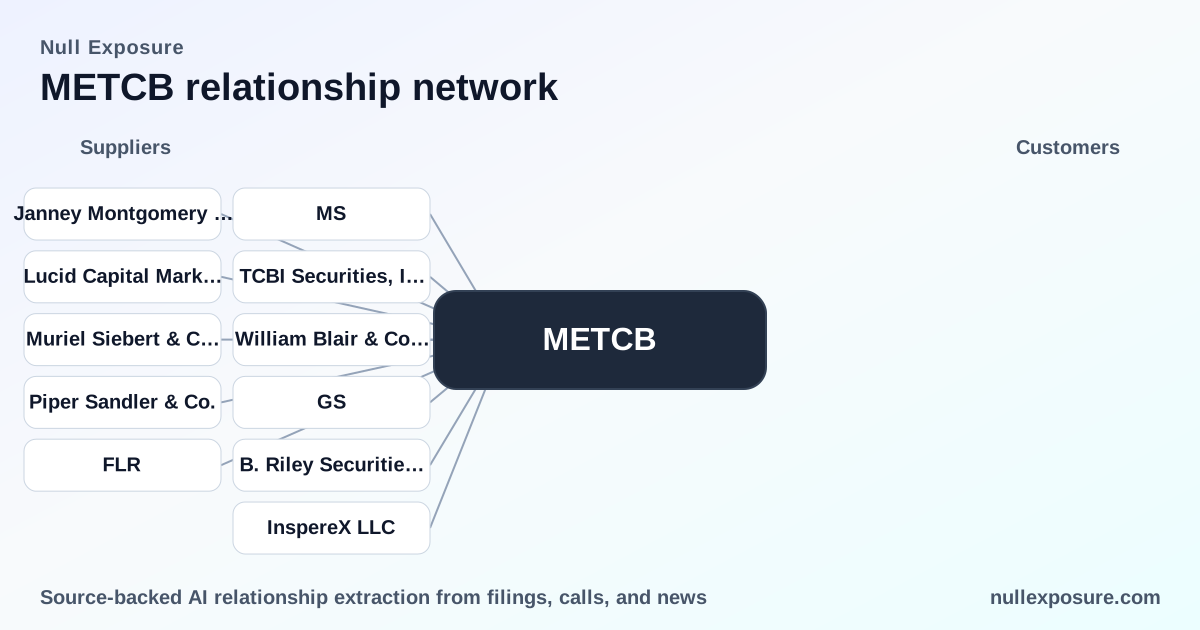
METCB supplier landscape: what every investor should know
METCB runs a supplier network that connects capital markets firms, securities underwriters and professional services providers to the company’s financing and operational activities. The business monetizes by contracting financial intermediaries for debt and equity market transactions, by sourcing and selling commodity inputs through strategic purchase and sales agreements, and by buying specialist engineering and advisory services to support project-level economics. For investors, the critical signal is a supplier mix weighted toward capital-markets intermediaries and large professional services firms, which implies execution-dependence on market counterparties and established institutions.
Discover more supplier intelligence at https://nullexposure.com/.
How METCB uses its supplier relationships in practice
METCB’s public filings and press activity show two consistent themes: (1) reliance on lead managers and bookrunners to execute securities offerings and hedging arrangements, and (2) engagement of national or global professional services firms for technical, accounting and disclosure work. That combination indicates a contracting posture that is execution-driven, concentrated in well-known counterparties, and operationally critical for capital access.
- Contracting posture: METCB contracts top-tier capital markets firms as temporary, transactional suppliers for discrete offerings rather than long-term managed services.
- Concentration: multiple lead roles are filled by a small universe of investment banks and broker-dealers, increasing counterparty concentration risk around financing events.
- Criticality: underwriter and bookrunner roles are critical to liquidity and financing execution; professional services engagements are critical to disclosures and accounting controls.
- Maturity: relationships are active and transactional in the near term, consistent with capital-raising cycles rather than evergreen supply contracts.
If you want a deeper view of counterparties and event-driven supplier risk, visit https://nullexposure.com/.
Complete list of counterparties referenced in public coverage
Below are every relationship referenced in the source results, each summarized in plain English with a compact source note.
-
Goldman Sachs & Co. LLC — Goldman Sachs acted as a delta-offering underwriter and was named among the underwriters that will offer borrowed Class A common stock to facilitate hedging for purchasers of notes. According to a PR Newswire release dated March 10, 2026, Goldman Sachs jointly coordinated the concurrent delta offering for hedging purposes. (PR Newswire, 2026)
-
Morgan Stanley & Co. LLC — Morgan Stanley functioned alongside Goldman Sachs as a delta-offering underwriter and was also cited as the underwriters’ consent party for a 90‑day lock-up, indicating a lead role in the financing structure. MarketScreener and PR Newswire noted Morgan Stanley’s positioning in the offering and lock-up arrangements (MarketScreener; PR Newswire, March 2026).
-
TCBI Securities, Inc. (Texas Capital Securities) — TCBI is listed as a lead manager on a senior unsecured notes offering, evidencing a primary syndication role in that financing. The PR Newswire announcement of the pricing named TCBI among the lead managers (PR Newswire, March 2026).
-
Muriel Siebert & Co., LLC — Identified as a lead manager for the debt offering, Muriel Siebert supported syndication activities and distribution of the notes. The PR Newswire pricing release includes Muriel Siebert in the lead manager group (PR Newswire, March 2026).
-
InspereX LLC — InspereX was named alongside Muriel Siebert and TCBI as a lead manager for the offering, contributing to placement and distribution channels for the notes. (PR Newswire, March 2026)
-
William Blair & Company, L.L.C. — William Blair served as a joint book-running manager on the offering, implying responsibility for bookbuilding and pricing execution. The pricing release lists William Blair among joint bookrunners (PR Newswire, March 2026).
-
B. Riley Securities, Inc. — B. Riley acted as a joint book-running manager on the issuance, supporting order collection and syndicate coordination. (PR Newswire, March 2026)
-
Janney Montgomery Scott LLC — Janney was listed as a joint book-running manager, participating in bookbuilding and market execution responsibilities. (PR Newswire, March 2026)
-
Piper Sandler & Co. — Piper Sandler is named as a joint book-running manager on the financing, indicating active syndicate involvement in pricing and placement. (PR Newswire, March 2026)
-
Lucid Capital Markets, LLC — Lucid was designated as lead bookrunner for the offering, a role that centers on managing orders and supporting primary market execution. (PR Newswire, March 2026)
-
Muriel Siebert & Co., LLC — (repeat entry in results reflects the same lead manager role on the offering; see the March 10, 2026 pricing release for details). (PR Newswire, March 2026)
-
Fluor Corporation — Fluor is referenced for having prepared a preliminary economic analysis and technical material for the Brook Mine Property, signaling an engineering/advisory engagement on project economics. A PR Newswire release covering a strategic agreement with DOE NETL cites Fluor’s technical contribution to exploration and economic work. (PR Newswire, March 2026)
What these relationships imply for investors
The supplier roster is dominated by capital markets intermediaries and a small set of professional services firms, which creates a mix of advantages and vulnerabilities for METCB:
- Execution capability is high: using recognized lead managers and bookrunners supports access to institutional distribution and market depth when METCB requires financing.
- Counterparty concentration risk is material: repeated reliance on familiar underwriters concentrates execution risk around syndicate performance and market sentiment at issuance windows.
- Operational criticality is elevated: professional services engagements (accounting, disclosure, technical engineering) are company-level levers for regulatory compliance and project valuation; these are not optional overhead but gating inputs to financing and investor communications.
- Relationship maturity is transactional: evidence indicates active, event-driven relationships rather than long-term outsourcing, which affects predictability of fees and continuity.
Company-level signals from public disclosures also indicate METCB engages large professional services firms for technical accounting and disclosure control work and both buys and sells commodity inputs under strategic sourcing arrangements — an operational footprint that complements capital markets activity.
Explore supplier risk profiles and counterparty mapping at https://nullexposure.com/.
Bottom line for investors
METCB’s supplier ecosystem reflects a financing-first operating model: capital markets intermediaries run the primary execution playbook while large professional services firms underpin accounting, disclosure and technical validation. Investors should value METCB’s access to institutional underwriters while monitoring concentration around a small group of counterparties and the timing sensitivity of transactional supplier relationships. For ongoing diligence and supplier-tracking tools, return to https://nullexposure.com/.